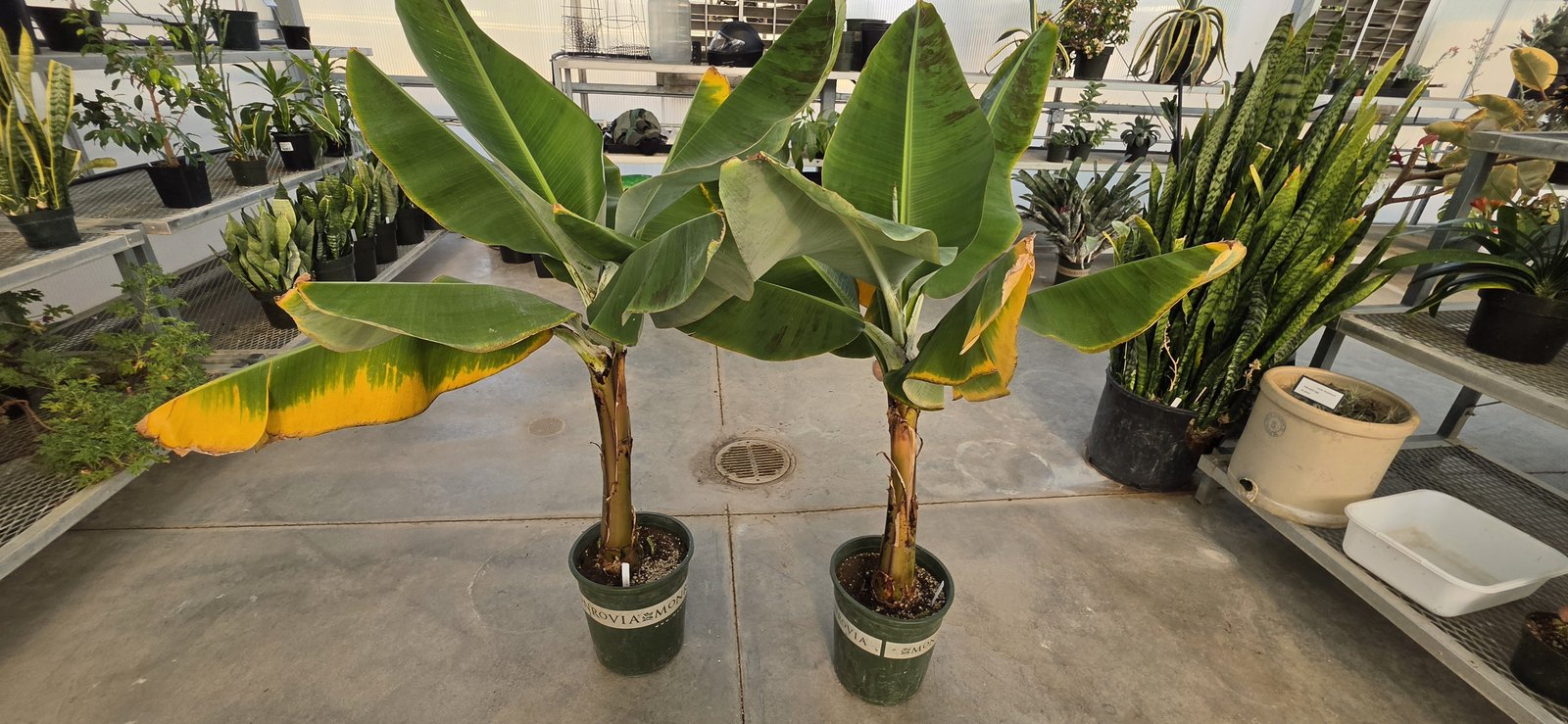
Musa acuminata · Banana plant
CON-0145
📍 Location not set
Identification
Musa acuminata · Banana plant
The plants show the classic pseudostem growth habit of Musa species - a trunk formed by tightly overlapping leaf sheaths, topped with large paddle-shaped leaves with a prominent central midrib and pinnate parallel venation running perpendicular to it, characteristic of banana plants. The leaves show typical splitting along the veins from wind/handling, common in banana foliage. The yellowing/browning at leaf margins and tips suggests stress (possibly cold damage, nutrient deficiency, or transplant shock) rather than being a natural variegation pattern, though it's worth noting some ornamental banana cultivars do have naturally variegated foliage. Without seeing a flower/inflorescence or fruit, or clearer detail on the pseudostem coloration/markings, I cannot narrow this to a specific species or cultivar (e.g., Musa basjoo, Musa acuminata, or an ornamental hybrid). The pot labels appear to read something like 'ROVIA' and 'MON' which could be a cultivar tag, but the text is too obscured to read reliably. To confirm species-level ID, a photo of the full pseudostem base with any coloration patterns, the flower/inflorescence, or a clearer shot of the label would help rule out similar broad-leaved plants like Strelitzia (bird of paradise) or Ensete species, though the overlapping pseudostem structure most closely matches true Musa.
Generated 2026-08-24 23:10 by anthropic (claude-sonnet-5).
Health
Care Information
- Light
- Bright light with some direct sun is ideal; can tolerate partial shade but growth and fruiting slow down.
- Water
- Keep soil consistently moist but not waterlogged; water when the top inch begins to dry, more frequently in heat and active growth.
- Nutrients
- Heavy feeder -- apply a balanced or high-potassium fertilizer every 2-4 weeks during the growing season; reduce in cooler months.
- Repotting
- Repot or move up container size annually in spring as it grows quickly and is a vigorous root producer; large specimens may need permanent large tubs or in-ground planting.
- Soil media
- Rich, well-draining, organic potting mix; benefits from added compost for fertility and moisture retention.
- Temp & humidity
- 70-85F; high humidity (60%+) -- mist regularly or place in a humid greenhouse zone if room air is dry.
- Temperature range
- 🌡️ 70-85F
- Humidity range
- 💦 60%+
- Care group
- 🏷️ Bright & Humid
- Toxicity
- No known toxicity concerns; generally safe around visitors and pets, though large leaves can be a physical hazard if they fall.
- Pests & diseases
- Watch for spider mites, aphids, and mealybugs, especially in dry conditions; susceptible to fungal leaf spot and root rot if overwatered or poorly drained.
- Propagation
- Propagate by division -- separate rooted offsets (pups) from the base of the mother plant once they have several leaves and their own roots.
Generated 2026-08-24 23:50 by anthropic (claude-sonnet-5).