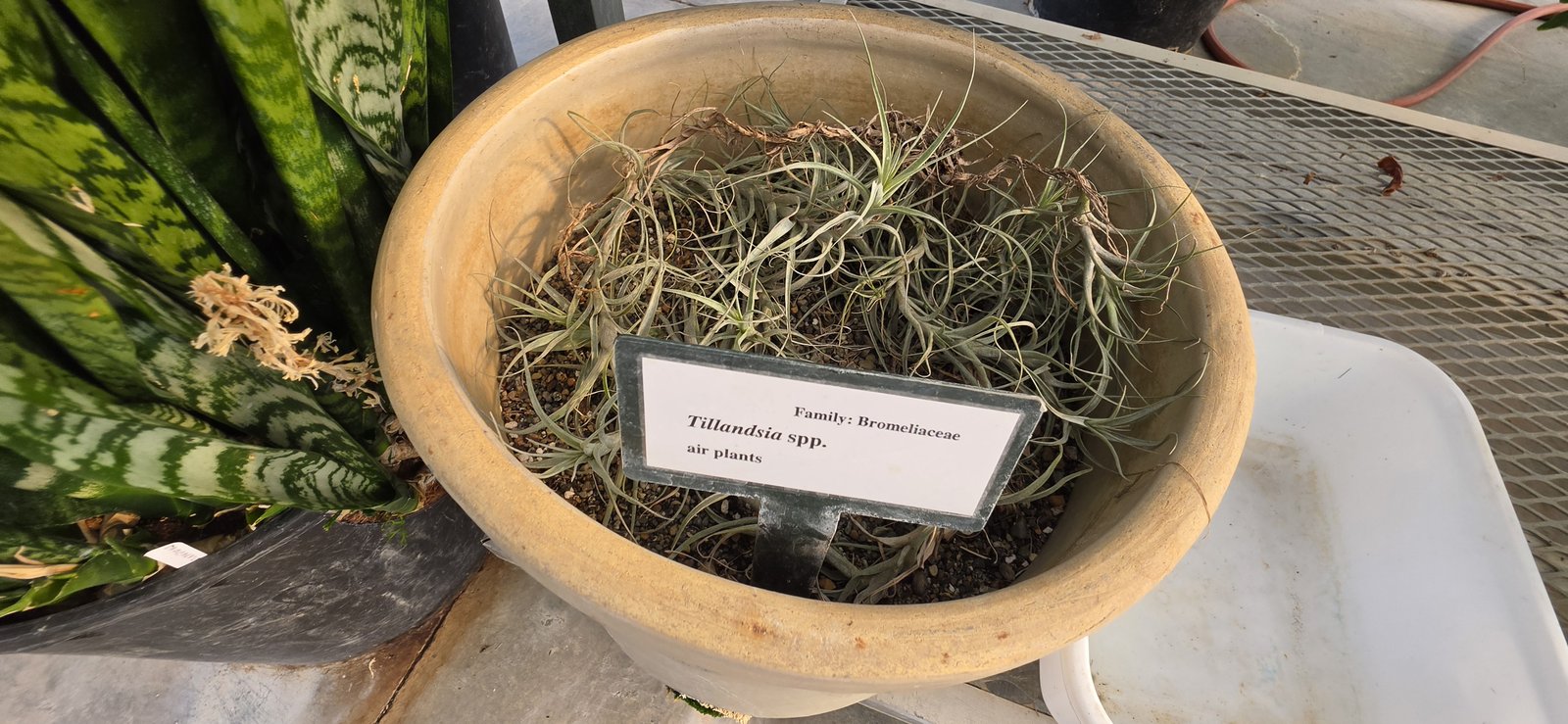
Tillandsia spp. · Air plants
CON-0144
📍 Location not set
Identification
Tillandsia spp. · Air plants
The pot contains a physical identification label reading 'Family: Bromeliaceae, Tillandsia spp., air plants,' which is a reliable curatorial source in this conservatory setting. This matches the visual characteristics of the plants themselves: clumping rosettes of narrow, silvery-gray, curling leaves covered in trichomes (fuzzy scales), a hallmark of xeric-adapted Tillandsia species (often called 'air plants') that absorb moisture through leaf structures rather than relying heavily on roots. The genus-level label (spp.) indicates that multiple species or an unspecified species are present, so a more specific species identification is not warranted without closer inspection of individual plants' leaf width, curl pattern, and any flower/inflorescence structures, which could help distinguish between common species like T. ionantha, T. tectorum, or T. bulbosa.
Generated 2026-08-24 23:11 by anthropic (claude-sonnet-5).
Health
Care Information
- Light
- Bright indirect light or dappled sun; some direct morning sun is fine for many species, but avoid intense unfiltered midday sun which can bleach or scorch leaves.
- Water
- Mist or soak 2-3 times a week; submerge in room-temp water for 20-30 minutes weekly if not misting daily, then shake out excess water and let dry upside down within a few hours to prevent rot.
- Nutrients
- Use a diluted (quarter-strength) bromeliad or orchid fertilizer in the water/mist about once a month during the growing season; skip in winter.
- Repotting
- Not potted in soil - no repotting needed. Simply reposition or reattach to mounts as the plant grows or produces offsets (pups).
- Soil media
- None - true epiphyte grown mounted on bark/wood, in a wire basket, or displayed loose; never plant in soil or potting mix.
- Temp & humidity
- 65-80F; moderate to high humidity (50%+) - regular misting or soaking is essential since they absorb water through leaf trichomes rather than roots.
- Temperature range
- 🌡️ 65-80F
- Humidity range
- 💦 50%+
- Care group
- 🏷️ Bright & Humid
- Toxicity
- No known toxicity concerns for people or pets.
- Pests & diseases
- Generally trouble-free; watch for scale and mealybugs, and rot at the base from water pooling in the crown or insufficient drying time after watering.
- Propagation
- Division of offsets (pups) that form at the base after flowering - remove once they are about one-third the size of the parent and have some roots or a firm holdfast.
Generated 2026-08-24 23:11 by anthropic (claude-sonnet-5).