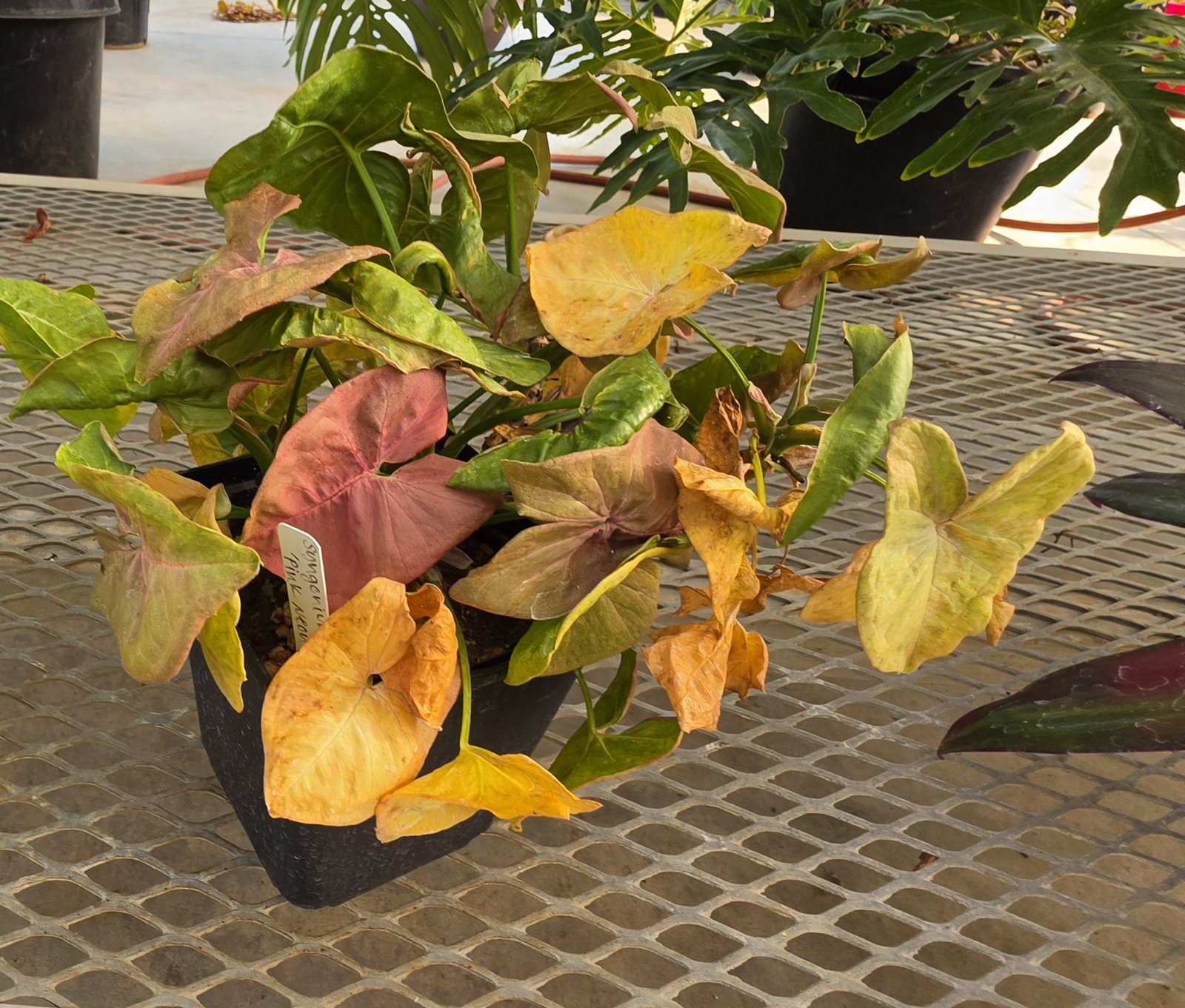
Syngonium podophyllum · Arrowhead Plant (Pink Allusion or similar cultivar)
CON-0142
📍 Location not set
Identification
Syngonium podophyllum · Arrowhead Plant (Pink Allusion or similar cultivar)
The plant label is partially visible and reads 'Syngonium... Pink...' which strongly supports genus identification. The leaves show the characteristic arrowhead/sagittate shape typical of juvenile Syngonium podophyllum, with pink to reddish coloration in the veins and blade of several leaves, consistent with pink-variegated cultivars like 'Pink Allusion' or 'Neon Robusta'. The plant is in visibly poor health with many leaves yellowing, browning, and wilting, likely due to underwatering, overwatering, or stress, which makes precise cultivar identification difficult since leaf color intensity and pattern (used to distinguish cultivars) are compromised. Similar genera to rule out include Philodendron (which has similar arrow-shaped juvenile leaves but different leaf texture and petiole attachment) and Alocasia (which has more rigid, veined leaves). The visible plant tag showing 'Syngonium' with a cultivar name partially readable as 'Pink...' makes this identification fairly confident at the genus level, though the exact cultivar epithet is not fully legible in the image.
Generated 2026-08-24 23:12 by anthropic (claude-sonnet-5).
Health
Care Information
- Light
- Bright indirect light tolerated best; can adapt to medium light but variegation fades and growth slows in low light. Avoid direct hot sun which scorches leaves.
- Water
- Water when the top 1-2 inches of soil are dry, typically weekly; reduce frequency in winter. Dislikes sitting in soggy soil.
- Nutrients
- Balanced liquid fertilizer diluted to half-strength every 4 weeks during spring-summer growth; skip or reduce in winter.
- Repotting
- Repot every 1-2 years in spring when roots fill the pot or vines become unwieldy.
- Soil media
- Well-draining aroid mix -- standard potting soil amended with perlite and orchid bark works well.
- Temp & humidity
- 65-80F; moderate to high humidity (50%+ preferred) though it tolerates average indoor humidity reasonably well.
- Temperature range
- 🌡️ 65-80F
- Humidity range
- 💦 50%+
- Care group
- 🏷️ Bright & Humid
- Toxicity
- Contains calcium oxalate crystals; toxic if chewed/ingested by pets or people, and sap can irritate skin -- wear gloves when pruning and keep away from curious visitors or animals.
- Pests & diseases
- Watch for spider mites, mealybugs, and scale, especially in dry air; root rot can occur if overwatered or soil stays soggy.
- Propagation
- Stem cuttings with a node root readily in water or moist soil; this is the easiest and most reliable method.
Generated 2026-08-24 23:13 by anthropic (claude-sonnet-5).