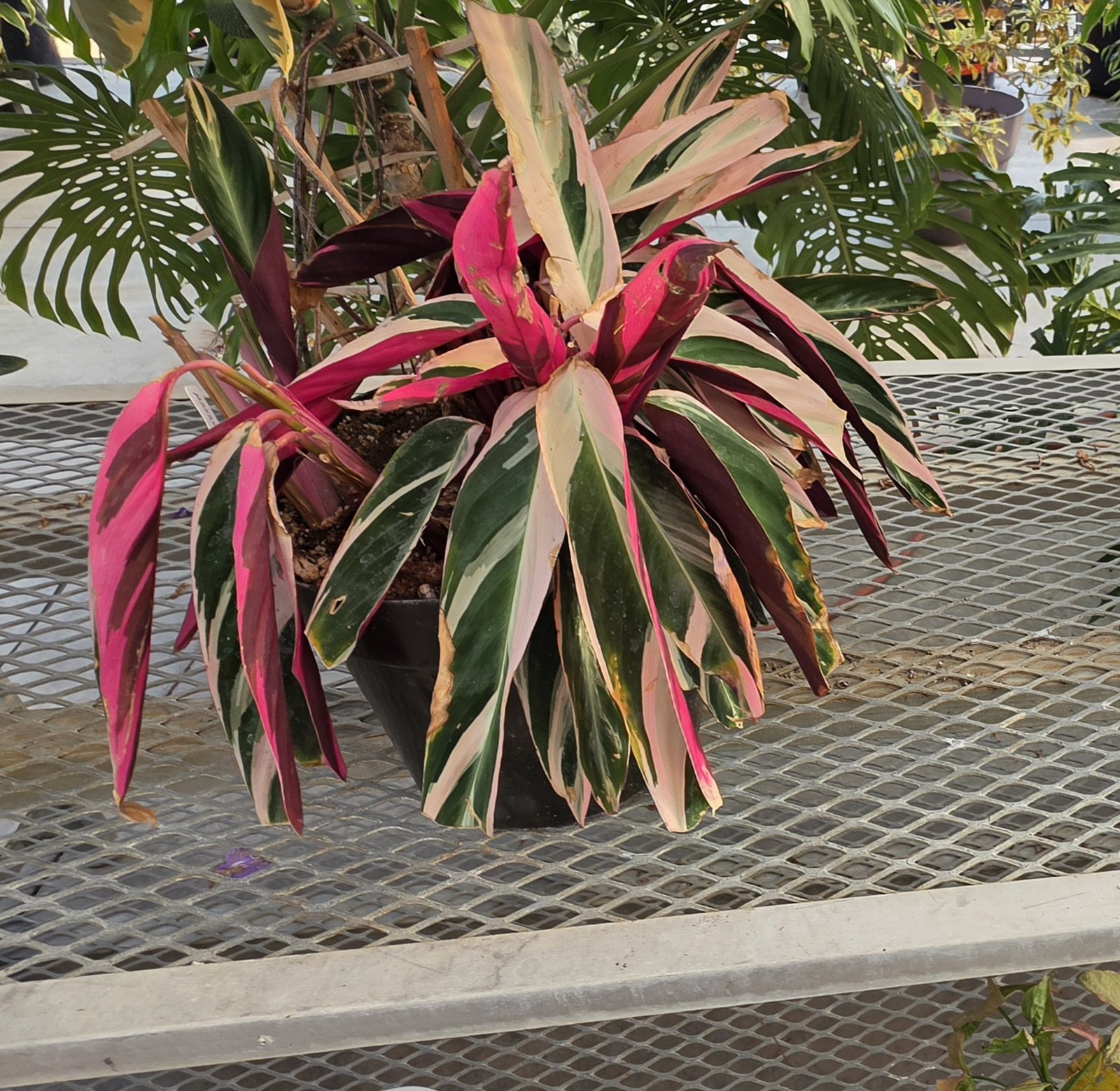
Stromanthe sanguinea 'Triostar' · Triostar Stromanthe (also called Tricolor Stromanthe or Tricolor Ginger)
CON-0136
📍 Location not set
Identification
Stromanthe sanguinea 'Triostar' · Triostar Stromanthe (also called Tricolor Stromanthe or Tricolor Ginger)
The plant shows lance-shaped leaves radiating from a central basal clump, with striking variegation in cream/white, dark green, and vivid pink/magenta patches, and leaf undersides and some leaf margins showing deep magenta-red coloration - classic for Stromanthe sanguinea 'Triostar'. The irregular, splashed pattern of pink and cream on green (rather than uniform striping) and the drooping, somewhat floppy leaf habit are consistent with this cultivar, which is known for being highly variable in variegation intensity depending on light. Some leaf tip browning/scorching is visible, which is common in Triostar when humidity is too low or it gets too much direct light - consistent with a conservatory setting. Similar plants to rule out include Calathea roseopicta or other Calathea/Goeppertia species with pink variegation, and Ctenanthe 'Grey Star' or Ctenanthe burle-marxii, but those typically lack the strong magenta leaf undersides and the particular elongated lance shape seen here. The combination of leaf shape, coloration pattern, and the pink leaf reverse strongly supports the suspected ID, though without seeing the leaf underside clearly or a flower, I can't be fully certain it isn't a closely related Stromanthe cultivar or hybrid.
Generated 2026-10-06 04:04 by anthropic (claude-sonnet-5).
Health
Care Information
- Light
- Bright, indirect light; avoid direct sun which fades and scorches the dramatic pink/white/green leaf patterning. Too little light will cause variegation to revert to green.
- Water
- Keep soil evenly moist but not soggy; water when the top inch starts to dry out, usually every 5-7 days. Reduce slightly in winter but never let it fully dry out, as this plant is sensitive to drought stress.
- Nutrients
- Balanced liquid fertilizer diluted to half-strength every 4 weeks during spring through fall growing season; stop feeding in winter.
- Repotting
- Repot every 1-2 years in spring, sizing up only slightly as it prefers being a bit snug.
- Soil media
- Rich, well-draining potting mix with added peat/coco coir and perlite to retain moisture while allowing airflow to roots.
- Temp & humidity
- 65-80F; needs high humidity (60%+) -- use a pebble tray, humidifier, or grouping with other tropicals; leaf edges will brown in dry air.
- Temperature range
- 🌡️ 65-80F
- Humidity range
- 💦 60%+
- Care group
- 🏷️ Bright & Humid
- Toxicity
- Non-toxic to pets and people; safe for areas with public foot traffic.
- Pests & diseases
- Watch for spider mites in dry conditions, and root rot if overwatered or left in soggy soil; also prone to leaf curling/browning if humidity is too low or water quality is poor (sensitive to fluoride/chlorine, so filtered or distilled water is best).
- Propagation
- Division at repotting time -- separate rhizome sections with roots and at least one growth point attached; this is more reliable than stem cuttings for this rhizomatous species.
Generated 2026-10-06 04:04 by anthropic (claude-sonnet-5).