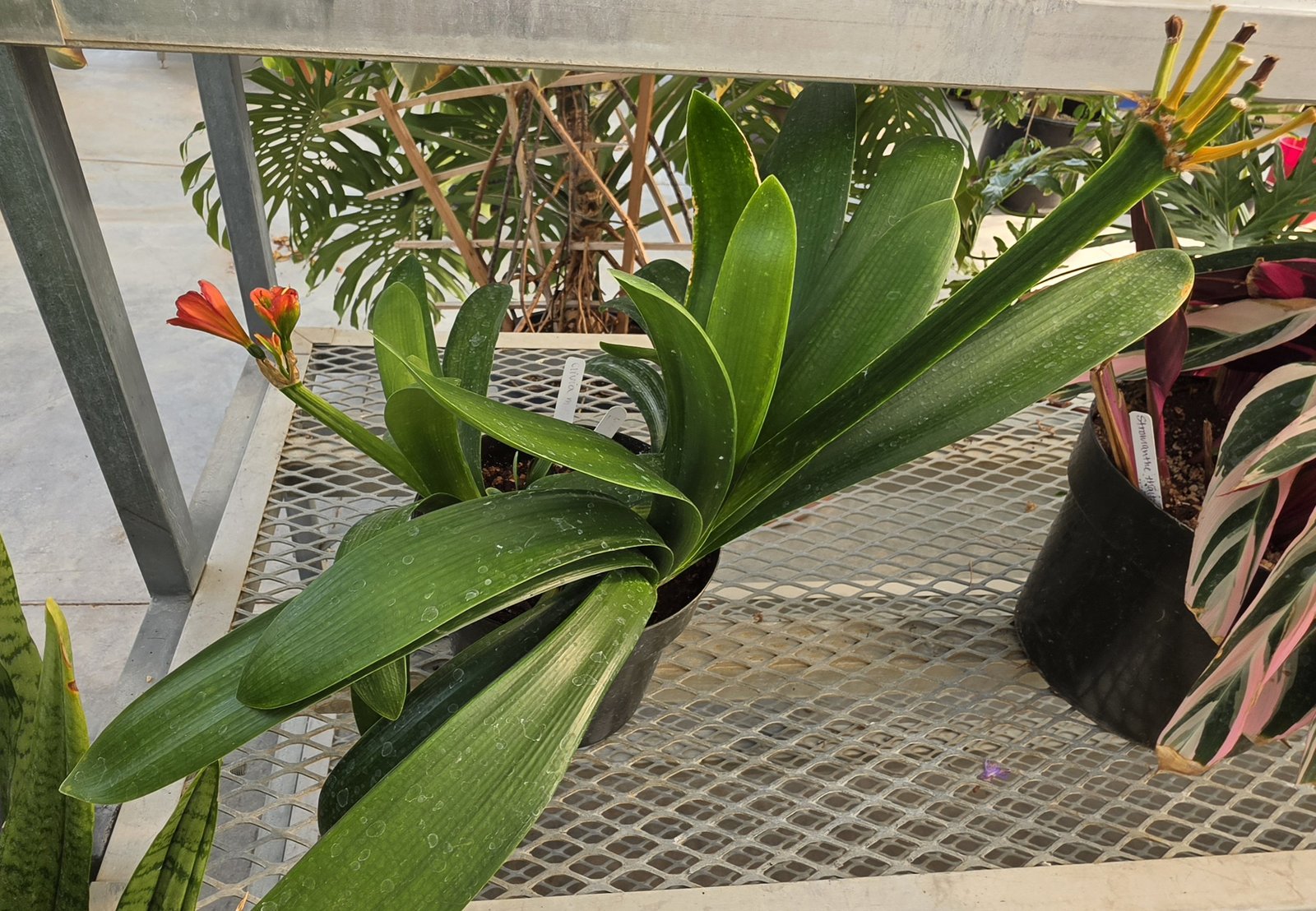
Clivia miniata · Natal lily (bush lily)
CON-0135
📍 Location not set
Identification
Clivia miniata · Natal lily (bush lily)
The plant shows a basal fan of strap-shaped, dark green, glossy leaves with a pronounced central midrib arranged in a distichous (two-ranked) overlapping pattern at the base, typical of Clivia. An emerging flower stalk with orange-red tubular buds clustered at the tip is visible to the left, consistent with the umbellate orange flowers of Clivia miniata. There also appears to be a partially visible plant label in the pot reading 'Clivia...' which supports the suspected identification. Similar genera like Crinum or Haemanthus (Amaryllidaceae relatives) could produce comparable strap leaves, but the leaf thickness, glossiness, and flower color/shape are most consistent with Clivia miniata rather than those alternatives. Confidence is 'probable' rather than 'certain' because the flower is only partially open/visible, limiting full confirmation of floral structure.
Generated 2026-10-06 04:06 by anthropic (claude-sonnet-5).
Health
Care Information
- Light
- Bright indirect light or dappled shade; avoid direct sun which can scorch the strap-like leaves. Tolerates low light but flowers best with bright indirect exposure.
- Water
- Water thoroughly then let soil dry out between waterings, roughly every 10-14 days; cut back significantly in winter to encourage flowering.
- Nutrients
- Balanced liquid fertilizer every 4-6 weeks during spring/summer growth; stop feeding in autumn/winter during the cool rest period.
- Repotting
- Repot only every 3-4 years as Clivia prefers being slightly rootbound to flower well; disturb roots as little as possible when you do repot.
- Soil media
- Well-draining, slightly chunky potting mix -- standard potting soil amended with extra perlite or bark works well.
- Temp & humidity
- 60-75F during active growth, with a cooler winter rest period around 50-55F for 6-8 weeks to trigger blooming; moderate humidity is fine, no misting required.
- Temperature range
- 🌡️ 50-75F
- Humidity range
- 💦 40-50%
- Care group
- 🏷️ Medium Light & Moderate Humidity
- Toxicity
- All parts, especially the sap and bulb, contain lycorine and are toxic if ingested by pets or people; sap can also irritate skin, so use gloves when handling or dividing.
- Pests & diseases
- Watch for mealybugs and scale, especially hidden in the leaf bases; root/bulb rot can occur if overwatered or if drainage is poor.
- Propagation
- Division at repotting time -- separate offsets with their own roots once a clump has several growth points; can also be grown from seed but this is slow (2+ years to flower).
Generated 2026-10-06 04:06 by anthropic (claude-sonnet-5).