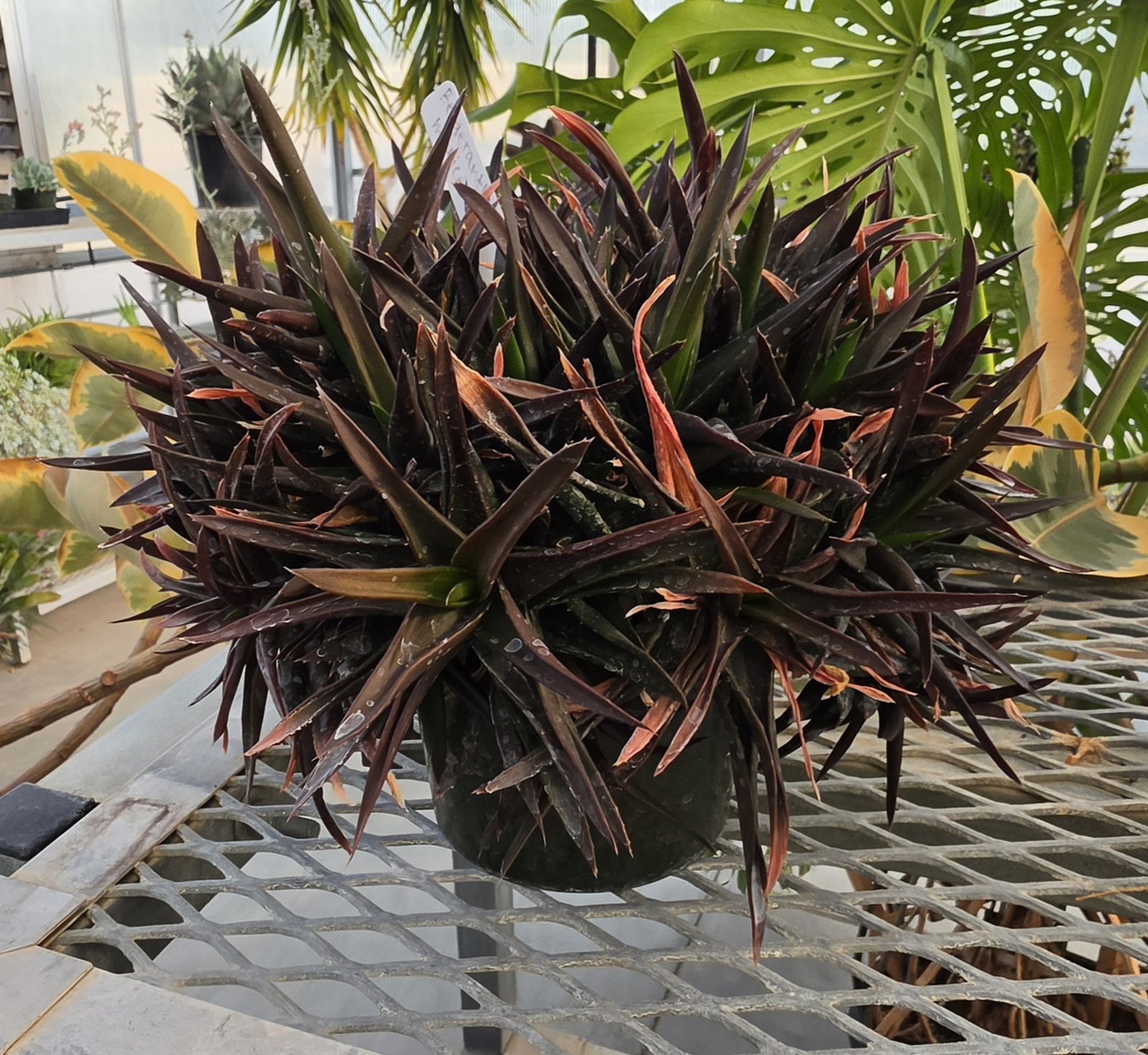
Dyckia sp. · Dyckia (Hardy Terrestrial Bromeliad)
CON-0134
📍 Location not set
Identification
Dyckia sp. · Dyckia (Hardy Terrestrial Bromeliad)
The plant forms a dense, spherical rosette of numerous narrow, rigid, succulent leaves radiating outward in all directions, each tapering to a sharp spine-like tip with fine marginal teeth/spines visible along the edges - characteristic of Dyckia, a terrestrial bromeliad genus. The dark purplish-bronze to near-black coloration with reddish-orange tones at leaf bases/tips is typical of cultivated Dyckia hybrids (many popular cultivars like 'Cherry Coke' or 'Black Gold' show this coloring). The whitish speckled/scurfy trichomes visible on the leaf surfaces are also consistent with Dyckia or related Pitcairnioideae bromeliads. However, without seeing a flower spike, the base/offsets more clearly, or precise leaf margin spine spacing, I cannot confirm the exact species or cultivar - there are many Dyckia hybrids with similar dark coloring. Similar genera to rule out include Hechtia (also spiny terrestrial bromeliad) and Deuterocohnia, which have comparable rosette forms. A photo of the flower stalk, a close-up of the spine pattern along a single leaf margin, and the greenhouse tag information (partially visible but illegible) would help narrow this to species/cultivar level.
Generated 2026-10-06 04:08 by anthropic (claude-sonnet-5).
Health
Care Information
- Light
- Full sun to very bright light; Dyckia rosettes color up best and stay compact with strong direct light.
- Water
- Allow soil to dry out between waterings; drought-tolerant and prone to rot if kept wet, so water sparingly, especially in winter.
- Nutrients
- Light feeding with a dilute balanced or cactus fertilizer monthly during spring/summer growth; skip in winter.
- Repotting
- Repot every 2-3 years or when the clump outgrows its pot; these form dense offsetting clusters over time.
- Soil media
- Very well-draining cactus/succulent mix, ideally with extra grit or sand for sharp drainage.
- Temp & humidity
- 65-85F; tolerates low to moderate humidity well and does not need misting -- this is a dry-climate terrestrial bromeliad, not a tropical epiphyte.
- Temperature range
- 🌡️ 65-85F
- Humidity range
- 💦 20-50%
- Care group
- 🏷️ Bright & Dry
- Toxicity
- No known toxicity concerns, but leaf margins have sharp recurved spines -- handle with thick gloves to avoid cuts.
- Pests & diseases
- Generally trouble-free; watch for mealybugs or scale in leaf axils, and root/crown rot if overwatered or drainage is poor.
- Propagation
- Divide offsets (pups) from the base of the mother rosette once they have some roots, ideally at repotting time; can also be grown from seed but slower.
Generated 2026-10-06 04:08 by anthropic (claude-sonnet-5).