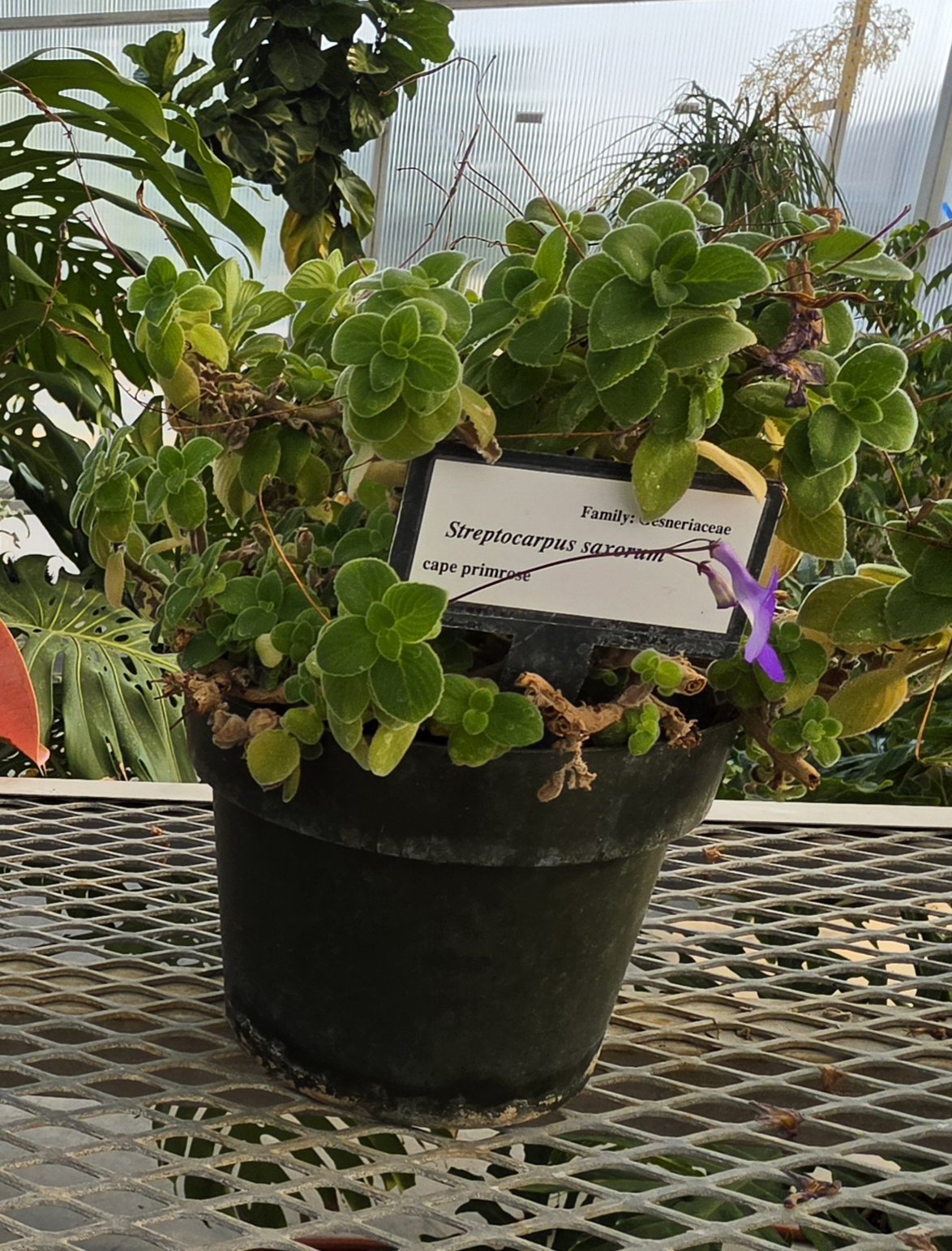
Streptocarpus saxorum · Cape primrose (false African violet)
CON-0133
📍 Location not set
Identification
Streptocarpus saxorum · Cape primrose (false African violet)
The plant has a labeled tag in the photo explicitly reading 'Family: Gesneriaceae, Streptocarpus saxorum, cape primrose,' which matches the visual characteristics: trailing, succulent-like fuzzy rounded leaves with scalloped margins arranged in a mounding/trailing habit, and small purple tubular flowers with five lobes visible on a thin stalk. This matches known features of Streptocarpus saxorum, a trailing gesneriad sometimes called 'false African violet,' distinct from upright-leaved Streptocarpus hybrids. The fuzzy succulent foliage and small lavender flowers are consistent with this species rather than other Gesneriaceae like Saintpaulia (African violet), which has larger single rosette leaves and no trailing stems.
Generated 2026-10-06 04:09 by anthropic (claude-sonnet-5).
Health
Care Information
- Light
- Bright indirect light is best; a few hours of gentle morning sun is fine, but protect from harsh midday direct sun which can bleach or scorch the fuzzy leaves.
- Water
- Allow the top inch or so of soil to dry out between waterings, then water thoroughly; this species is more drought-tolerant than its African violet cousins but dislikes sitting in soggy soil.
- Nutrients
- Feed with a balanced, diluted liquid fertilizer every 2-4 weeks during spring through fall; stop or cut back in winter when growth slows.
- Repotting
- Repot every 1-2 years in spring, or when the trailing stems outgrow the pot; it has a shallow, modest root system so doesn't need deep pots.
- Soil media
- Well-draining, light potting mix -- a standard potting soil amended with perlite works well; avoid heavy, water-retentive mixes.
- Temp & humidity
- 65-80F; moderate humidity (40-60%) is fine -- this species tolerates average room conditions better than many gesneriads and doesn't require misting or pebble trays.
- Temperature range
- 🌡️ 65-80F
- Humidity range
- 💦 40-60%
- Care group
- 🏷️ Medium Light & Moderate Humidity
- Toxicity
- No known toxicity concerns for pets or people.
- Pests & diseases
- Watch for mealybugs and aphids in leaf axils, and powdery mildew or botrytis in overly humid, still air; root or crown rot can occur if overwatered or soil stays wet.
- Propagation
- Very easy from stem cuttings -- trailing stem sections root readily in moist soil or water; leaf cuttings can also work but stem cuttings are faster and more reliable.
Generated 2026-10-06 04:09 by anthropic (claude-sonnet-5).