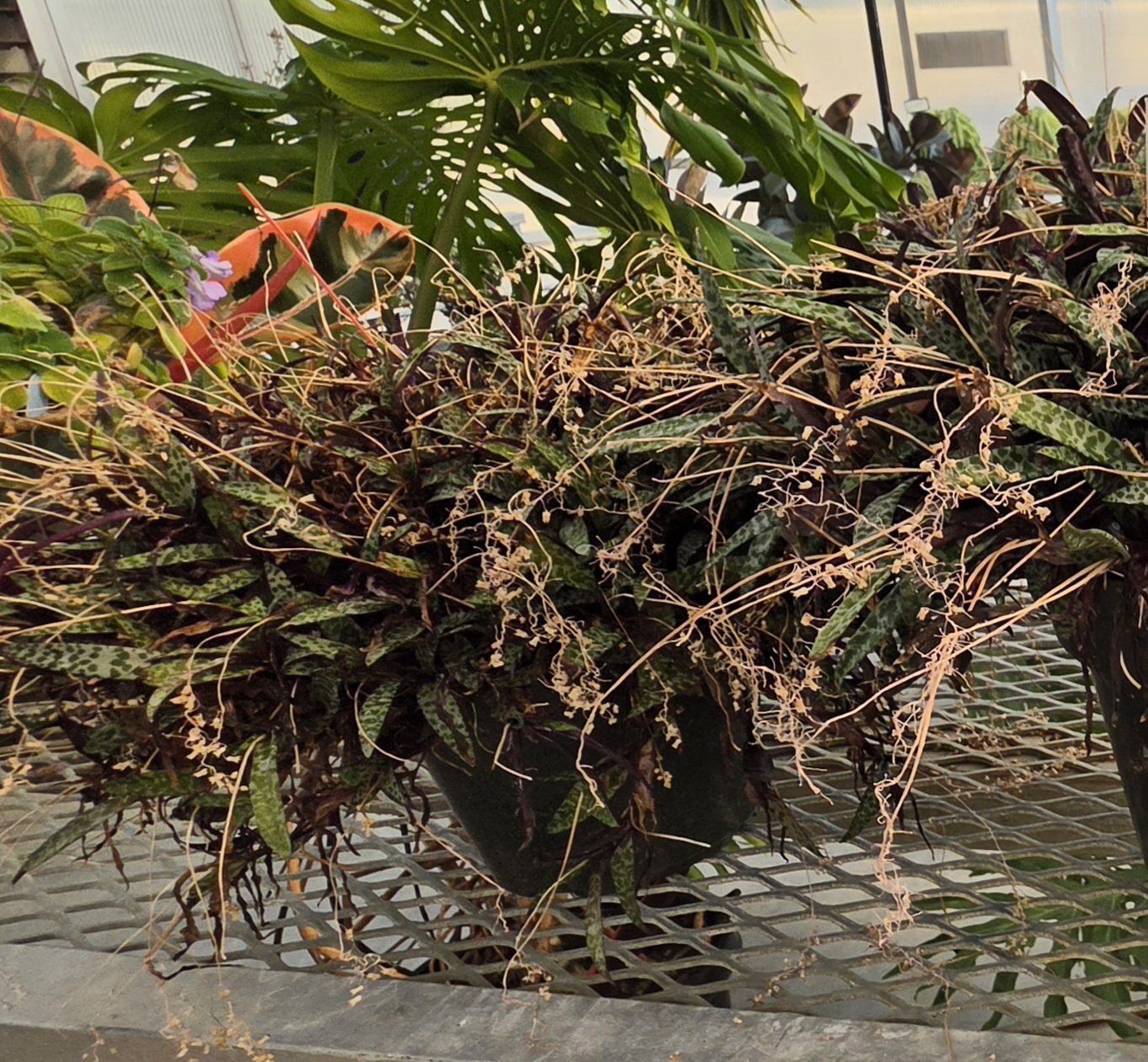
Ledebouria socialis · Silver Squill
CON-0131
📍 Location not set
Identification
Ledebouria socialis · Silver Squill
The spotted, lance-shaped leaves with silvery-green mottling and dark purple undersides/margins visible in the foliage mat are consistent with Ledebouria socialis, a bulbous succulent known for this exact silver-and-purple leopard-print leaf pattern. The dense clumping habit from a container (bulbs crowding together) also matches the species' typical offsetting growth. The numerous thin, dried tan/beige wiry strands threading through the clump appear to be spent dried flower stalks (scapes) with shriveled seed capsules, which is typical of Ledebouria after flowering - the small racemes dry out into exactly this kind of wiry, pod-studded debris. Without a clearer close-up of a single leaf (to confirm leaf cross-section shape and the purple leaf underside) or an intact inflorescence, I can't push this to 'certain', but the leaf pattern is quite distinctive and matches the suspected ID well. Similar genera to rule out would be Scilla (closely related/sometimes synonymized) or Drimiopsis, but the strong purple pigmentation and silver blotching favor Ledebouria socialis specifically.
Generated 2026-10-06 04:13 by anthropic (claude-sonnet-5).
Health
Care Information
- Light
- Bright indirect light to some direct morning sun; a sunny windowsill suits it well.
- Water
- Water thoroughly then let soil dry out almost completely before watering again, roughly every 2-3 weeks; the bulbs store water and rot easily if kept wet.
- Nutrients
- Dilute balanced liquid fertilizer monthly during spring and summer growth; withhold in autumn and winter.
- Repotting
- Repot every 2-3 years in spring, or when offsets crowd the pot -- it actually enjoys being slightly pot-bound.
- Soil media
- Cactus/succulent mix or standard potting soil amended heavily with perlite for sharp drainage.
- Temp & humidity
- 60-80F; tolerates average room humidity (30-50%) with no special humidity needs.
- Temperature range
- 🌡️ 60-80F
- Humidity range
- 💦 30-50%
- Care group
- 🏷️ Bright & Dry
- Toxicity
- Sap and bulbs are considered toxic if ingested and may irritate skin -- handle with gloves and keep away from pets and small children.
- Pests & diseases
- Generally trouble-free; watch for mealybugs in leaf axils and bulb rot from overwatering or poorly drained soil.
- Propagation
- Divide offset bulbs (bulblets) from the base at repotting time and pot separately; leaf cuttings can also root but are slower.
Generated 2026-10-06 04:14 by anthropic (claude-sonnet-5).