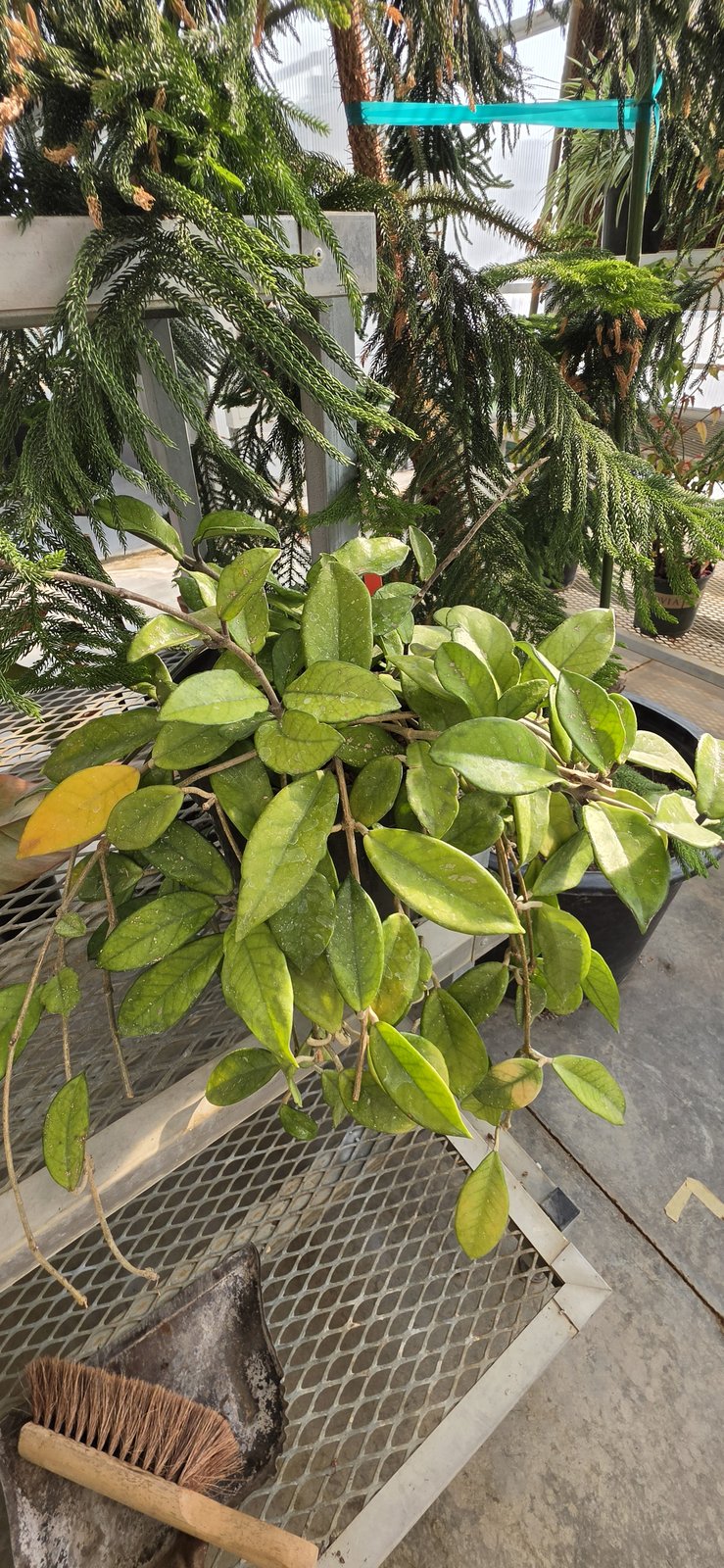
Hoya carnosa · Wax plant
CON-0128
📍 Location not set
Identification
Hoya carnosa · Wax plant
The trailing vine in the foreground has thick, fleshy, waxy-textured ovate-to-elliptic leaves with a glossy surface and visible succulent quality typical of Hoya species. The leaves are arranged oppositely along semi-woody, somewhat twining stems, and the pendulous growth habit in a hanging pot is consistent with Hoya carnosa, one of the most commonly cultivated Hoya species in conservatories. Some leaf yellowing and slight speckling suggest minor stress (possibly mineral deposits or mealybug/scale residue) but don't obscure the diagnostic leaf shape and texture. To confirm the exact species/cultivar, a photo of flowers (Hoya flowers have a distinctive star-shaped corona) would help rule out similar species like Hoya australis, Hoya pubicalyx, or Hoya obovata, which have similar leaf shapes but differ in size, venation, or leaf thickness. The background plant (with cascading conifer-like foliage) is a Cupressus or Araucaria and is not the subject of this identification since it is out of focus and secondary to the main hanging specimen.
Generated 2026-08-31 16:20 by anthropic (claude-sonnet-5).
Health
Care Information
- Light
- Bright indirect light; some direct morning sun encourages blooming, but avoid harsh midday sun which can bleach or scorch leaves.
- Water
- Allow soil to dry out fairly well between waterings, roughly every 10-14 days; this succulent-leaved vine is more tolerant of underwatering than overwatering.
- Nutrients
- Balanced liquid fertilizer diluted to half strength every 4 weeks during spring/summer growth; skip feeding in winter.
- Repotting
- Repot only every 2-3 years, or when badly rootbound -- Hoya actually blooms better when slightly potbound, so don't rush this.
- Soil media
- Well-draining chunky mix -- standard potting soil amended with perlite, orchid bark, or coarse sand to prevent soggy roots.
- Temp & humidity
- 65-85F; moderate to high humidity (40-60%) appreciated but tolerates average room humidity fine.
- Temperature range
- 🌡️ 65-85F
- Humidity range
- 💦 40-60%
- Care group
- 🏷️ Bright & Humid
- Toxicity
- Sap can cause mild skin irritation in sensitive individuals; generally considered low toxicity but best to keep away from pets/children chewing on leaves.
- Pests & diseases
- Watch for mealybugs and aphids especially around flower buds and new growth; root rot if kept too wet. Otherwise a fairly resilient, low-trouble plant.
- Propagation
- Stem cuttings with at least one node root readily in water or moist perlite/soil mix; leave old peduncles (bloom spurs) intact as they rebloom.
Generated 2026-08-31 16:20 by anthropic (claude-sonnet-5).