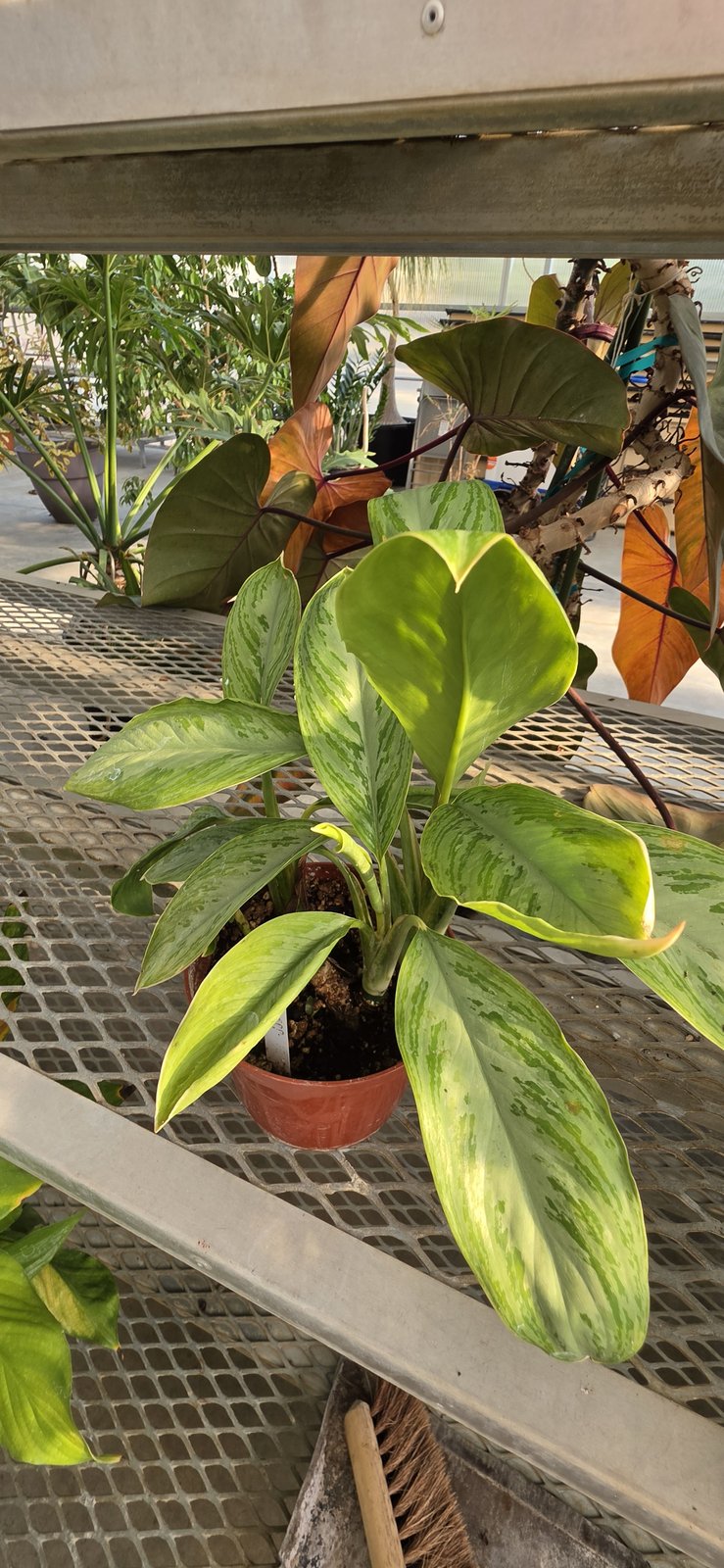
Aglaonema commutatum · Chinese evergreen
CON-0126
📍 Location not set
Identification
Aglaonema commutatum · Chinese evergreen
The plant shows a clumping, rosette-like growth habit arising from a central point (not a trailing/vining stem), which rules out Philodendron hederaceum. The leaves are elongated-lanceolate with pointed tips and a variegation pattern of darker green stripes/streaking radiating from the midrib against a lighter green-cream background — a classic Aglaonema variegation style (similar to cultivars like 'Stripes', 'Emerald Bay', or 'Silver Bay') rather than the heart-shaped, silvery-flecked leaves typical of Philodendron micans types. The glossy leaf surface and thick petioles emerging in a cluster from soil level are also consistent with Aglaonema rather than Philodendron. I can't be fully certain of the exact cultivar without seeing the plant's tag more clearly or a close-up of leaf venation and petiole color, and there are many similar variegated Aglaonema cultivars that could match. Other genera to rule out include Dieffenbachia (which has similar blotchy variegation but usually broader, less pointed leaves) and Homalomena. A clearer photo of the leaf underside, petiole coloration, and the visible plant tag would help pin down the exact cultivar.
Generated 2026-08-24 22:43 by anthropic (claude-sonnet-5).
Health
Care Information
- Light
- Tolerates low to medium light well but grows best in bright, indirect light; avoid direct sun which can scorch or bleach the leaves.
- Water
- Water when the top inch or two of soil is dry, roughly every 7-10 days; this species is sensitive to overwatering, so err on the drier side and never let it sit in water.
- Nutrients
- Feed with a balanced liquid fertilizer diluted to half-strength monthly during spring and summer; skip fertilizing in fall and winter.
- Repotting
- Repot every 2 years or when rootbound, ideally in spring; it has a modest root system and doesn't need frequent repotting.
- Soil media
- Well-draining, peat-based potting mix with added perlite for aeration.
- Temp & humidity
- 65-80F; moderate to high humidity (40-60%) is ideal, but it tolerates average indoor humidity reasonably well.
- Temperature range
- 🌡️ 65-80F
- Humidity range
- 💦 40-60%
- Care group
- 🏷️ Low Light & Humid
- Toxicity
- Contains calcium oxalate crystals; toxic if chewed or ingested by pets or people, causing mouth/throat irritation -- keep away from curious visitors and pets.
- Pests & diseases
- Generally trouble-free but can attract mealybugs and spider mites, especially in dry conditions; root rot can occur if overwatered or in poorly-draining soil.
- Propagation
- Easily propagated by stem cuttings or division of offsets/clumps at repotting time; cuttings root readily in water or moist soil.
Generated 2026-08-24 22:44 by anthropic (claude-sonnet-5).