Aglaonema commutatum · Chinese Evergreen
CON-0125
📍 Location not set
Identification
Aglaonema commutatum · Chinese Evergreen
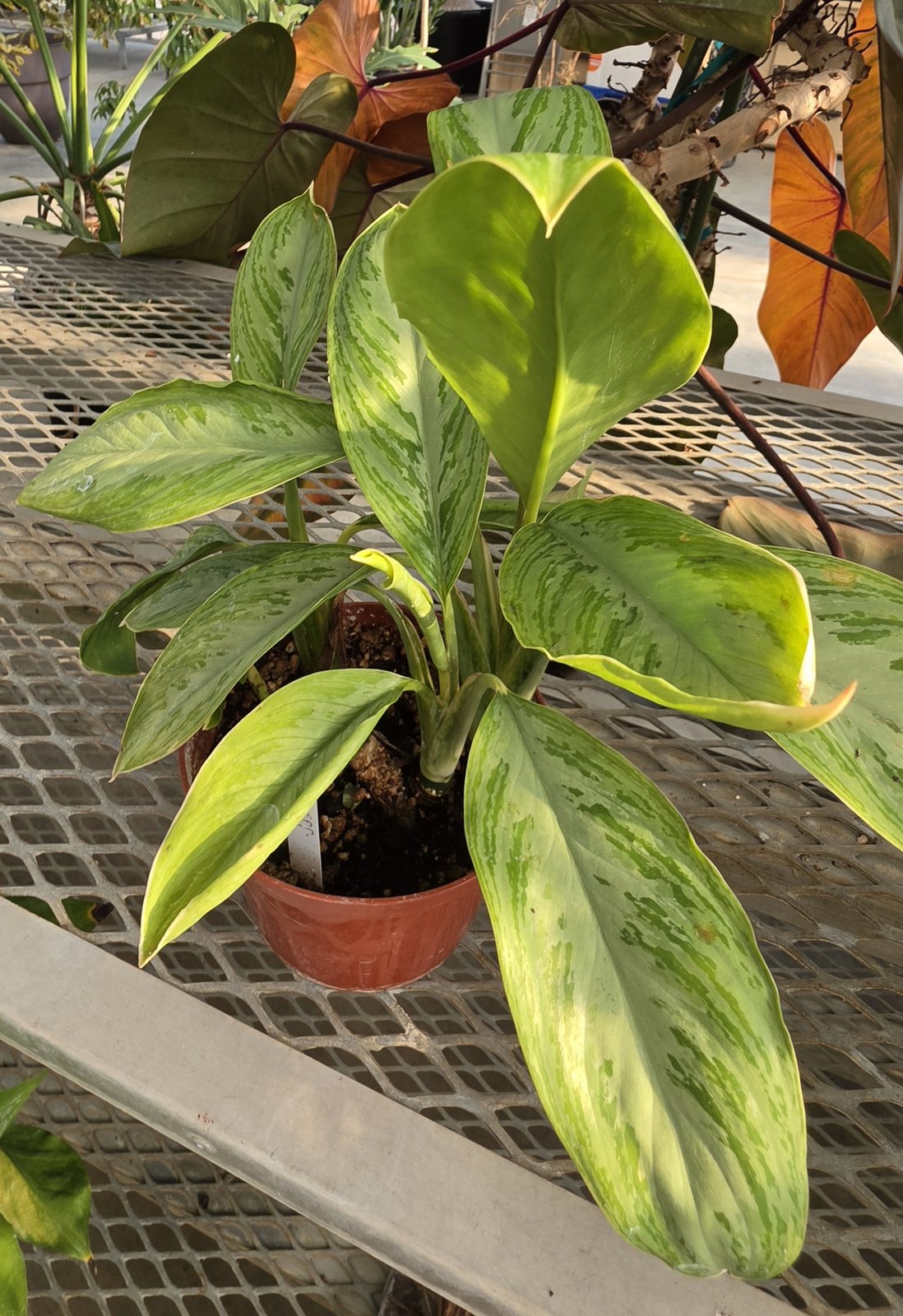
The plant shows the characteristic growth habit of Aglaonema: a compact rosette of lance-to-elliptic leaves arising from a short, somewhat succulent stem with visible leaf scars, growing from a central potted clump. The leaves display strong silvery-green variegation with irregular blotching and streaking along the lateral veins, and pale cream-yellow margins, which is typical of variegated Aglaonema cultivars (many hybrids exist, such as 'Silver Bay' or 'Stripes', making exact cultivar ID difficult). Leaf texture appears glossy and leathery, consistent with Aroid foliage. Similar-looking genera to rule out include Dieffenbachia (which has similar variegation patterns but typically thicker, more upright stems and different leaf shape) and Philodendron (visible in the background of this photo, with more heart-shaped, glossy uniform-green leaves lacking this speckled variegation). Without a flower spike (spathe/spadix) visible, exact species/cultivar confirmation is not possible, so I'm giving a genus/species-level 'probable' rather than a specific cultivar name.
Generated 2026-08-21 17:48 by anthropic (claude-sonnet-5).
Health
Care Information
- Light
- Tolerates low to medium indirect light; grows best in bright indirect light but avoid direct sun which scorches the leaves.
- Water
- Water when the top 1-2 inches of soil are dry, roughly every 7-10 days; reduce frequency in winter and avoid letting it sit in water.
- Nutrients
- Feed with a balanced liquid fertilizer diluted by half, monthly during spring and summer; skip fertilizing in fall and winter.
- Repotting
- Repot every 2 years or when rootbound, ideally in spring; this species is a slow grower and doesn't need frequent repotting.
- Soil media
- Well-draining standard potting mix with added perlite or orchid bark for aeration.
- Temp & humidity
- 65-80F; moderate to high humidity (40-60%) - benefits from a pebble tray or occasional misting in dry rooms.
- Temperature range
- 🌡️ 65-80F
- Humidity range
- 💦 40-60%
- Care group
- 🏷️ Medium Light & Moderate Humidity
- Toxicity
- Contains calcium oxalate crystals; toxic if chewed or ingested by pets or people, causing mouth/throat irritation - keep away from curious visitors and pets.
- Pests & diseases
- Generally hardy but watch for mealybugs and spider mites, especially in dry conditions; root rot can occur if overwatered or soil stays soggy.
- Propagation
- Stem cuttings or division at repotting time - separate rooted offsets/suckers from the base of the plant.
Generated 2026-08-21 17:49 by anthropic (claude-sonnet-5).