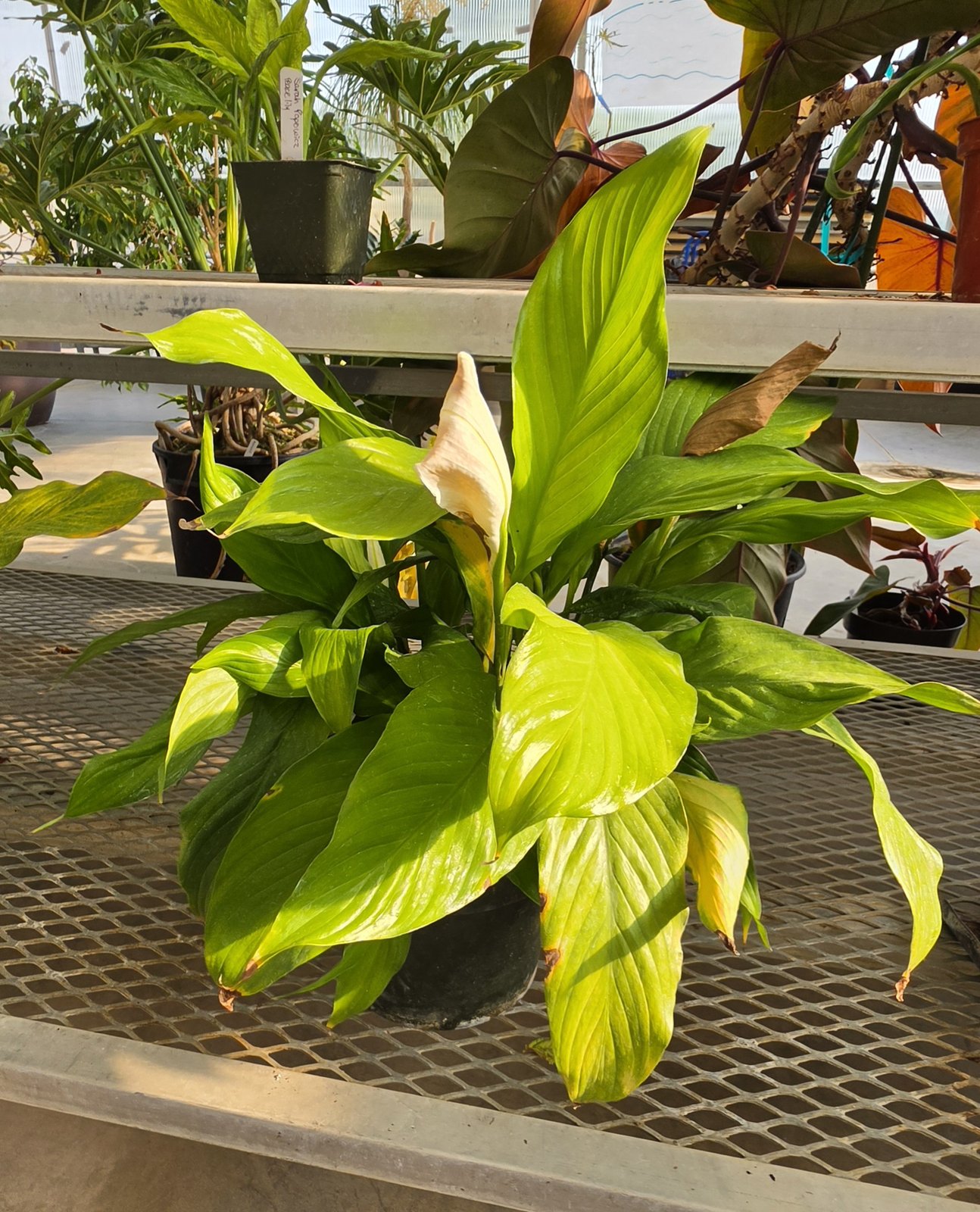
Spathiphyllum wallisii · Peace Lily
CON-0124
📍 Location not set
Identification
Spathiphyllum wallisii · Peace Lily
The plant shows the classic Spathiphyllum growth habit: a clumping rosette of glossy, lance-shaped leaves with prominent parallel pinnate venation arising directly from the soil on individual petioles, and a single creamy-white spathe (modified leaf bract) partially unfurled around what would be a central spadix. The spathe shape—hooded, elongated, and slightly twisted—is diagnostic for Spathiphyllum rather than a true lily or Anthurium (which has a flatter, more heart-shaped spathe and a more prominent protruding spadix). The yellow-green coloration of the leaves seen here is unusual for typical peace lily cultivars, which are normally deep green; this could indicate a variegated/chartreuse cultivar (such as 'Golden Glow' or similar), a nutrient deficiency (iron chlorosis is common in Spathiphyllum), or excessive light exposure causing bleaching. Some leaf tips also show browning, consistent with common peace lily stress symptoms (underwatering, salt buildup, or low humidity). Given the many cultivars of Spathiphyllum wallisii and hybrids, I can't be certain of the exact cultivar, but the genus and general species identification as a Spathiphyllum (peace lily) is well supported by the flower and leaf morphology. To confirm the exact cultivar, a photo of a healthier, undamaged leaf showing true coloration and a fully opened spathe/spadix would help rule out similar plants like Anthurium or Alocasia (visible in the background) which have different leaf textures and flower structures.
Generated 2026-08-21 17:50 by anthropic (claude-sonnet-5).
Health
Care Information
- Light
- Medium to bright indirect light; tolerates low light but blooms best with brighter, filtered light. Avoid direct sun which scorches leaves.
- Water
- Keep soil evenly moist; water when the top inch feels dry, typically weekly. Plant droops noticeably when thirsty, making it easy to gauge -- but avoid letting it sit in soggy soil.
- Nutrients
- Balanced liquid fertilizer at half strength monthly during spring and summer; skip or reduce in winter.
- Repotting
- Repot every 1-2 years in spring, or once roots are visibly crowded and pushing out of the pot.
- Soil media
- Well-draining, peat-based potting mix with perlite for aeration.
- Temp & humidity
- 65-80F; enjoys high humidity (50%+) but adapts reasonably well to average indoor humidity -- mist or use a pebble tray in drier rooms.
- Temperature range
- 🌡️ 65-80F
- Humidity range
- 💦 50%+
- Care group
- 🏷️ Bright & Humid
- Toxicity
- Contains calcium oxalate crystals; toxic if chewed/ingested by pets or people, causing mouth and throat irritation. Keep away from small children and pets.
- Pests & diseases
- Generally hardy; watch for mealybugs and spider mites, especially in dry air. Root rot can occur if overwatered or left in poorly draining soil.
- Propagation
- Division at repotting time -- separate clumps with roots and leaves attached; each division establishes readily.
Generated 2026-08-21 17:50 by anthropic (claude-sonnet-5).