Spathiphyllum wallisii · Peace Lily
CON-0123
📍 Location not set
Identification
Spathiphyllum wallisii · Peace Lily
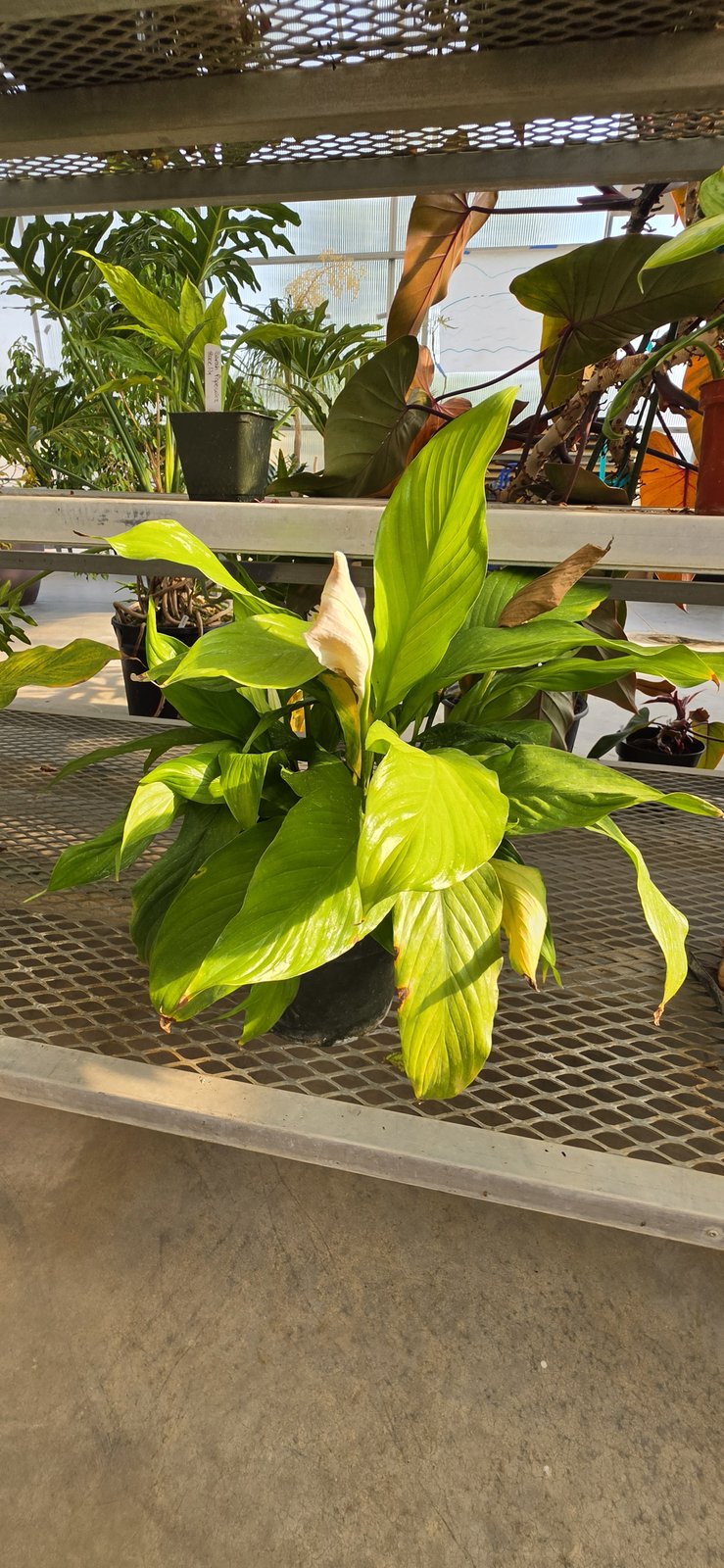
The plant shows the characteristic clumping rosette of glossy, lance-shaped, deeply veined dark green leaves arising directly from the soil on long petioles, consistent with Spathiphyllum. There is a visible inflorescence with a creamy-white spathe emerging among the foliage, a hallmark of Spathiphyllum wallisii, which typically has a more slender, elongated spathe compared to larger hybrid cultivars (e.g., 'Sensation' or 'Mauna Loa', which have broader spathes and larger stature). The leaf size and plant proportions here are moderate, fitting well within the range typical of S. wallisii or one of its many similar cultivars. Some leaf tip browning suggests minor stress (e.g., low humidity or fluoride/salt buildup), common in cultivated peace lilies. Without a clearer close-up of the spathe and spadix or leaf venation, exact cultivar-level certainty isn't possible, but the overall gestalt strongly supports the requester's suspicion of Spathiphyllum wallisii over alternatives like Aglaonema or Anthurium, which have different leaf textures and flower structures.
Generated 2026-08-21 17:51 by anthropic (claude-sonnet-5).
Health
Care Information
- Light
- Medium to bright indirect light; tolerates low light but blooms less; avoid direct sun which scorches leaves.
- Water
- Keep soil evenly moist; water when the top inch is dry, roughly weekly. Drooping leaves are a reliable sign it needs water.
- Nutrients
- Balanced liquid fertilizer diluted to half-strength every 4-6 weeks during spring-summer; skip or reduce in winter.
- Repotting
- Repot every 1-2 years in spring when rootbound, sizing up one pot size.
- Soil media
- Well-draining, peat-based potting mix with perlite for aeration.
- Temp & humidity
- 65-80F; prefers high humidity (50%+) - mist regularly or use a pebble tray, especially in drier rooms.
- Temperature range
- 🌡️ 65-80F
- Humidity range
- 💦 50%+
- Care group
- 🏷️ Bright & Humid
- Toxicity
- Contains calcium oxalate crystals; toxic if chewed/ingested by pets or people, causing mouth/throat irritation - keep away from public foot traffic and curious pets.
- Pests & diseases
- Generally trouble-free; watch for mealybugs and spider mites in dry air, and root rot from overwatering or poor drainage.
- Propagation
- Division at repotting - separate offsets/clumps with roots attached and pot individually.
Generated 2026-08-21 17:52 by anthropic (claude-sonnet-5).