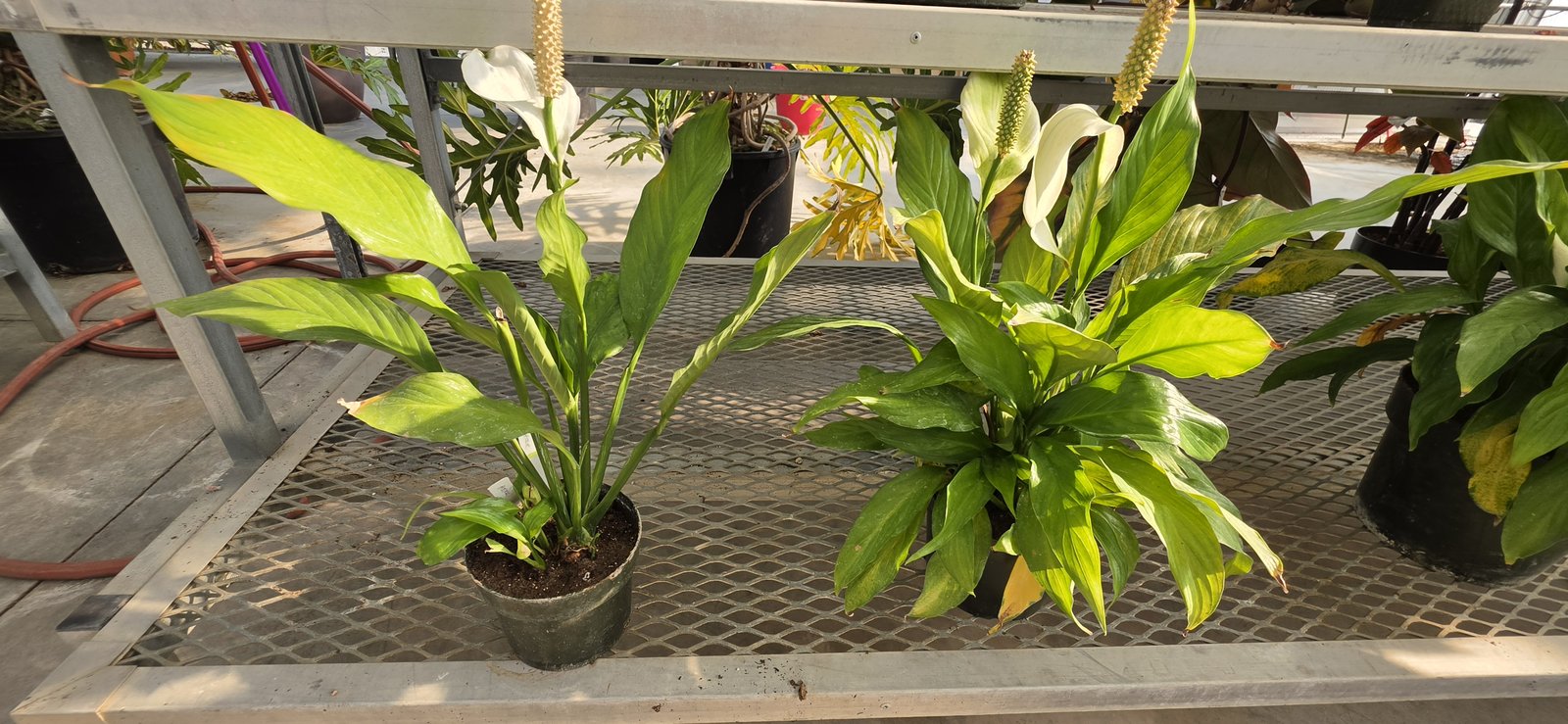
Spathiphyllum wallisii · Peace Lily
CON-0122
📍 Location not set
Identification
Spathiphyllum wallisii · Peace Lily
The plants show the characteristic features of Spathiphyllum: clumping rosettes of lance-shaped, glossy, dark green leaves with prominent parallel venation arising directly from the soil line, and tall slender flower spikes bearing a white, hooded spathe surrounding a pale, finger-like spadix. This inflorescence structure (white spathe + cylindrical spadix) is diagnostic for Spathiphyllum. The variegated yellow-green leaf coloring seen on the right-hand plant is a common cultivar trait within S. wallisii hybrids/cultivars sold in nurseries. Given the requester's suspicion and the clear match to the genus's floral and foliar traits, S. wallisii is a reasonable species-level call, though many nursery 'peace lilies' are actually interspecific hybrids or cultivars (e.g., 'Mauna Loa', 'Domino') rather than true wild-type S. wallisii, which is why I'm not fully certain. To confirm the exact species/cultivar, a close-up of the spathe shape (flat vs. cupped), leaf margin, and any variegation pattern would help rule out hybrids like Spathiphyllum x 'Sensation' or other Araceae such as Anthurium (which has a differently shaped, often colored spathe) or Zantedeschia (calla lily, which has a more funnel-shaped spathe and different leaf shape).
Generated 2026-10-06 04:16 by anthropic (claude-sonnet-5).
Health
Care Information
- Light
- Medium to bright indirect light; tolerates low light but blooms less, and direct sun will scorch the leaves.
- Water
- Keep soil evenly moist but not soggy; water when the top inch of soil feels dry, roughly once a week. Drooping leaves are a reliable sign it needs water.
- Nutrients
- Balanced liquid fertilizer diluted to half-strength every 4-6 weeks during spring and summer; skip feeding in fall/winter.
- Repotting
- Repot every 1-2 years in spring when roots become crowded or it stops blooming well.
- Soil media
- Well-draining standard potting mix with added perlite or bark for aeration.
- Temp & humidity
- 65-80F; prefers high humidity (50%+) but adapts reasonably well to average indoor humidity -- mist or use a pebble tray in dry rooms.
- Temperature range
- 🌡️ 65-80F
- Humidity range
- 💦 50%+
- Care group
- 🏷️ Bright & Humid
- Toxicity
- Contains calcium oxalate crystals; toxic if chewed or ingested by pets or people, causing mouth/throat irritation -- keep away from public foot traffic and curious pets.
- Pests & diseases
- Generally hardy; watch for mealybugs and spider mites, and root rot if overwatered or left in soggy soil.
- Propagation
- Division at repotting time -- separate rooted offsets/clumps from the base of the plant and pot individually.
Generated 2026-10-06 04:16 by anthropic (claude-sonnet-5).