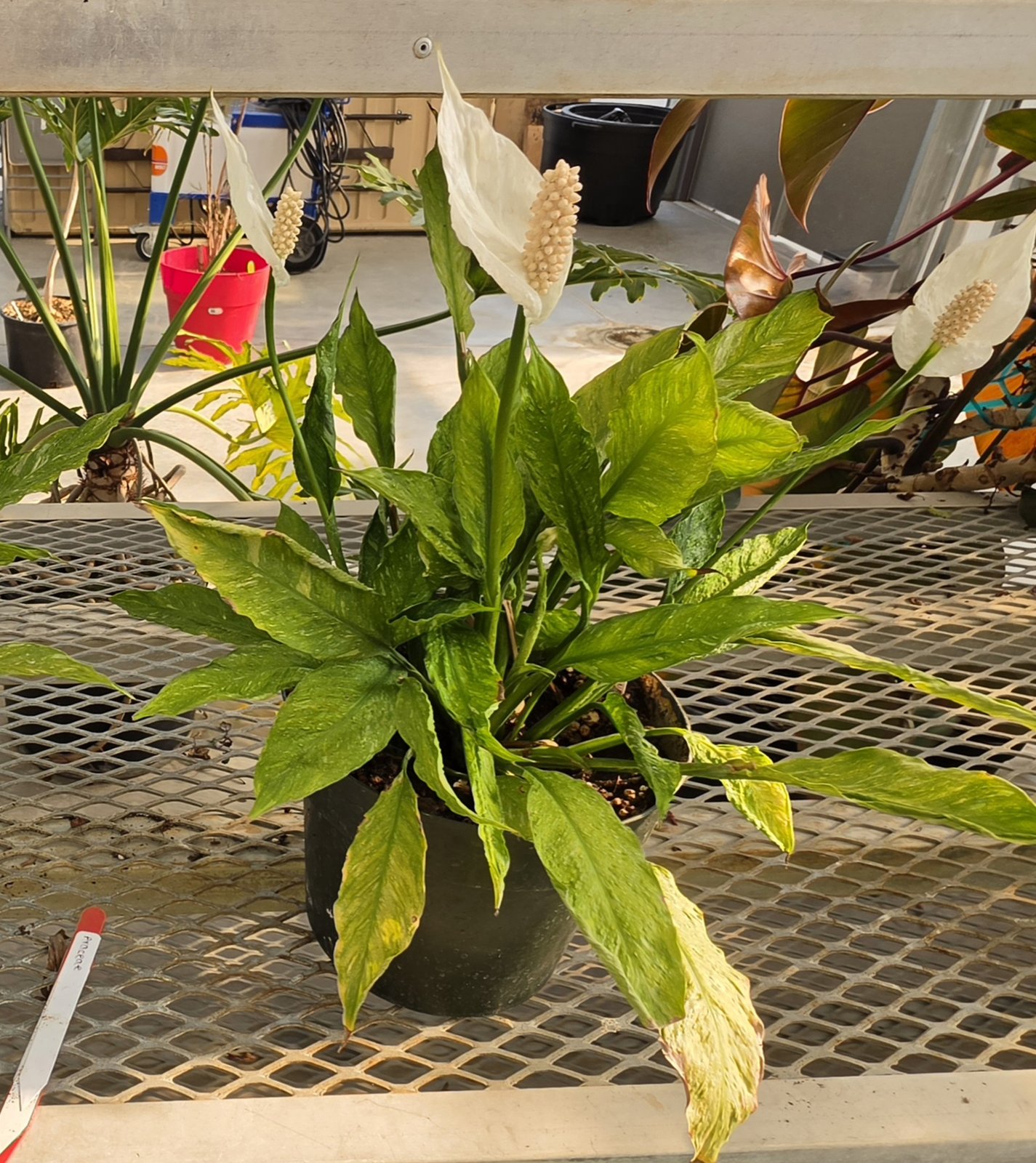
Spathiphyllum sp. (variegated cultivar) · Peace Lily
CON-0119
📍 Location not set
Identification
Spathiphyllum sp. (variegated cultivar) · Peace Lily
The plant shows classic Spathiphyllum characteristics: lance-shaped, glossy green leaves arising in a rosette from soil level, and distinctive inflorescences consisting of a white spathe (modified leaf bract) surrounding a cream/tan spadix covered in tiny flowers - this is a textbook peace lily flower structure. The leaves in this specimen show strong yellow-green variegation (marbling/streaking pattern), suggesting this is a variegated cultivar such as 'Domino' or a similar variegated peace lily variety rather than the common solid-green 'Mauna Loa' type. Some lower leaves show yellowing/browning which could be natural older leaf senescence or possibly stress (overwatering, nutrient deficiency, or too much direct light causing leaf scorch on the pale variegated tissue, which is common in variegated Spathiphyllum since it has less chlorophyll for photosynthesis). I cannot pin down the exact cultivar without more information on the origin/breeding history, but the genus Spathiphyllum is very clear from the flower and leaf morphology. To rule out similar-looking plants like Anthurium (which also has a spathe/spadix but typically has a flatter, more colorful spathe and different leaf texture) or Zantedeschia (calla lily, which has a more funnel-shaped spathe and different leaf shape), the leaf shape and spadix texture visible here are consistent with Spathiphyllum rather than these alternatives.
Generated 2026-08-21 00:52 by anthropic (claude-sonnet-5).
Health
Care Information
- Light
- Bright, indirect light; variegated cultivars need more light than solid-green types to maintain their coloring but avoid direct sun which can scorch leaves.
- Water
- Water when the top inch or two of soil is dry, roughly once a week; plant droops noticeably when thirsty and perks back up quickly after watering.
- Nutrients
- Balanced liquid fertilizer diluted to half-strength monthly during spring/summer growth; withhold or reduce in winter.
- Repotting
- Repot every 1-2 years in spring or when rootbound and no longer flowering well.
- Soil media
- Well-draining, peat-based potting mix with perlite for aeration.
- Temp & humidity
- 65-80F; moderate to high humidity (40-60%) - mist occasionally or use a pebble tray in drier rooms.
- Temperature range
- 🌡️ 65-80F
- Humidity range
- 💦 40-60%
- Care group
- 🏷️ Medium Light & Moderate Humidity
- Toxicity
- Contains calcium oxalate crystals; toxic if chewed/ingested by pets or people, causing mouth/throat irritation - keep away from public foot traffic and curious pets.
- Pests & diseases
- Generally hardy; watch for mealybugs and spider mites, and root rot from overwatering or poor drainage.
- Propagation
- Division at repotting time - separate rooted offsets/clumps from the base of the plant.
Generated 2026-08-21 00:52 by anthropic (claude-sonnet-5).