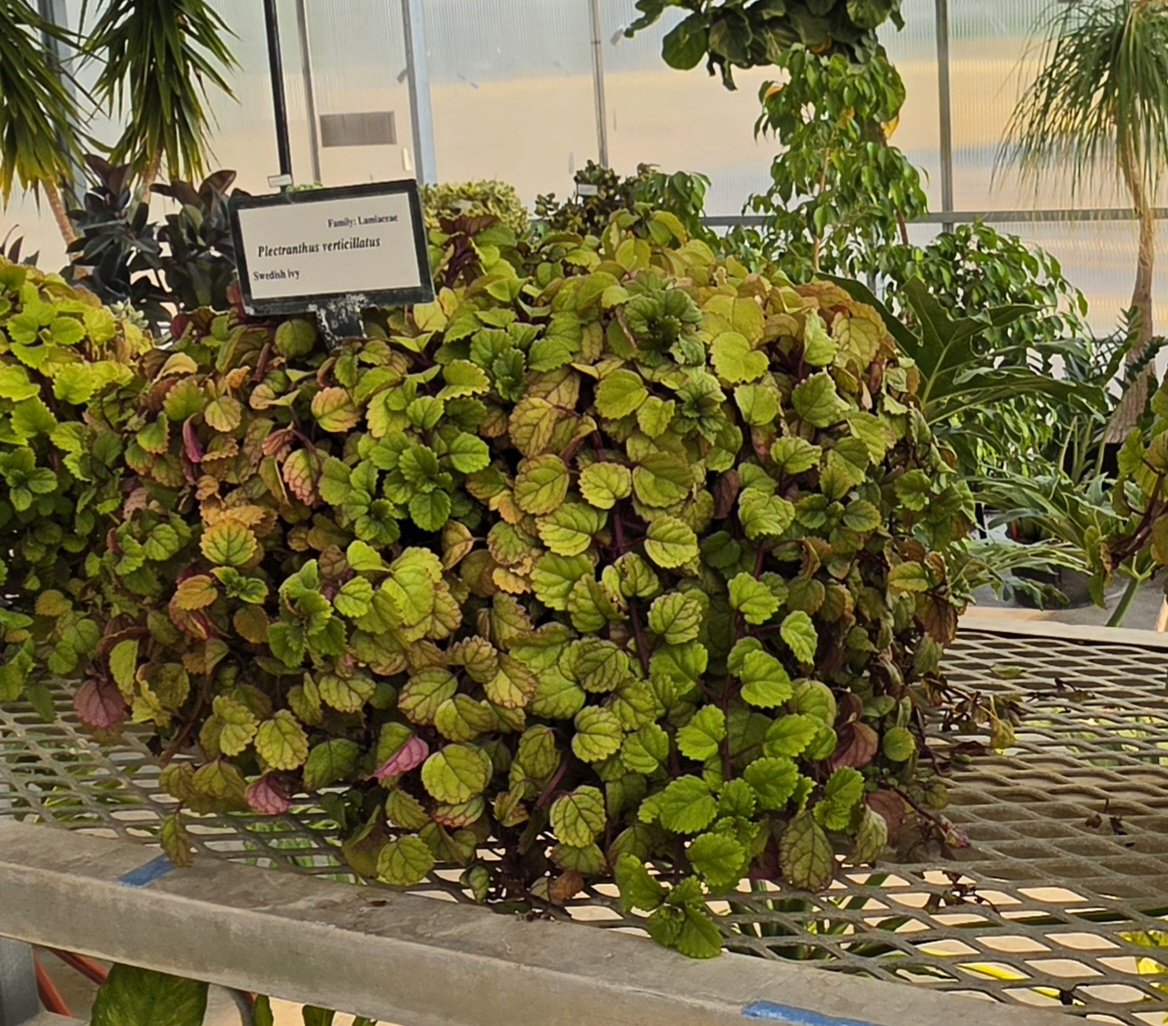
Plectranthus verticillatus · Swedish ivy
CON-0117
📍 Location not set
Identification
Plectranthus verticillatus · Swedish ivy
The plant matches the visible label in the photo (Family: Lamiaceae, Plectranthus verticillatus, Swedish ivy), and the visual characteristics are consistent with this identification: trailing/cascading growth habit forming a dense mound, opposite rounded-to-ovate leaves with scalloped/crenate margins, succulent-looking fleshy stems with reddish-purple coloration, and a spreading habit typical of Plectranthus species used in hanging baskets. The leaf venation and slightly glossy texture also fit Lamiaceae family characteristics. Confidence is 'probable' rather than 'certain' because I'm relying partly on the placard rather than purely independent visual diagnosis, and some Plectranthus species (like P. australis, also called Swedish ivy) look very similar and could be confused without closer inspection of flowers or precise leaf margin serration. A close-up of any flowers (which would show the characteristic two-lipped Lamiaceae corolla) or leaf undersides would help confirm the exact species with full certainty.
Generated 2026-08-24 23:07 by anthropic (claude-sonnet-5).
Health
Care Information
- Light
- Bright indirect light is ideal; tolerates some direct morning sun but avoid harsh midday sun which can bleach or scorch leaves.
- Water
- Water when the top inch or two of soil dries out, letting it dry slightly between waterings; reduce frequency in winter.
- Nutrients
- Feed with a balanced liquid houseplant fertilizer diluted to half strength every 4 weeks during spring through summer; skip fertilizing in fall/winter.
- Repotting
- Repot every 1-2 years in spring, or when roots fill the pot; this plant grows quickly and often benefits from occasional pruning more than repotting.
- Soil media
- Well-draining standard potting mix with added perlite; avoid heavy, waterlogged soils.
- Temp & humidity
- 60-80F; average household/conservatory humidity is fine (30-50%), no special humidity needs.
- Temperature range
- 🌡️ 60-80F
- Humidity range
- 💦 30-50%
- Care group
- 🏷️ Medium Light & Moderate Humidity
- Toxicity
- No significant toxicity reported, but as with many plants it's best kept out of reach of pets and small children who may chew leaves; minor GI upset possible if ingested.
- Pests & diseases
- Generally trouble-free; watch for mealybugs and spider mites in dry conditions, and stem rot if kept too wet or in poorly draining soil.
- Propagation
- Very easy from stem cuttings -- root readily in water or moist soil, often rooting within a couple of weeks.
Generated 2026-08-24 23:08 by anthropic (claude-sonnet-5).