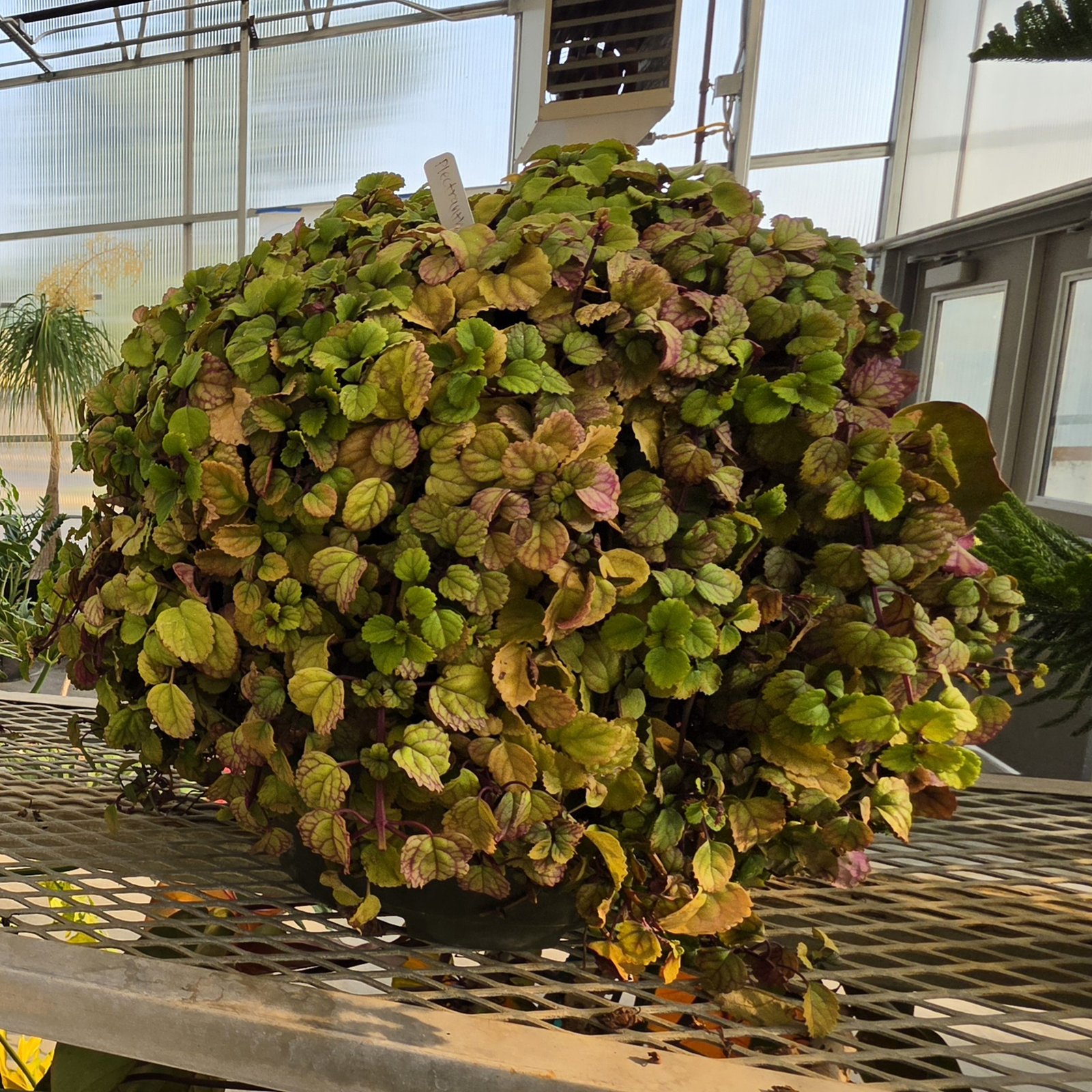
Plectranthus verticillatus · Swedish ivy
CON-0116
📍 Location not set
Identification
Plectranthus verticillatus · Swedish ivy
The visible plant label appears to start with 'Plect...' which strongly suggests Plectranthus. The growth habit matches: a dense, trailing/mounding mass of small, rounded to ovate leaves with scalloped (crenate) margins, trailing purplish-red stems visible where the foliage parts, and a mix of green, yellow-green, and purple-tinged leaf coloration typical of many Plectranthus cultivars (e.g., Plectranthus ciliatus or Plectranthus verticillatus types). The leaves show a slightly succulent, fuzzy texture common to the mint family (Lamiaceae), consistent with Plectranthus. Without a clearer view of the label text or a flower/close-up of leaf venation and margin serration, I can't confirm the exact species or cultivar—several Plectranthus species and cultivars (P. ciliatus, P. verticillatus, P. forsteri) look very similar in this trailing, mounded form. A clearer photo of the plant tag, a close-up of a single leaf showing venation and margin detail, and any flowers (if present) would help confirm the exact species.
Generated 2026-08-15 00:01 by anthropic (claude-sonnet-5).
Health
Care Information
- Light
- Bright indirect light to some direct morning sun; leggy, stretched growth signals too little light.
- Water
- Water when the top inch of soil feels dry, letting it dry out somewhat between waterings; these are fairly forgiving but dislike sitting in soggy soil.
- Nutrients
- Balanced liquid fertilizer diluted to half-strength every 2-4 weeks during spring/summer growth; skip or reduce in winter.
- Repotting
- Repot annually or every other year in spring as growth is fast and plants can quickly become rootbound or leggy (often easier to propagate cuttings than repot old specimens).
- Soil media
- Well-draining standard potting mix with added perlite or sand.
- Temp & humidity
- Prefers 65-80F; average household/conservatory humidity is fine, though it appreciates good air circulation. Not cold-hardy -- protect below 50F.
- Temperature range
- 🌡️ 65-80F
- Humidity range
- 💦 30-50%
- Care group
- 🏷️ Medium Light & Moderate Humidity
- Toxicity
- Mildly toxic if ingested (contains aromatic oils that can cause GI upset in pets); foliage can also cause mild skin irritation in sensitive individuals -- reasonable caution near visitors and pets.
- Pests & diseases
- Watch for mealybugs and spider mites, especially in dry indoor conditions; susceptible to root rot and stem rot if overwatered or poorly drained. Generally fast-growing and resilient otherwise.
- Propagation
- Extremely easy from stem cuttings -- root readily in water or moist soil within 1-2 weeks; a good species for propagation demonstrations.
Generated 2026-08-24 22:59 by anthropic (claude-sonnet-5).