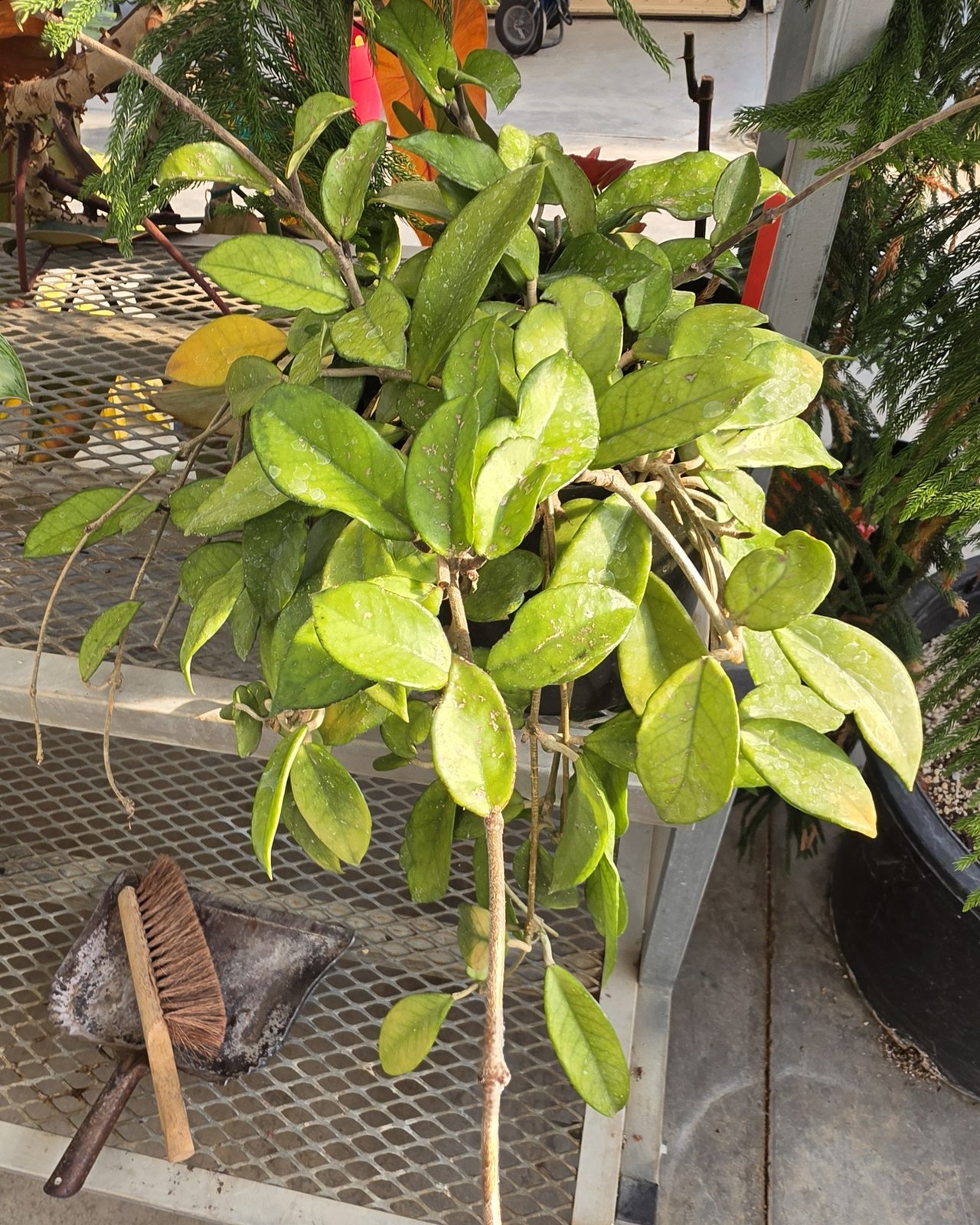
Hoya carnosa · Wax plant
CON-0115
📍 Location not set
Identification
Hoya carnosa · Wax plant
The plant shows thick, waxy, succulent-textured ovate leaves with a glossy surface and slightly pointed tips, arranged oppositely along trailing, semi-woody vines - characteristic of Hoya species. The trailing/cascading growth habit seen spilling over the shelf edge, combined with the fleshy leaf texture and visible aerial-root-like nodes along the stems, strongly suggests Hoya carnosa, one of the most common cultivated wax plants. Some leaves show mottled yellow-green variegation patterns which could indicate this is a variegated cultivar (like 'Krimson Queen' or 'Tricolor') or simply nutrient stress/uneven light exposure. Similar species to rule out include Hoya australis, Hoya obovata, or Hoya pubicalyx, which have similar leaf shapes but differ in leaf size, thickness, and vein patterns. A photo of the flowers (Hoya produces distinctive star-shaped waxy umbels) or a clearer close-up of leaf margins and venation would help confirm the exact species/cultivar with certainty.
Generated 2026-08-31 16:23 by anthropic (claude-sonnet-5).
Health
Care Information
- Light
- Bright indirect light; some direct morning sun encourages blooming but avoid harsh midday sun which can bleach or scorch leaves.
- Water
- Let the potting mix dry out significantly (nearly to the bottom of the pot) between waterings; this succulent-leaved vine tolerates drought far better than overwatering.
- Nutrients
- Balanced liquid fertilizer diluted to half-strength every 4-6 weeks during spring/summer growth; withhold in winter.
- Repotting
- Repot only every 2-3 years or when badly rootbound -- Hoya blooms best when slightly pot-bound, so don't rush to upsize.
- Soil media
- Very well-draining mix -- standard potting soil cut with extra perlite/orchid bark; can also be grown mounted or in orchid bark as a semi-epiphyte.
- Temp & humidity
- 65-85F; moderate humidity (40-60%) is fine, though it appreciates higher humidity for lusher growth.
- Temperature range
- 🌡️ 65-85F
- Humidity range
- 💦 40-60%
- Care group
- 🏷️ Bright & Dry
- Toxicity
- Mildly toxic if ingested by pets or people; sap can also cause mild skin irritation in sensitive individuals -- reasonable to keep away from heavy public handling.
- Pests & diseases
- Watch for mealybugs and aphids, especially clustering around flower buds and new growth; root rot is the main risk if kept too wet or in poorly draining soil.
- Propagation
- Stem cuttings with at least one node root readily in water or moist perlite/soil; leave peduncles (bloom spurs) intact after flowering since they rebloom.
Generated 2026-08-31 16:24 by anthropic (claude-sonnet-5).