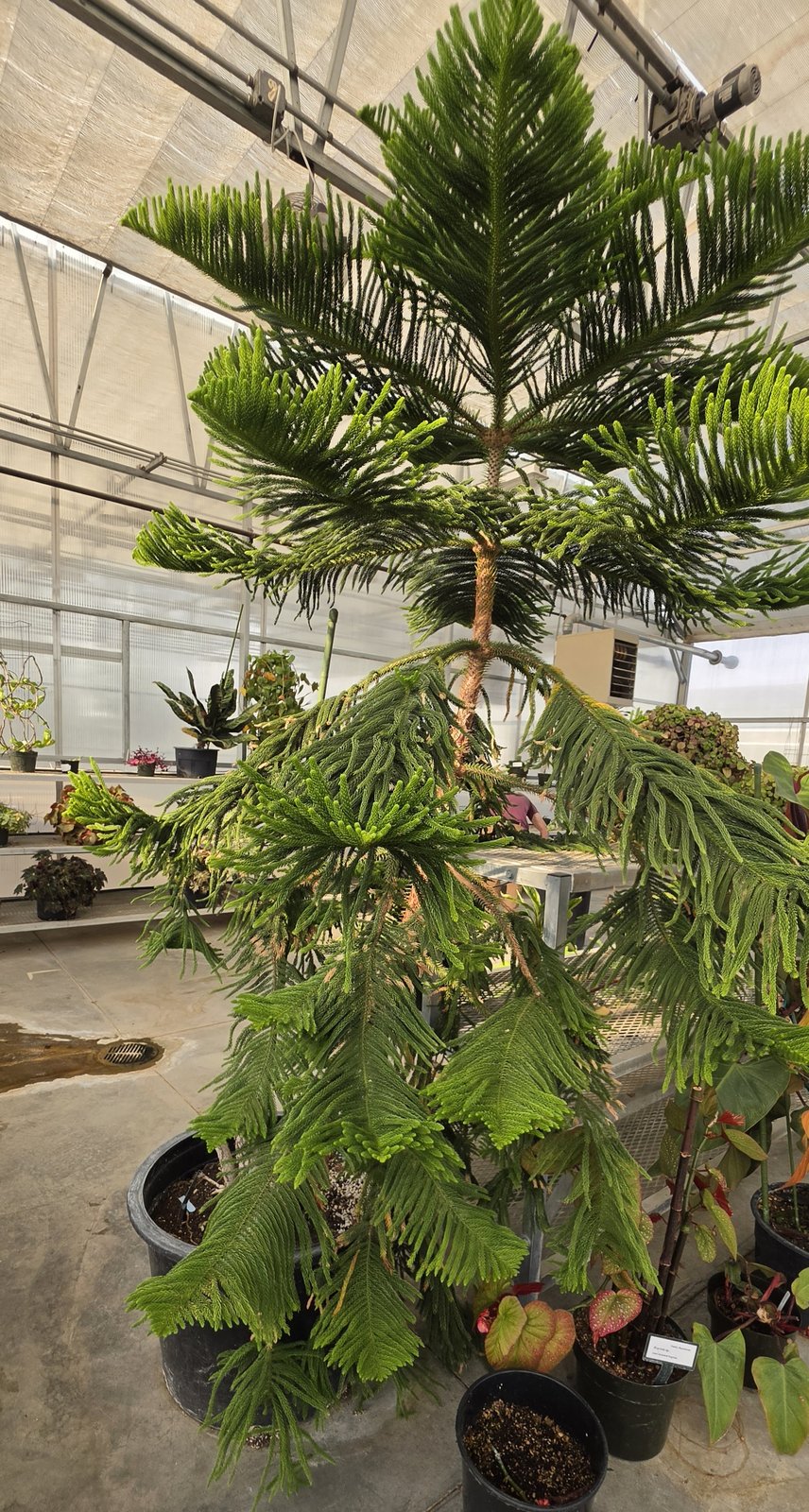
Araucaria heterophylla · Norfolk Island Pine
CON-0113
📍 Location not set
Identification
Araucaria heterophylla · Norfolk Island Pine
The plant shows the characteristic symmetrical, tiered branching pattern radiating horizontally from a central trunk, with soft, needle-like, incurved leaves densely arranged spirally around the branchlets. The branches emerge in distinct whorls, giving a pagoda-like architecture typical of Araucaria species grown as houseplants/conservatory specimens. The bright green, awl-shaped foliage and the drooping, feathery branch tips are consistent with Araucaria heterophylla (Norfolk Island Pine), the most commonly cultivated Araucaria in greenhouse/indoor collections. Similar species to rule out include Araucaria bidwillii (Bunya Pine, which has broader, sharper, more rigid leaves) and Araucaria columnaris (Cook Pine, which has a narrower, more columnar habit with less horizontal branching). Without a clearer view of individual leaf attachment or cone structures, I cannot be fully certain it isn't another Araucaria species, but the overall habit strongly suggests A. heterophylla.
Generated 2026-08-27 15:51 by anthropic (claude-sonnet-5).
Health
Care Information
- Light
- Bright indirect light to partial sun; tolerates lower light but grows leggy, avoid deep shade long-term.
- Water
- Water when the top 1-2 inches of soil are dry, roughly every 7-10 days; let it dry out a bit more in winter to avoid root rot.
- Nutrients
- Balanced liquid fertilizer monthly during spring through summer; skip feeding in fall and winter.
- Repotting
- Repot every 2-3 years in spring, sizing up gradually as it's a large, slow-growing tree -- avoid drastically oversized pots which hold excess moisture.
- Soil media
- Well-draining, slightly acidic potting mix -- standard potting soil with added perlite or coarse sand works well.
- Temp & humidity
- 60-75F; moderate humidity (40-50%) is fine, though it appreciates slightly higher humidity if available.
- Temperature range
- 🌡️ 60-75F
- Humidity range
- 💦 40-50%
- Care group
- 🏷️ Medium Light & Moderate Humidity
- Toxicity
- Mildly toxic if ingested by pets or people; needles can also cause minor skin irritation -- keep away from small children and pets prone to chewing.
- Pests & diseases
- Generally hardy; watch for scale and mealybugs, especially on lower branches, and root rot from overwatering or poor drainage.
- Propagation
- Best grown from seed; stem/tip cuttings are possible but often produce lopsided, non-symmetrical growth, so seed propagation is preferred for a well-shaped tree.
Generated 2026-08-27 15:51 by anthropic (claude-sonnet-5).