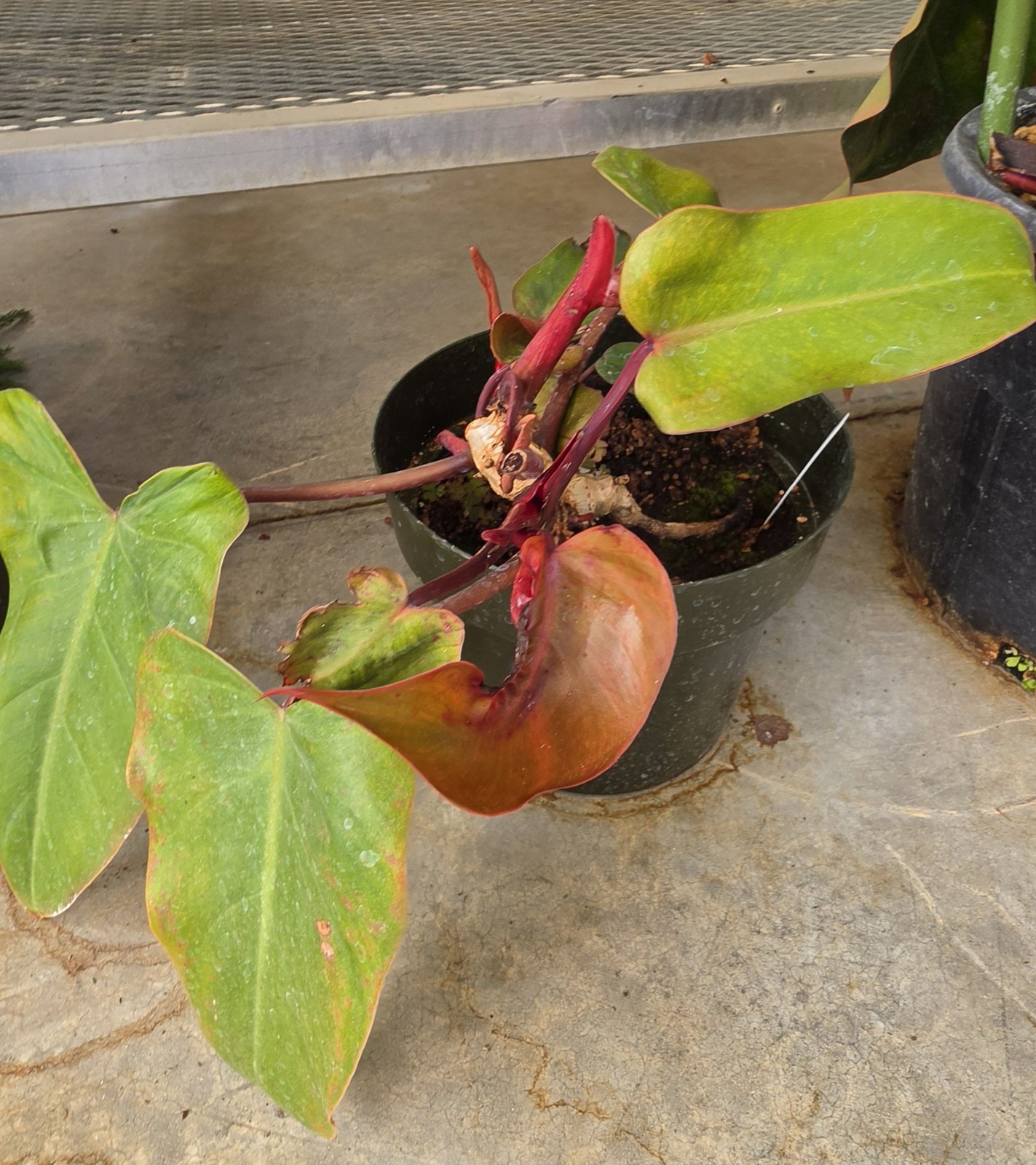
Philodendron erubescens · Blushing philodendron
CON-0112
📍 Location not set
Identification
Philodendron erubescens · Blushing philodendron
The plant shows arrow/hastate-shaped leaves with a glossy surface, reddish-maroon petioles and new growth (cataphylls) that are deep red and persist at the stem, and reddish coloring on the underside/margins of emerging leaves — all classic traits of Philodendron erubescens, which is known for its reddish-purple new leaves and petioles that mature to green. The leaf shape here is simple and entire (not lobed or bristly), which rules out P. squamiferum (which has distinctive hairy/bristly red petioles and often three-lobed leaves) — this plant's petioles are smooth and waxy, not hairy, supporting erubescens over squamiferum. Vining/climbing habit with alternating leaves on a reddish stem also fits. I can't rule out very similar red-flushed philodendron hybrids/cultivars (e.g. 'Red Emerald', 'Pink Princess' parentage lines, or P. erubescens hybrids) which look nearly identical as juveniles, so I'm not fully certain of exact species vs. a cultivar derived from it.
Generated 2026-10-06 05:10 by anthropic (claude-sonnet-5).
Health
Care Information
- Light
- Bright, indirect light; will tolerate medium light but leaf fenestration (the violin-shaped lobing) develops best with brighter conditions. Avoid direct hot sun which can scorch leaves.
- Water
- Water when the top 1-2 inches of soil are dry, typically every 7-10 days; let it dry out a bit more in winter to avoid root rot.
- Nutrients
- Feed with a balanced liquid fertilizer diluted to half-strength monthly during spring through fall; skip feeding in winter.
- Repotting
- Repot every 1-2 years in spring, or when roots emerge from drainage holes or the mix breaks down; this vining aroid also appreciates a moss pole or trellis to climb as it matures.
- Soil media
- Chunky, well-draining aroid mix -- potting soil amended with bark, perlite, and a bit of charcoal.
- Temp & humidity
- 65-80F; moderate to high humidity (50%+) is ideal -- mist regularly or use a pebble tray/humidifier in drier rooms.
- Temperature range
- 🌡️ 65-80F
- Humidity range
- 💦 50-70%
- Care group
- 🏷️ Bright & Humid
- Toxicity
- Contains calcium oxalate crystals; toxic if chewed or ingested by pets or people, and sap can irritate skin and eyes. Keep away from curious pets and small children, and wear gloves when pruning.
- Pests & diseases
- Generally hardy; watch for spider mites and mealybugs in dry air, and scale occasionally. Overwatering or poor drainage can lead to root rot.
- Propagation
- Stem cuttings root readily in water or moist chunky mix -- take a cutting with at least one node and aerial root attached.
Generated 2026-08-24 23:02 by anthropic (claude-sonnet-5).