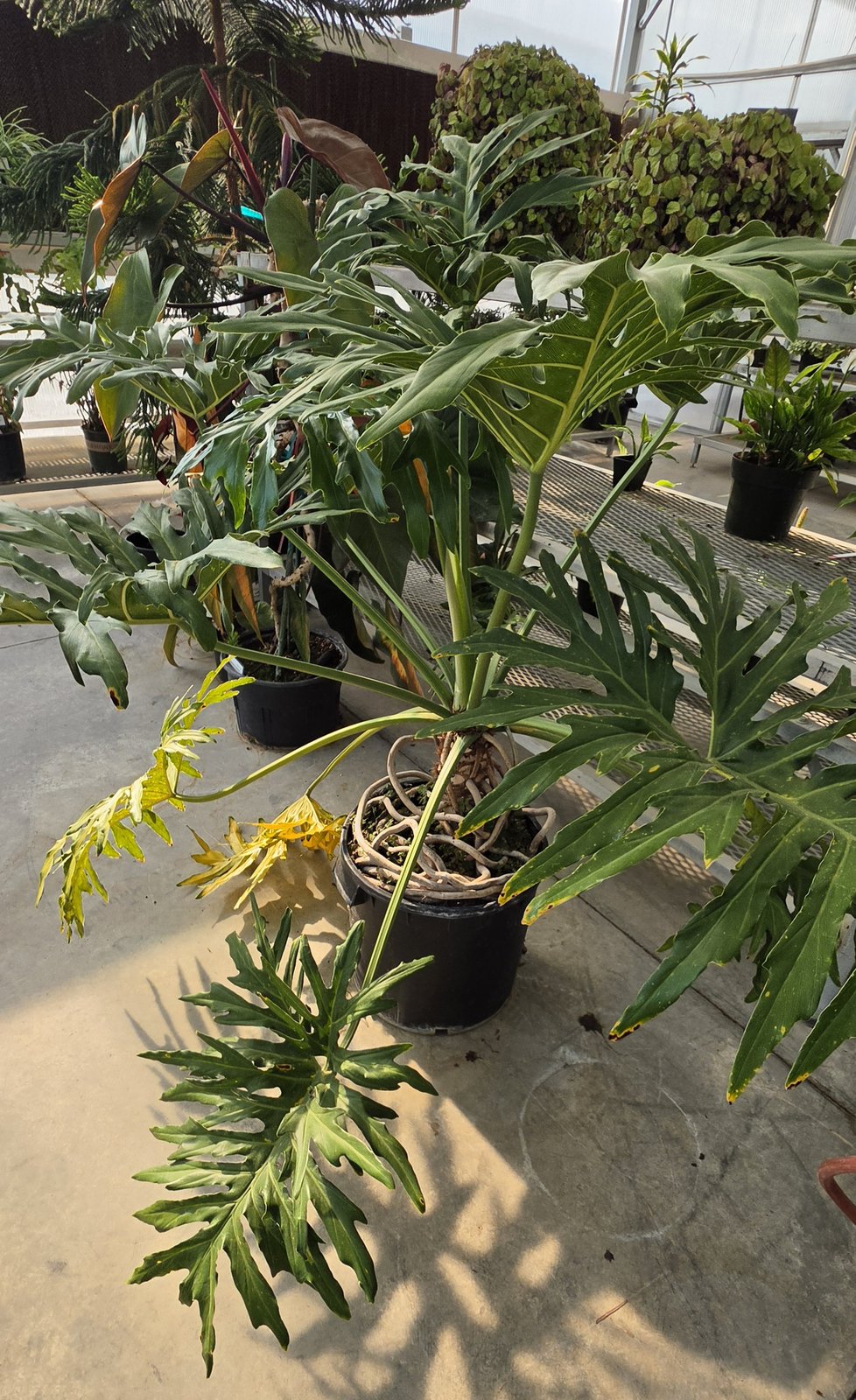
Thaumatophyllum bipinnatifidum (syn. Philodendron bipinnatifidum) · Split-leaf Philodendron / Tree Philodendron
CON-0109
📍 Location not set
Identification
Thaumatophyllum bipinnatifidum (syn. Philodendron bipinnatifidum) · Split-leaf Philodendron / Tree Philodendron
The plant shows large, deeply pinnatifid (feather-like lobed) leaves with a glossy dark green upper surface and prominent pale midribs/veins, arranged on thick, semi-woody petioles emerging from a central stem climbing on a moss/coir pole. This deeply dissected leaf pattern with numerous narrow finger-like lobes radiating from a central point is characteristic of Thaumatophyllum bipinnatifidum (formerly classified as Philodendron bipinnatifidum, and often confused with P. selloum). The overall growth habit—self-heading with a stout trunk and aerial roots—also matches this species. Some yellowing/older leaves are visible, suggesting normal leaf senescence or minor stress rather than disease. Similar species to rule out include Philodendron 'Xanadu' (which has smaller, more compact, less deeply cut leaves) and Monstera deliciosa (which has fenestrations/holes rather than fully separated lobes). A close-up of the leaf margin near the petiole junction, or a look at the inflorescence (spathe/spadix) if present, would help confirm the exact species versus similar large-leaved Thaumatophyllum/Philodendron cultivars.
Generated 2026-08-26 21:07 by anthropic (claude-sonnet-5).
Health
Care Information
- Light
- Bright indirect light is ideal, but it tolerates medium light well; avoid direct hot sun which can scorch the large leaves.
- Water
- Water when the top 1-2 inches of soil dry out, roughly every 7-10 days; reduce frequency in winter. Dislikes sitting in soggy soil.
- Nutrients
- Feed with a balanced liquid fertilizer monthly during spring through fall; skip or reduce in winter.
- Repotting
- Repot every 1-2 years in spring -- this plant grows large and forms a thick trunk, so size up pots as it matures or it can become rootbound and topple.
- Soil media
- Rich, well-draining aroid mix -- standard potting soil amended with perlite and bark works well.
- Temp & humidity
- 65-85F; moderate to high humidity (40-60%) is fine, though it appreciates higher humidity for lusher growth.
- Temperature range
- 🌡️ 65-85F
- Humidity range
- 💦 40-60%
- Care group
- 🏷️ Bright & Humid
- Toxicity
- Contains calcium oxalate crystals -- toxic if chewed/ingested by pets or people, and sap can irritate skin/eyes; keep away from public foot traffic and use gloves when pruning.
- Pests & diseases
- Generally hardy; watch for spider mites and mealybugs in dry air, and root rot if overwatered or left in poorly draining soil.
- Propagation
- Stem cuttings with a node root readily in water or moist soil; larger specimens can also be propagated by air-layering or by rooting basal offsets/suckers with aerial roots attached.
Generated 2026-08-26 21:08 by anthropic (claude-sonnet-5).