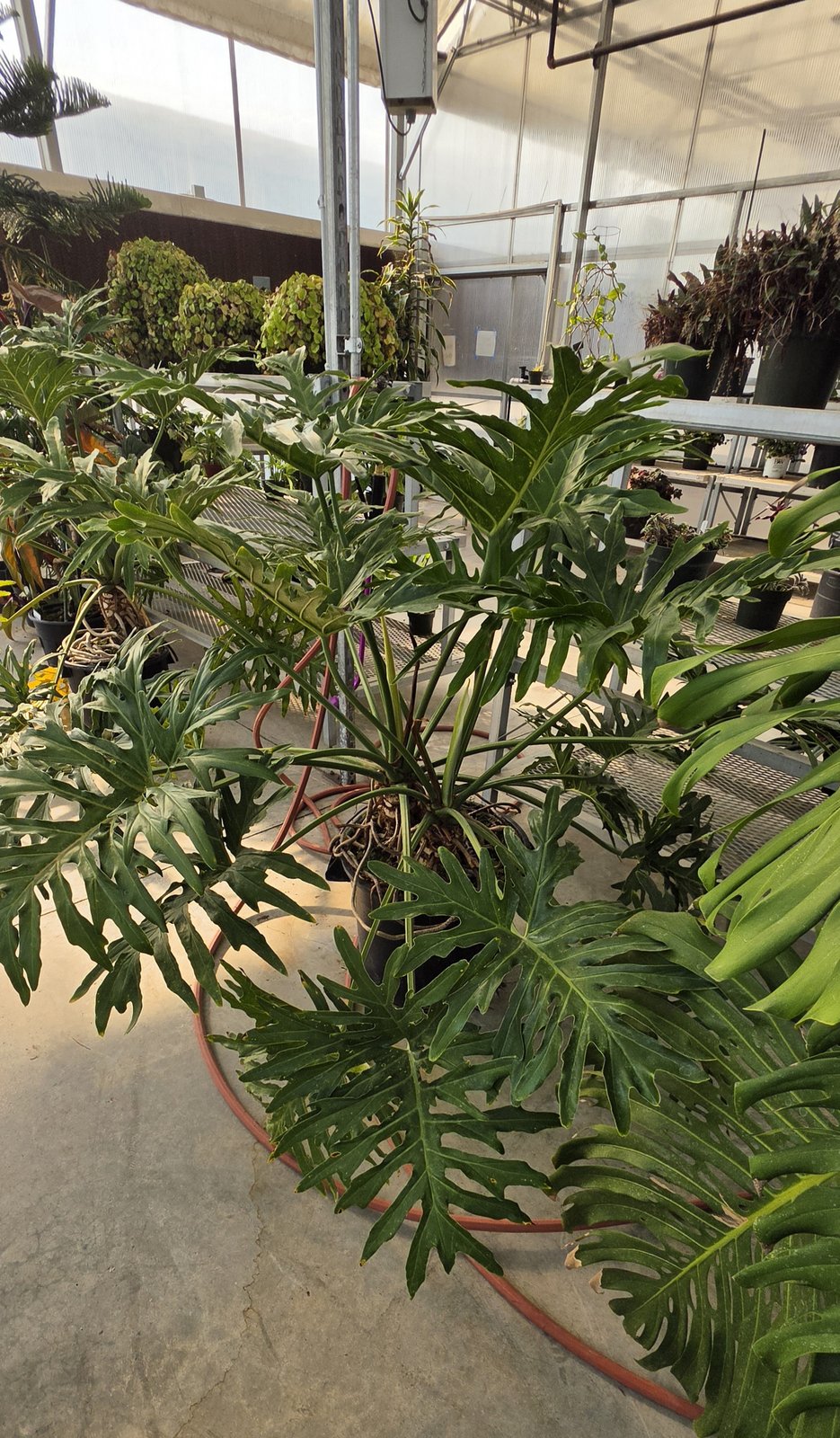
Thaumatophyllum bipinnatifidum · Split-leaf philodendron (Lacy tree philodendron)
CON-0108
📍 Location not set
Identification
Thaumatophyllum bipinnatifidum · Split-leaf philodendron (Lacy tree philodendron)
The plant shows large, deeply and irregularly pinnatifid leaves with multiple narrow, elongated lobes radiating from a central midrib, held on long, thick, upright petioles arising from a stout, sub-woody central stem/rosette base with visible aerial/fibrous roots at the base - all classic features of Thaumatophyllum bipinnatifidum (formerly Philodendron bipinnatifidum, 'Selloum'). The self-heading (non-vining) growth habit and glossy dark green leaf color are consistent with this species. That said, the confidence is 'probable' rather than 'certain' because similar dissected foliage occurs in related aroids such as Thaumatophyllum xanadu (smaller, more compact) and some large-leaved Philodendron or Monstera hybrids, and without a clearer view of the petiole cross-section, sinus shape at leaf base, or any flowering spathe, a definitive species-level call can't be fully locked in. A close-up of where the leaf blade meets the petiole and the overall mature plant size/spread would help confirm.
Generated 2026-08-26 21:12 by anthropic (claude-sonnet-5).
Health
Care Information
- Light
- Bright, indirect light is ideal; tolerates medium light but growth slows and leaf splitting is less pronounced. Avoid direct hot sun which can scorch the leaves.
- Water
- Water when the top 1-2 inches of soil are dry, keeping the mix evenly moist but never soggy; cut back in winter. Sensitive to overwatering, which quickly leads to root rot.
- Nutrients
- Feed with a balanced liquid fertilizer monthly during spring through fall; skip feeding in winter when growth slows.
- Repotting
- Repot every 2 years or when rootbound, sizing up one pot size; this is a large, fast-growing plant so expect to eventually move it to a large floor container or planter bed.
- Soil media
- Rich, well-draining potting mix with added perlite or bark for aeration; it appreciates organic matter but must not stay waterlogged.
- Temp & humidity
- 70-85F; moderate to high humidity (50%+) is best, though it adapts reasonably well to average indoor humidity.
- Temperature range
- 🌡️ 70-85F
- Humidity range
- 💦 50%+
- Care group
- 🏷️ Bright & Humid
- Toxicity
- Contains calcium oxalate crystals; toxic if chewed or ingested by pets or people, causing mouth/throat irritation and swelling. Sap can also irritate skin, so use gloves when pruning and keep away from unsupervised visitors or pets.
- Pests & diseases
- Generally hardy and trouble-free; watch for spider mites and mealybugs in dry conditions, and root rot or bacterial leaf spot if overwatered or kept too wet.
- Propagation
- Easily propagated by stem cuttings with at least one node, rooted in water or moist soil; larger specimens can also be divided at the base if offsets have formed.
Generated 2026-08-26 21:12 by anthropic (claude-sonnet-5).