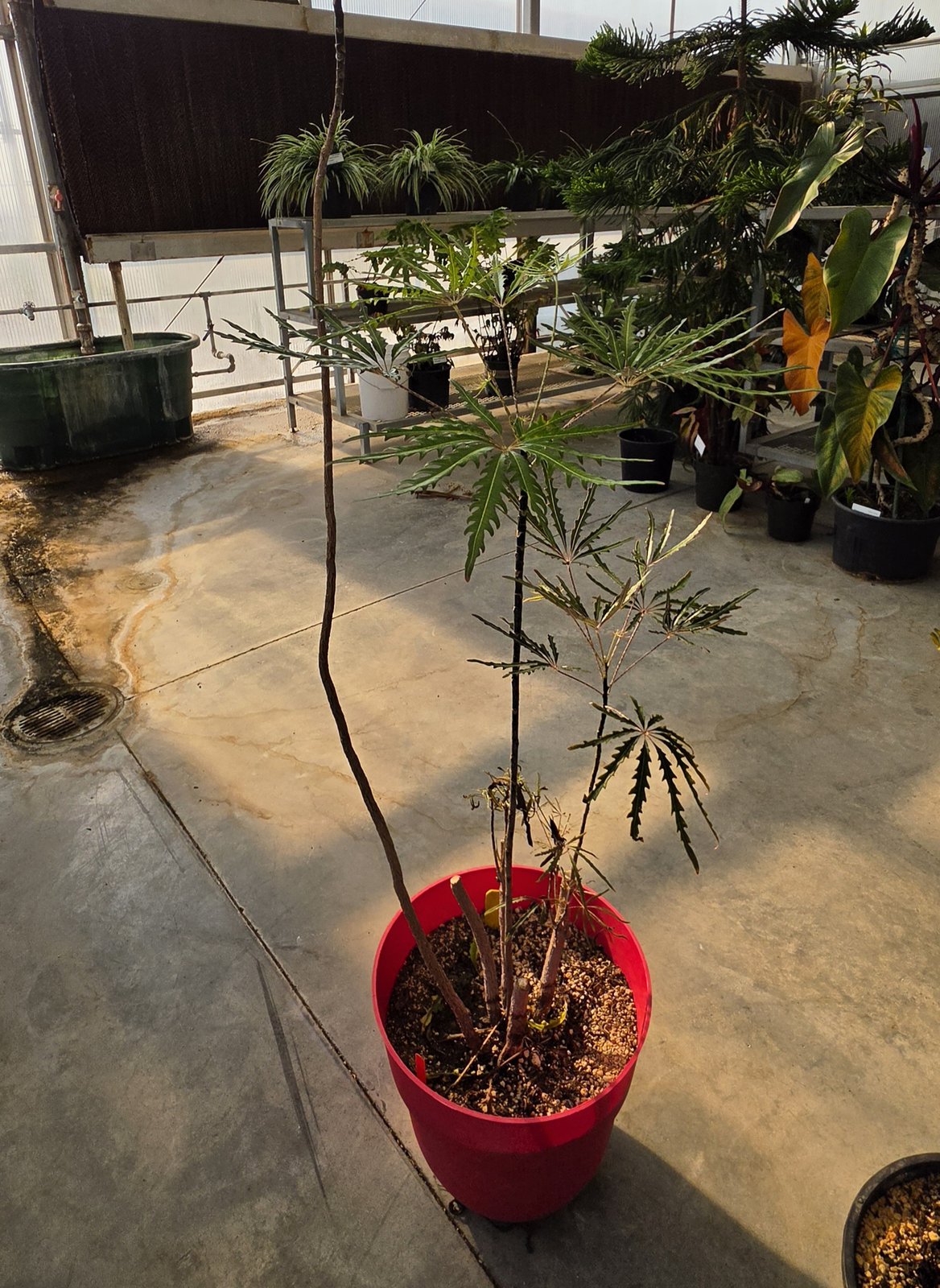
Schefflera elegantissima · False aralia
CON-0103
📍 Location not set
Identification
Schefflera elegantissima · False aralia
The plant shows palmately compound leaves with 7-10 narrow, deeply serrated (almost fern-like) leaflets radiating from a central petiole, borne on slender, cane-like woody stems with widely spaced leaf clusters. This is the classic juvenile foliage form of Schefflera elegantissima (syn. Dizygotheca elegantissima, Plerandra elegantissima), a common conservatory/houseplant known as false aralia. This rules out Tetrapanax papyrifer, which has large, simple, palmately lobed (not compound with separate toothed leaflets) leaves with a fuzzy/felted underside and much thicker stems. Other genera to rule out include Aralia (leaflets typically broader and less finely toothed) and Oreopanax (leaflets usually not as narrow/serrated). Confidence is 'probable' rather than 'certain' because the photo doesn't show leaflet undersides, petiolule attachment detail, or flowers, which would help distinguish it definitively from other Schefflera/Araliaceae relatives with similar juvenile foliage.
Generated 2026-08-26 21:28 by anthropic (claude-sonnet-5).
Health
Care Information
- Light
- Bright, indirect light; tolerates medium light but leaf color and compactness are best with more brightness. Avoid direct sun, which can scorch the delicate foliage.
- Water
- Water when the top 1-2 inches of soil dry out, about once a week; let it dry out a bit more between waterings in winter. Doesn't like sitting in wet soil.
- Nutrients
- Feed with a balanced liquid fertilizer diluted by half, monthly during spring and summer growth; skip fertilizing in fall and winter.
- Repotting
- Repot every 2 years or when rootbound, ideally in spring; this species doesn't mind being slightly snug in its pot.
- Soil media
- Well-draining, peat-based potting mix with added perlite or bark for aeration.
- Temp & humidity
- 65-80F; moderate to high humidity (40-60%) - occasional misting or a pebble tray helps, especially in dry indoor air.
- Temperature range
- 🌡️ 65-80F
- Humidity range
- 💦 40-60%
- Care group
- 🏷️ Medium Light & Moderate Humidity
- Toxicity
- Mildly toxic if ingested by pets or people (contains calcium oxalate crystals); can cause mouth/throat irritation. Keep away from curious pets and small children.
- Pests & diseases
- Watch for spider mites and scale, especially in dry conditions; check leaf undersides regularly. Prone to leaf drop and root rot if overwatered or kept too cold.
- Propagation
- Stem cuttings root reasonably well in water or moist soil, taken below a node in spring/summer with some warmth; can be slow to establish.
Generated 2026-08-26 21:29 by anthropic (claude-sonnet-5).