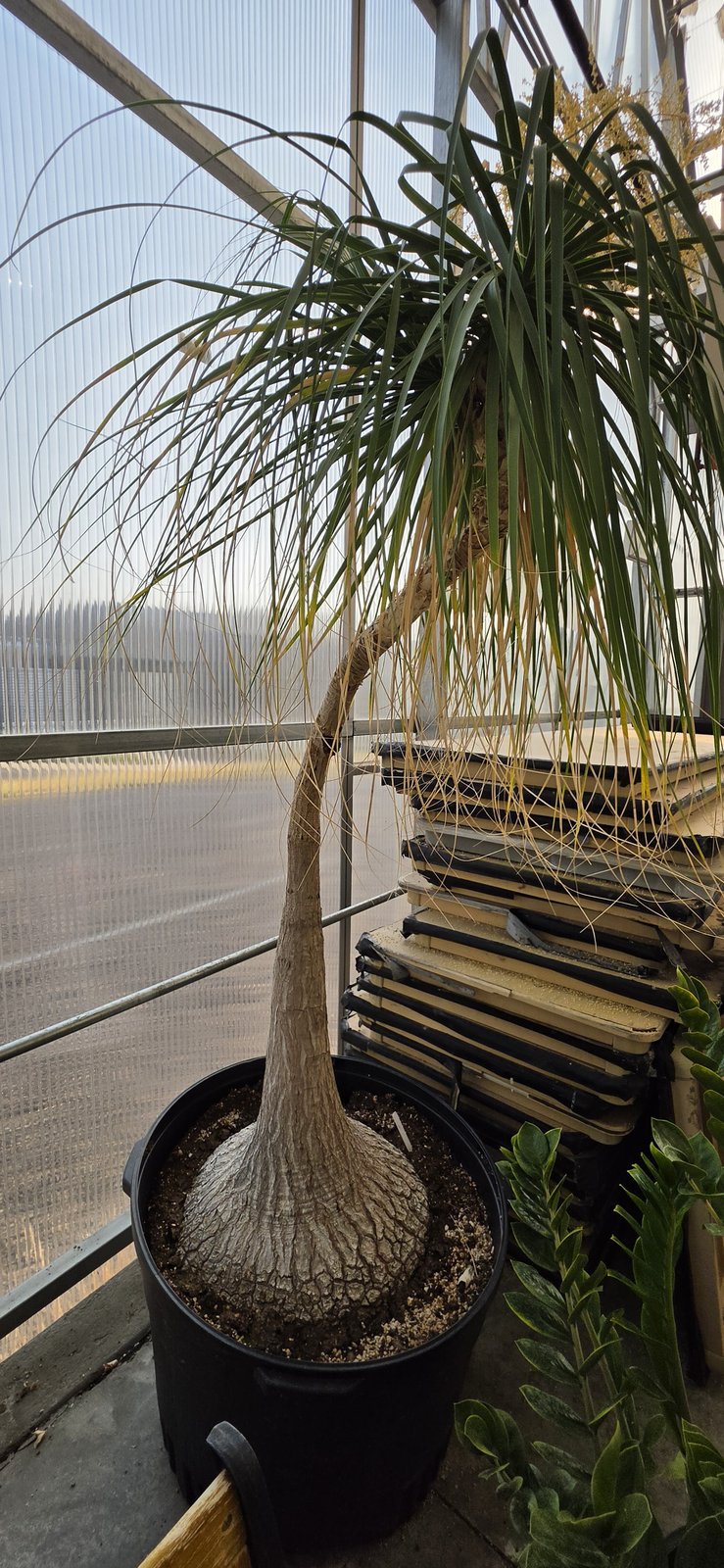
Beaucarnea recurvata · Ponytail Palm (Elephant's Foot)
CON-0101
📍 Location not set
Identification
Beaucarnea recurvata · Ponytail Palm (Elephant's Foot)
The plant shows the classic bulbous, swollen caudex (base) that tapers into a woody trunk, topped with a dense rosette of long, thin, strap-like, gracefully curving/drooping leaves - a hallmark combination unique to Beaucarnea recurvata. The bark-like textured caudex with vertical fissures is characteristic of mature specimens grown in containers, which restrict the caudex somewhat compared to ground-grown plants. The single trunk with a slight curve and the cascading 'ponytail' of leaves are diagnostic. Similar species to rule out include other Beaucarnea species (e.g., B. stricta, B. gracilis) which have more upright or differently shaped leaves, and Nolina species, which are related and can look similar but typically have less pronounced caudex swelling. Dracaena species (like Dracaena draco) can also have a somewhat similar growth habit but lack the swollen bulbous base and have stiffer, broader leaves. Confidence is 'probable' rather than 'certain' because exact species-level distinction among Beaucarnea can require closer inspection of leaf margins and flower structures, which aren't visible here.
Generated 2026-08-24 22:50 by anthropic (claude-sonnet-5).
Health
Care Information
- Light
- Bright light, including several hours of direct sun; tolerates lower light but growth slows and the caudex won't develop as well.
- Water
- Drought-tolerant -- water deeply only when soil is completely dry, roughly every 2-3 weeks; the swollen caudex stores water so overwatering is the main risk.
- Nutrients
- Light feeding with a balanced liquid fertilizer diluted to half-strength monthly during spring/summer; none in winter.
- Repotting
- Repot only every 3-5 years or when badly rootbound; this plant prefers to be slightly snug and resents excessive disturbance.
- Soil media
- Very well-draining cactus/succulent mix, ideally with extra perlite or coarse sand to prevent water pooling around the caudex.
- Temp & humidity
- 65-85F; low to moderate humidity is fine (30-50%) -- this is a desert-adapted plant and does not need misting or extra humidity.
- Temperature range
- 🌡️ 65-85F
- Humidity range
- 💦 30-50%
- Care group
- 🏷️ Bright & Dry
- Toxicity
- Non-toxic to pets and people; safe near public foot traffic.
- Pests & diseases
- Generally trouble-free; watch for mealybugs and spider mites in dry indoor air, and root/caudex rot if overwatered or soil stays wet.
- Propagation
- Usually grown from seed; offsets/basal pups (when present) can be removed and rooted, but this is slow and not always reliable in cultivation.
Generated 2026-08-24 22:51 by anthropic (claude-sonnet-5).