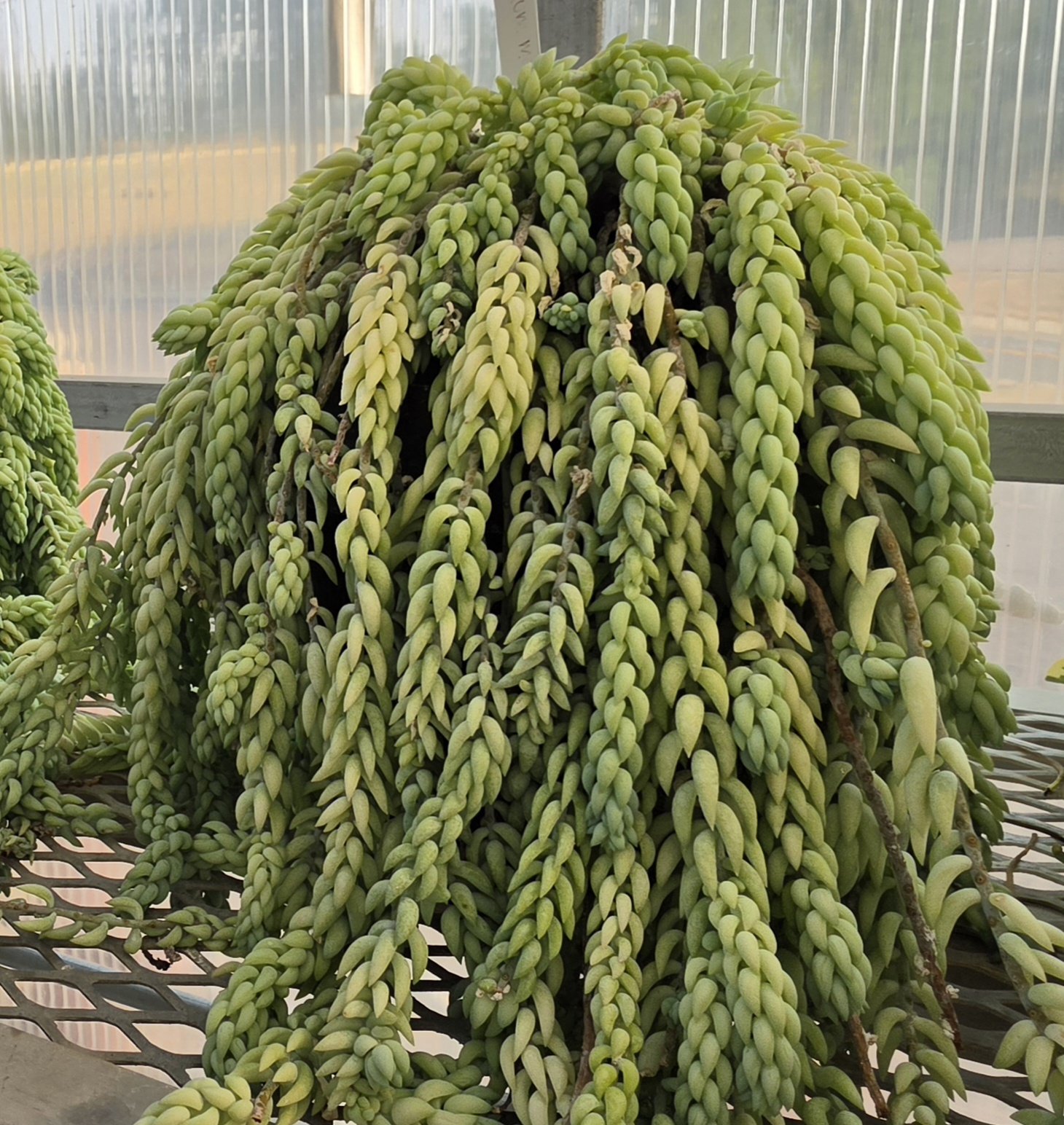
Sedum morganianum · Burro's Tail (Donkey's Tail)
CON-0095
📍 Location not set
Identification
Sedum morganianum · Burro's Tail (Donkey's Tail)
The plant shows the highly distinctive trailing/pendant growth habit with densely packed, overlapping, plump, tapering, bead-like succulent leaves arranged spirally along thick trailing stems, forming rope-like or braided-looking strands that hang down from a container in a greenhouse setting. This is classic for Sedum morganianum (Burro's Tail), a very commonly cultivated succulent known for exactly this cascading appearance. The leaf color is a soft glaucous green, and the leaves appear somewhat fused/braided in visual pattern, consistent with this species and also could suggest the similar cultivar 'Burrito' (Sedum morganianum 'Burrito'), which has shorter, more tightly packed leaves and slightly different stem visibility, or the hybrid Sedum × 'Burrito'. Given the length of the strands and slightly visible stem between leaf clusters, true Sedum morganianum is more likely than 'Burrito', but without a clearer close-up of individual leaf shape/length and stem exposure, I can't rule out the cultivar with full certainty. A close-up of a single leaf (its length and attachment) and any flowers (small pink/red star-shaped flowers if present) would help confirm species vs. cultivar identification.
Generated 2026-08-27 20:37 by anthropic (claude-sonnet-5).
Health
Care Information
- Light
- Bright light is essential, including some direct sun (especially morning sun); insufficient light causes leggy growth and wide gaps between leaves on the trailing stems.
- Water
- Allow soil to dry out completely between waterings, then water thoroughly; this is a drought-tolerant succulent that's much more likely to suffer from overwatering than underwatering.
- Nutrients
- Feed with a diluted balanced or cactus/succulent fertilizer monthly during spring and summer; withhold in fall and winter.
- Repotting
- Repot every 2-3 years or when it outgrows its container, ideally in spring; handle carefully since leaves ('beads') drop off very easily with minimal touch.
- Soil media
- Fast-draining cactus/succulent mix, ideally with extra perlite or pumice for sharp drainage.
- Temp & humidity
- Prefers 65-80F and low to average humidity; does not tolerate frost and should be kept above 50F. Best in a dry, sunny spot rather than a humid greenhouse zone.
- Temperature range
- 🌡️ 65-80F
- Humidity range
- 💦 20-40%
- Care group
- 🏷️ Bright & Dry
- Toxicity
- Considered mildly toxic to pets if ingested (may cause GI upset); no significant concern for human contact, but keep away from curious pets and small children.
- Pests & diseases
- Watch for mealybugs and aphids in leaf crevices; the main disease risk is root/stem rot from overwatering or poorly draining soil.
- Propagation
- Very easy from leaf or stem cuttings - let a fallen leaf or cut stem callus for a day or two, then lay on well-draining soil; roots and new plantlets form readily.
Generated 2026-08-27 20:37 by anthropic (claude-sonnet-5).