Yucca gloriosa · Spanish Dagger / Soft-tipped Yucca
CON-0090
Identification
Yucca gloriosa · Spanish Dagger / Soft-tipped Yucca
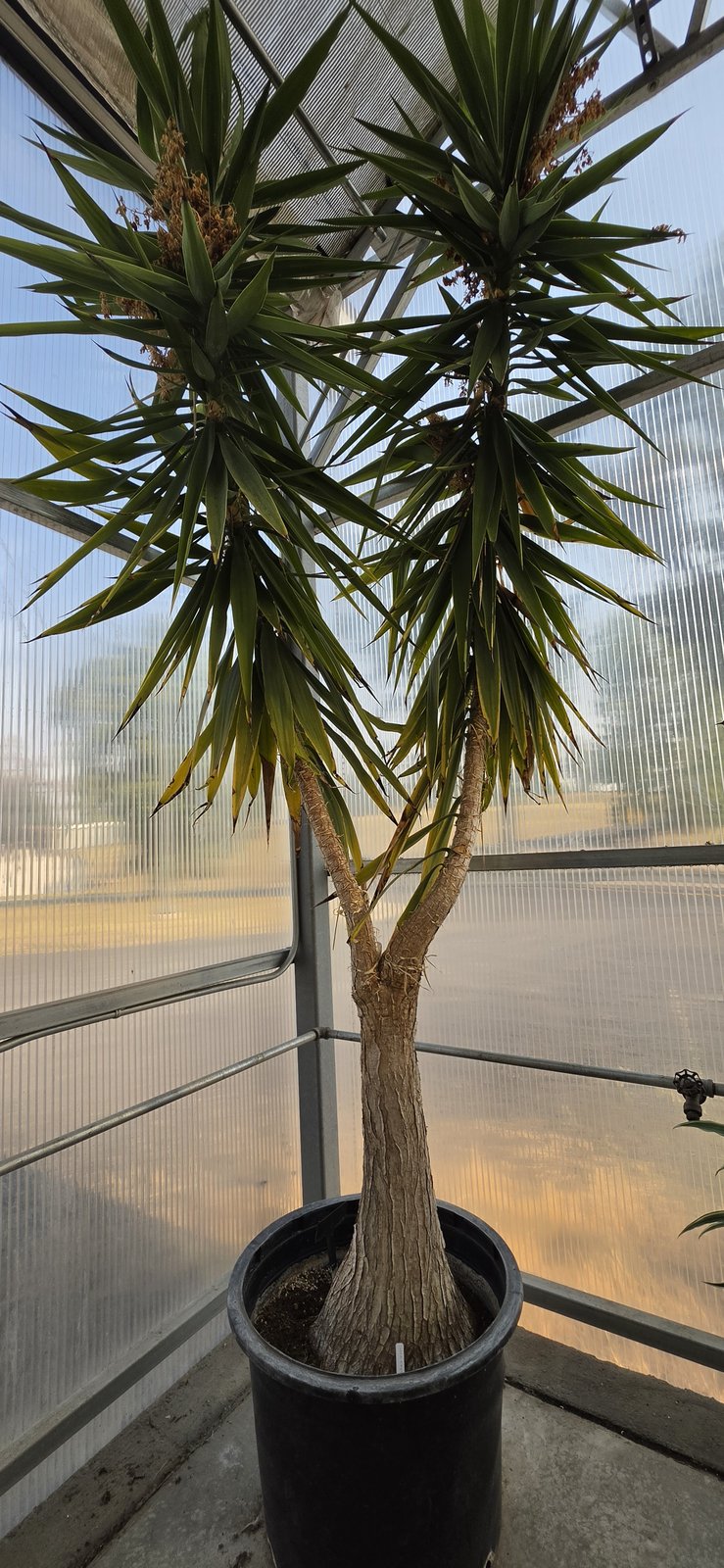
The plant shows the classic Yucca growth habit: a woody, rough-barked trunk with branching stems topped by dense rosettes of stiff, sword-shaped, blue-green to dark green leaves with sharp terminal points. The trunk has forked into two branches, each capped with a leaf rosette, and there are remnants of dried inflorescence panicles (brownish clusters) visible among the leaves near the top, consistent with past flowering typical of Yucca gloriosa or related tree-form yuccas. The relatively short, thick trunk with textured diamond-patterned bark and moderately wide leaves (not extremely narrow/filamentous) point toward Y. gloriosa rather than the narrower-leaved Y. aloifolia (which has more upright, stiffly held leaves and sharper marginal teeth) or Y. filamentosa (which is typically stemless or near-stemless with fibrous leaf margins). To confirm the species, a close-up of the leaf margin (smooth vs. finely toothed), leaf tip flexibility, and a clear photo of the flower or fruit would help distinguish it from similar tree yuccas such as Y. aloifolia, Y. treculeana, or Y. recurvifolia.
Generated 2026-08-15 06:01 by anthropic (claude-sonnet-5).
Health
Care Information
- Light
- Full sun to very bright light for best growth and form; tolerates some light shade but will get leggy.
- Water
- Drought-tolerant; water deeply only when soil is completely dry, roughly every 2-3 weeks, less in winter.
- Nutrients
- Light feeding with a balanced fertilizer once or twice during the growing season is plenty; avoid over-fertilizing.
- Repotting
- Repot every 2-3 years or when rootbound; this plant develops a substantial root system and dislikes frequent disturbance.
- Soil media
- Very well-draining soil -- a cactus/succulent mix or standard potting mix amended heavily with sand and perlite.
- Temp & humidity
- 55-90F; tolerates low humidity well and prefers dry air over damp conditions; can handle brief cold snaps down to near freezing once established.
- Temperature range
- 🌡️ 55-90F
- Humidity range
- 💦 20-40%
- Care group
- 🏷️ Bright & Dry
- Toxicity
- Leaves have sharp, sometimes spine-tipped edges that can cause puncture wounds; sap may mildly irritate skin. Mildly toxic if ingested by pets.
- Pests & diseases
- Generally trouble-free and pest-resistant; watch for scale or mealybugs occasionally, and root rot if kept too wet.
- Propagation
- Remove and pot up basal offsets (pups) with roots attached; can also grow from stem cuttings of older woody trunks or from seed, though offsets are fastest and most reliable.
Generated 2026-08-21 17:45 by anthropic (claude-sonnet-5).