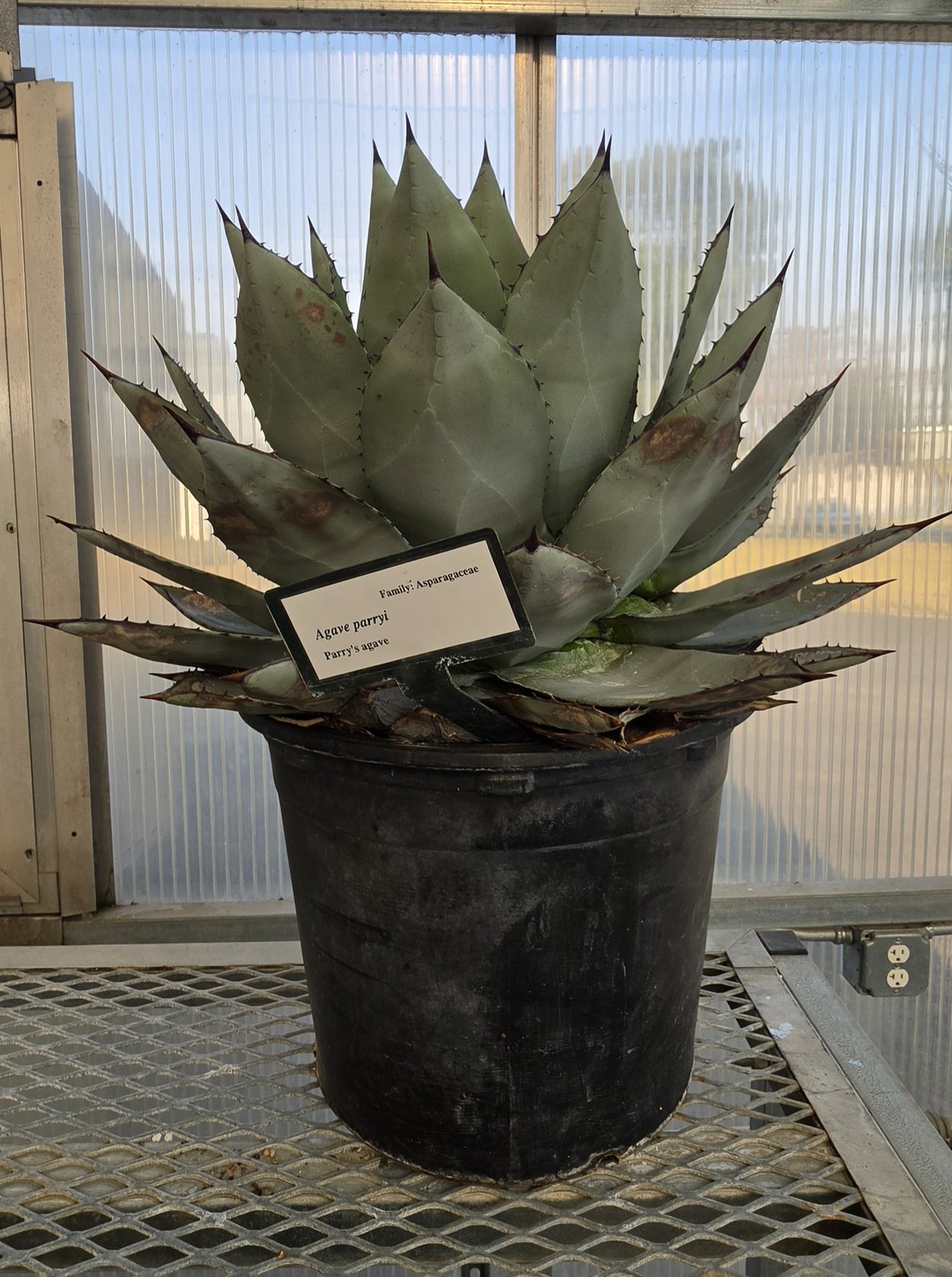
Agave parryi · Parry's agave
CON-0089
📍 Location not set
Identification
Agave parryi · Parry's agave
The plant has a compact, symmetrical rosette of thick, broad, glaucous blue-gray leaves with dark reddish-brown terminal spines and small marginal teeth along the leaf edges, characteristic of Agave parryi. This identification is confirmed by the visible plant label in the photo, which reads 'Agave parryi, Parry's agave, Family: Asparagaceae.' The overall growth habit—a dense, symmetrical, artichoke-like rosette—is also consistent with this species. Similar species that could be confused without the label include Agave havardiana and Agave parryi var. truncata, which share similar coloration and rosette shape but differ subtly in leaf width and imbrication.
Generated 2026-08-14 23:59 by anthropic (claude-sonnet-5).
Health
Care Information
- Light
- Full sun to very bright light; needs at least a half day of direct sun to maintain compact, tight rosette form.
- Water
- Water deeply then let soil dry out completely, roughly every 2-3 weeks; cut back significantly in winter to monthly or less.
- Nutrients
- Light feeding with a diluted cactus/succulent fertilizer once or twice during the growing season (spring-summer); avoid heavy feeding which causes leggy growth.
- Repotting
- Repot every 3-4 years or when it outgrows its container; this slow grower doesn't need frequent repotting.
- Soil media
- Very well-draining cactus/succulent mix, ideally amended with extra pumice or coarse sand.
- Temp & humidity
- Prefers 65-85F and tolerates brief cold snaps down to the low 20sF once mature; low humidity is fine, this is a desert-adapted xerophyte.
- Temperature range
- 🌡️ 55-90F
- Humidity range
- 💦 10-30%
- Care group
- 🏷️ Bright & Dry
- Toxicity
- Sap can cause skin irritation/contact dermatitis in sensitive individuals; leaf tips are sharp and can puncture skin, so caution near foot traffic and use gloves when handling.
- Pests & diseases
- Generally trouble-free; watch for agave snout weevil (causes collapse of the center) and scale; root rot is the main risk if overwatered or kept in poorly draining soil.
- Propagation
- Not recorded
Generated 2026-08-16 06:46 by anthropic (claude-sonnet-5).