Kalanchoe tomentosa · Panda plant
CON-0086
📍 Location not set
Identification
Kalanchoe tomentosa · Panda plant
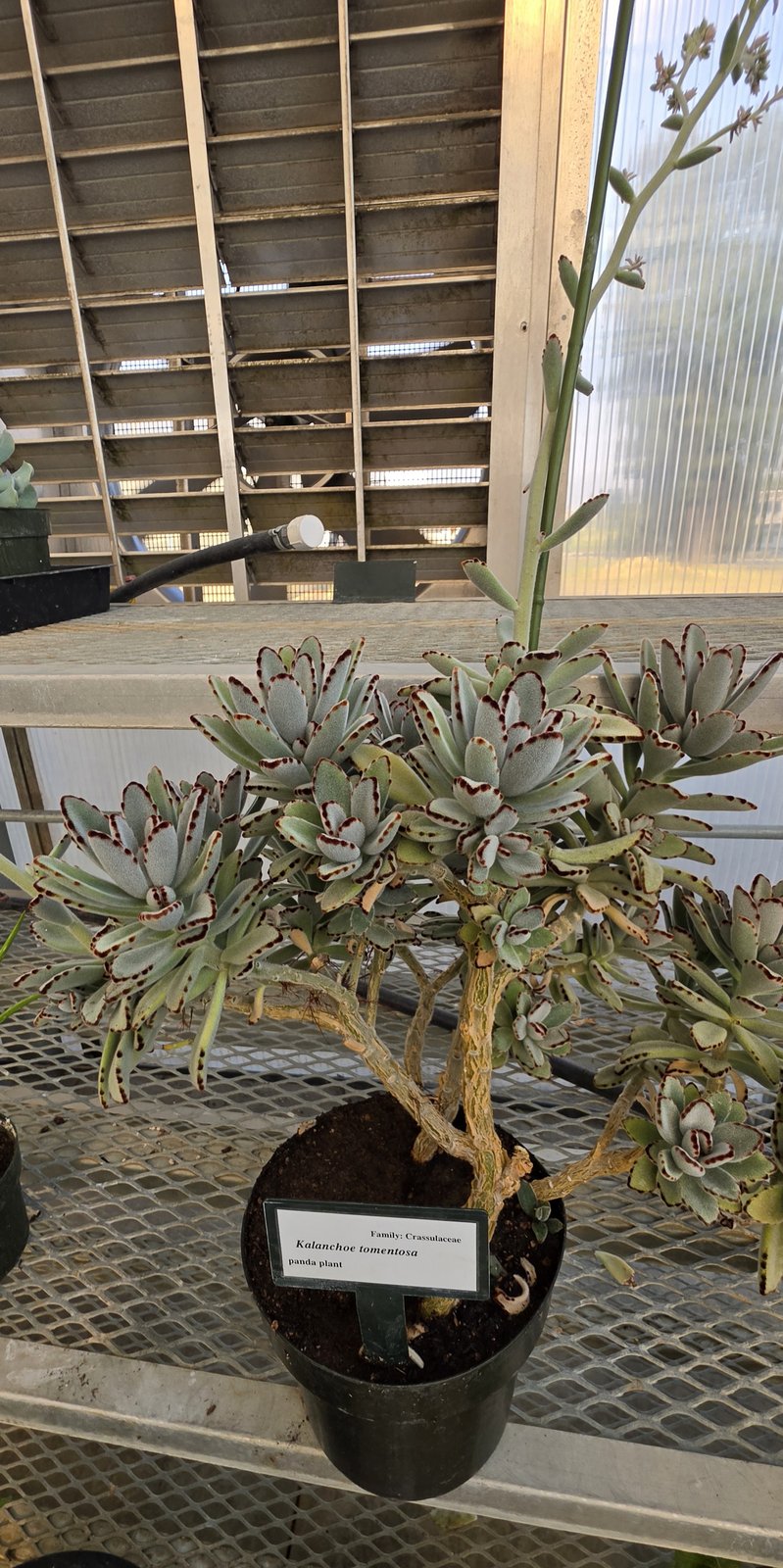
The plant has a visible identification label reading 'Family: Crassulaceae, Kalanchoe tomentosa, panda plant.' This matches the visual characteristics: fuzzy, felted silver-green leaves with distinctive dark brown/maroon spotted margins arranged in rosettes, a woody branching stem, and a tall flowering stalk emerging from the top consistent with Kalanchoe tomentosa's occasional bloom. The dense trichome covering giving the leaves a velvety appearance is a hallmark of this species, distinguishing it from similar Kalanchoe species like K. beharensis (which has larger, less spotted leaves) or K. millotii (which lacks the dark leaf margin markings).
Generated 2026-08-27 20:41 by anthropic (claude-sonnet-5).
Health
Care Information
- Light
- Bright light with some direct sun, especially morning sun; a south or west-facing window is ideal.
- Water
- Allow soil to dry out completely between waterings; water thoroughly then let dry, roughly every 2-3 weeks depending on season. Reduce watering significantly in winter.
- Nutrients
- Feed with a diluted balanced or cactus/succulent fertilizer monthly during spring and summer; skip fertilizing in fall and winter.
- Repotting
- Repot every 2 years or when rootbound, ideally in spring; this species has a shallow root system and doesn't need deep pots.
- Soil media
- Cactus/succulent mix with excellent drainage; add extra perlite or pumice if needed.
- Temp & humidity
- 65-80F; low humidity is fine (30-50%) - this plant tolerates dry indoor air well and prefers it over high humidity.
- Temperature range
- 🌡️ 65-80F
- Humidity range
- 💦 30-50%
- Care group
- 🏷️ Bright & Dry
- Toxicity
- Contains bufadienolide compounds that are toxic if ingested by pets or people; keep away from curious pets and small children.
- Pests & diseases
- Watch for mealybugs and aphids nestled in the fuzzy leaf texture; root rot and stem rot are common if overwatered or soil doesn't drain well.
- Propagation
- Leaf cuttings root easily -- let a leaf dry/callus for a day or two, then lay on well-draining soil until roots and a plantlet form. Stem cuttings also work well.
Generated 2026-08-27 20:41 by anthropic (claude-sonnet-5).