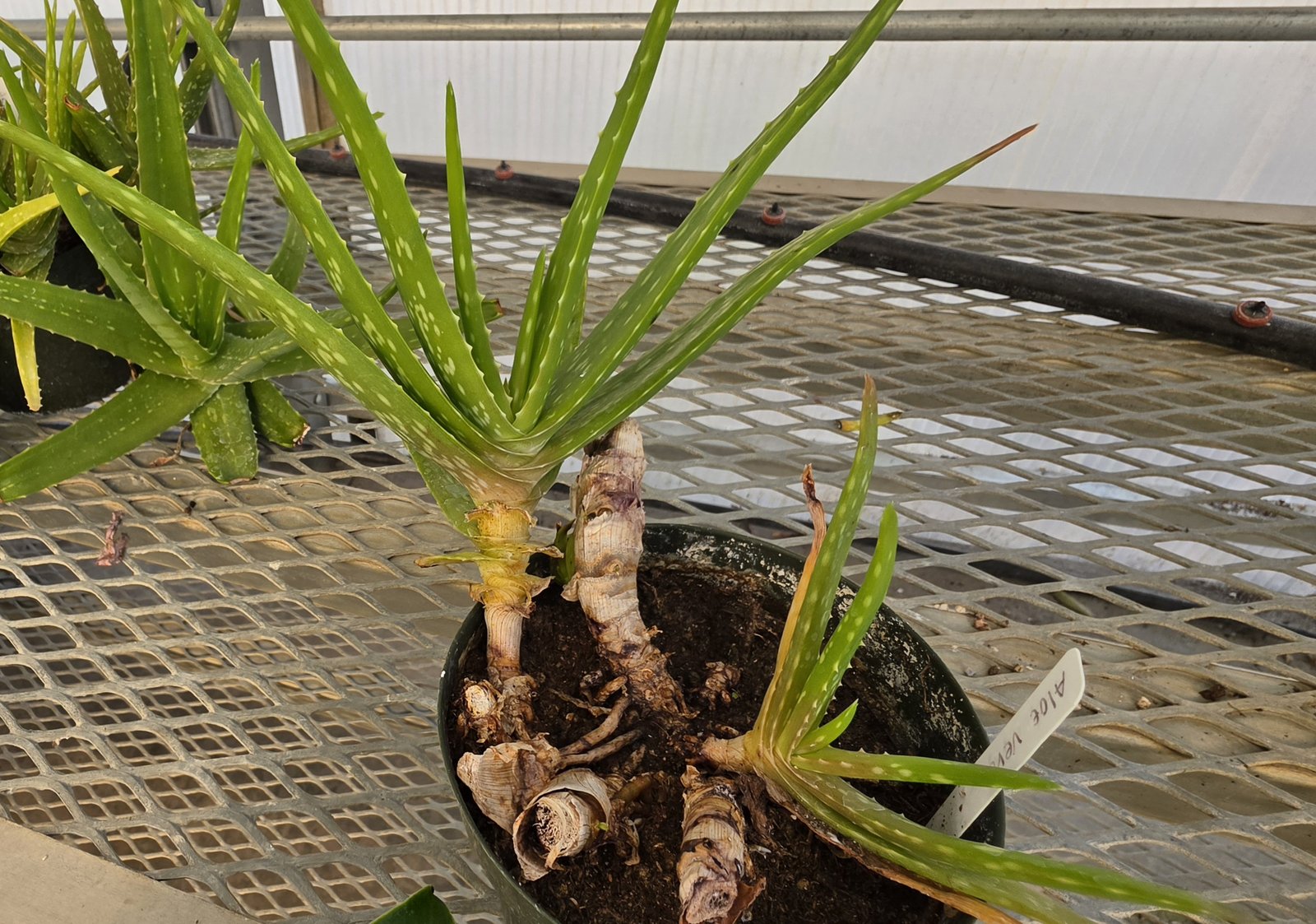
Aloe vera · Aloe vera
CON-0085
📍 Location not set
Identification
Aloe vera · Aloe vera
The plant shows the characteristic rosette of thick, fleshy, lance-shaped leaves with white flecking/spotting on a green background and small soft marginal teeth typical of juvenile Aloe vera. The growth habit includes multiple offset pups/rhizomatous stems emerging from soil around the main rosette, consistent with Aloe vera's clonal offsetting habit. Additionally, there is a plant label visible in the pot reading 'Aloe ver...' which corroborates the identification. Similar species to rule out include Aloe arborescens (lacks the white spotting and has narrower, more numerous leaves) and Aloe maculata/saponaria (which has more pronounced, permanent white spotting even in mature leaves and a more compact rosette), but the overall leaf shape, coloration, and the visible label strongly support Aloe vera.
Generated 2026-08-27 20:43 by anthropic (claude-sonnet-5).
Health
Care Information
- Light
- Bright light, ideally with several hours of direct or near-direct sun; a sunny south/west-facing window or bright greenhouse spot works well.
- Water
- Deep watering only when soil is completely dry, roughly every 2-3 weeks; reduce further in winter dormancy. Overwatering is the most common cause of death.
- Nutrients
- Light feeding with a diluted balanced or cactus/succulent fertilizer once a month during spring/summer growing season; skip fertilizer entirely in fall/winter.
- Repotting
- Repot every 2-3 years or when the plant becomes top-heavy or overcrowded with pups; best done in spring using fresh dry mix.
- Soil media
- Cactus/succulent mix with extra perlite or pumice for sharp drainage; never let it stay soggy.
- Temp & humidity
- 65-80F; low humidity is fine (10-40%) as this is an arid-adapted succulent -- no misting needed.
- Temperature range
- 🌡️ 65-80F
- Humidity range
- 💦 10-40%
- Care group
- 🏷️ Bright & Dry
- Toxicity
- Gel is used topically/medicinally in humans, but the plant is mildly toxic if ingested by pets (dogs, cats) causing vomiting or diarrhea; keep away from curious pets.
- Pests & diseases
- Generally trouble-free; watch for mealybugs and scale, and root rot from overwatering or poorly draining soil.
- Propagation
- Very easy via offsets ('pups') that form at the base -- separate once they have their own roots and pot in dry cactus mix, waiting a few days before first watering to let cuts callus.
Generated 2026-08-27 20:43 by anthropic (claude-sonnet-5).