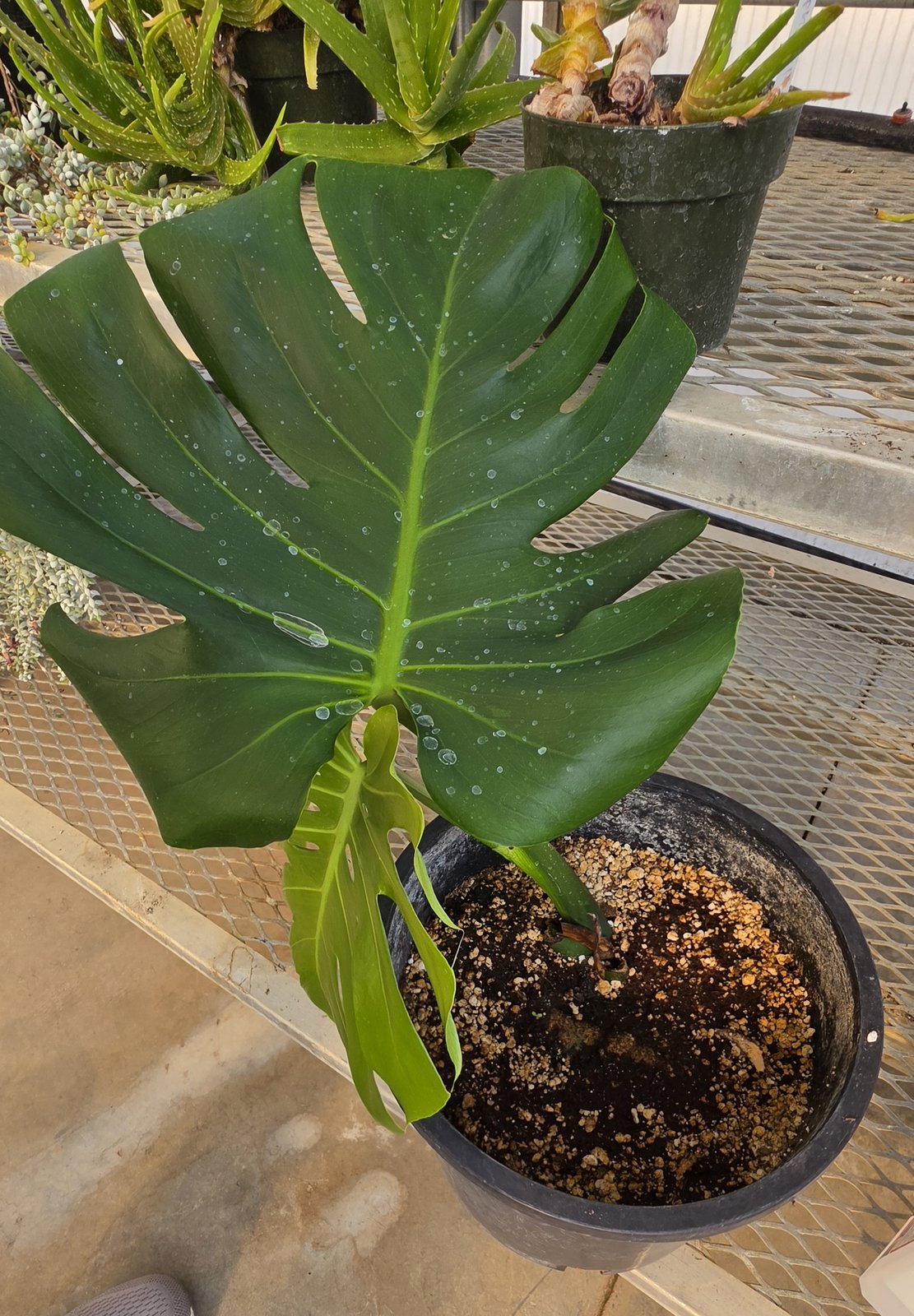
Monstera deliciosa · Swiss cheese plant
CON-0084
📍 Location not set
Identification
Monstera deliciosa · Swiss cheese plant
The leaf shows deep pinnate marginal lobing combined with what appear to be elongated internal perforations (fenestrations) between the primary veins on the right lobes, rather than lobes that are only split to the margin as in Thaumatophyllum bipinnatifidum. The glossy, dark green, leathery blade, the pronounced pale midrib and secondary veins, and the newly emerging paler juvenile leaf at the base (which shows a similar but less deeply cut pattern typical of young Monstera foliage) are consistent with Monstera deliciosa rather than a Philodendron/Thaumatophyllum, which typically shows only marginal incisions without true perforations. I'm not fully certain because the photo angle makes it hard to confirm true holes versus just deep marginal sinuses, and juvenile Monstera can resemble juvenile Thaumatophyllum or even Epipremnum in some stages. A clearer photo showing the underside of the leaf, the petiole geniculum (swollen joint where petiole meets blade), or a shot confirming actual through-holes in the blade (versus edge-to-edge splits) would help confirm this over similar-looking aroids such as Monstera adansonii (which has smaller, more numerous round holes) or juvenile Thaumatophyllum species.
Generated 2026-08-15 05:44 by anthropic (claude-sonnet-5).
Health
Care Information
- Light
- Bright, indirect light is ideal; can tolerate medium light but growth slows and leaf fenestration decreases. Avoid direct midday sun which can scorch leaves.
- Water
- Water when the top 1-2 inches of soil are dry, roughly every 7-10 days; reduce frequency in winter. Very sensitive to overwatering -- ensure the pot drains well.
- Nutrients
- Balanced liquid fertilizer every 4 weeks during spring/summer growing season; suspend feeding in fall and winter.
- Repotting
- Repot every 2 years or when roots fill the pot, ideally in spring; provide a moss pole or stake as it matures for aerial roots to climb.
- Soil media
- Well-draining, chunky aroid mix -- standard potting soil amended with bark, perlite, and some charcoal.
- Temp & humidity
- 65-85F; moderate to high humidity (50-60%) is ideal, though it tolerates average room humidity reasonably well.
- Temperature range
- 🌡️ 65-85F
- Humidity range
- 💦 50-60%
- Care group
- 🏷️ Bright & Humid
- Toxicity
- Contains calcium oxalate crystals; toxic if chewed or ingested by pets or people, causing mouth/throat irritation -- keep away from unattended foot traffic and curious pets.
- Pests & diseases
- Generally hardy; watch for spider mites and mealybugs in dry conditions, and scale on stems/leaves. Root rot is the main risk if overwatered or soil stays soggy.
- Propagation
- Not recorded
Generated 2026-08-15 05:44 by anthropic (claude-sonnet-5).