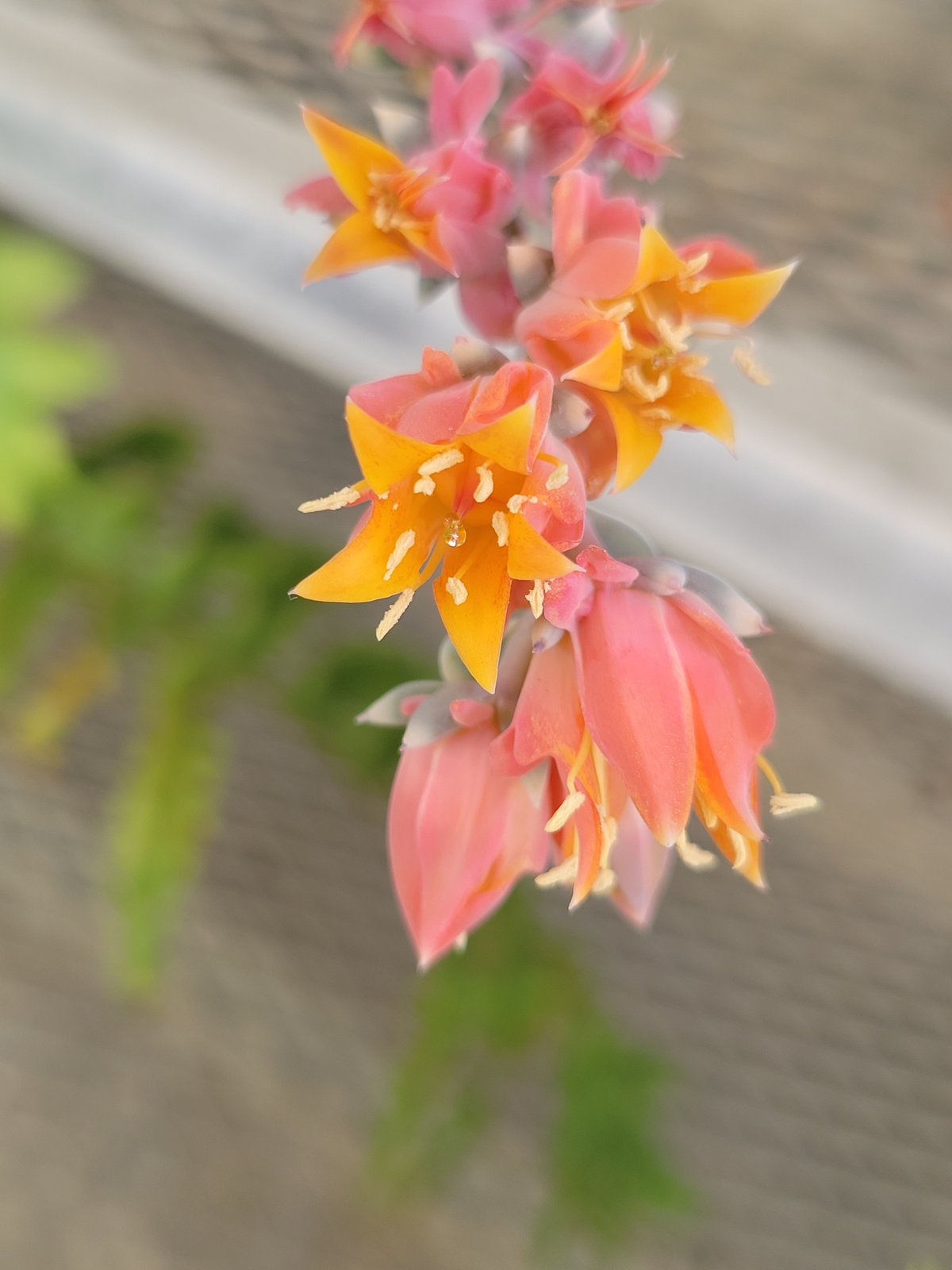
Echeveria runyonii 'Topsy Turvy' · Topsy Turvy Echeveria
CON-0081
📍 Location not set
Identification
Echeveria runyonii 'Topsy Turvy' · Topsy Turvy Echeveria
The plant shows the characteristic rosette growth habit of Echeveria with thick, fleshy, spoon-shaped leaves that curl/cup inward along their length (a hallmark of the 'Topsy Turvy' cultivar, where leaves fold upward like a scoop rather than lying flat). The leaf color is a powdery blue-green, consistent with runyonii's glaucous coating. The plant has multiple rosettes branching off an elongated, somewhat etiolated stem with dried leaf scars, suggesting it has stretched (possibly from lower light) and is producing offsets, which is typical of mature runyonii specimens. There is also a plant tag in the adjacent pot reading 'Echeveria Topsy Turvy', and this tag likely applies to this pot as well, supporting the identification. The leaf tips appear slightly more pointed than perfectly rounded, but overall the spoon/cupped leaf shape and coloration are consistent with this cultivar rather than other similar Echeverias like E. 'Lola' or E. secunda, which tend to have flatter or differently shaped leaves. I cannot rule out a very similar hybrid cultivar with complete certainty without a clearer flower or closer leaf margin view, so I am marking confidence as probable rather than certain.
Generated 2026-10-06 05:02 by anthropic (claude-sonnet-5).
Health
Care Information
- Light
- Bright light is essential; place in full sun to bright indirect light near a south or west-facing window. Some direct sun is tolerated and helps maintain compact, colorful rosette shape.
- Water
- Water deeply then let soil dry out completely before watering again, using the soak-and-dry method typical of succulents. Reduce watering significantly in winter when growth slows.
- Nutrients
- Feed sparingly with a diluted balanced fertilizer (quarter to half strength) once a month during spring and summer growing season only.
- Repotting
- Repot every 2 years or when the rosette outgrows its pot, ideally in spring; this species offsets and forms clusters so division may be needed to manage size.
- Soil media
- Fast-draining cactus/succulent mix, ideally amended with extra perlite or pumice for sharp drainage.
- Temp & humidity
- 60-80F; low humidity (30-40%) is fine -- this is a desert-adapted succulent and does not want a humid environment.
- Temperature range
- 🌡️ 60-80F
- Humidity range
- 💦 30-40%
- Care group
- 🏷️ Bright & Dry
- Toxicity
- No known toxicity concerns; generally considered safe for pets and people, though ingestion of large quantities is not advisable.
- Pests & diseases
- Watch for mealybugs nestled in leaf crevices and root mealybugs; root rot is the biggest risk if overwatered or kept in poorly draining soil.
- Propagation
- Propagates readily from leaf cuttings (lay a healthy leaf on dry soil, let it callus, plantlets form at the base) or from offsets/pups separated with roots attached.
Generated 2026-08-31 16:30 by anthropic (claude-sonnet-5).