Aloe vera · Aloe vera (True Aloe)
CON-0078
📍 Location not set
Identification
Aloe vera · Aloe vera (True Aloe)
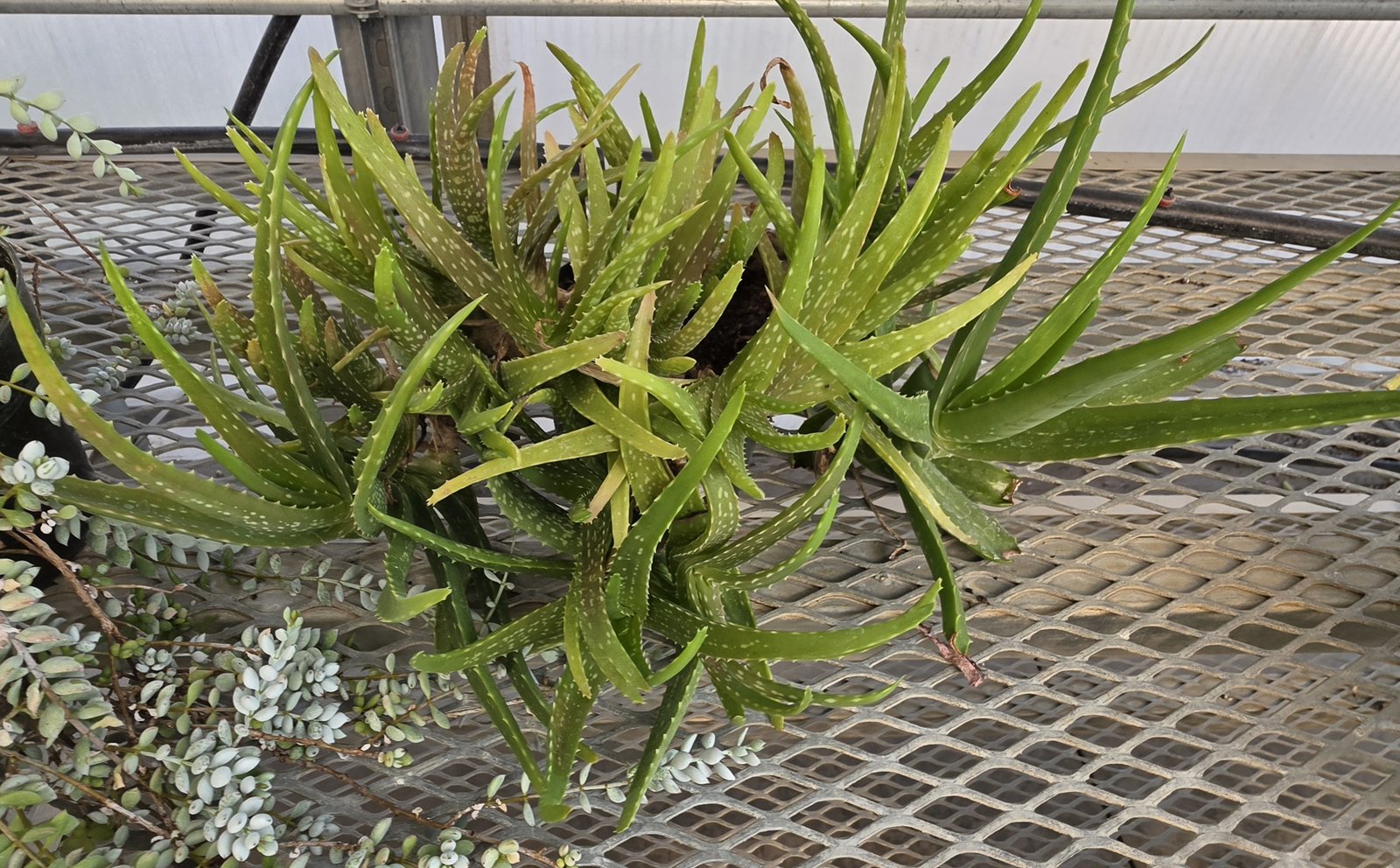
The plant shows a dense, clumping mass of narrow, lance-shaped, somewhat twisted leaves with fine marginal teeth and pale, elongated white speckling on the leaf surface - a pattern common in juvenile or crowded Aloe vera plants (mature plants often lose most of the spotting, but container-grown or younger offsets frequently retain faint speckles like these). The leaves are more slender, upright, and less flattened/triangular than typical Aloe maculata, and the clustering habit with numerous basal offsets pupping tightly together is very characteristic of Aloe vera's vegetative propagation pattern. Aloe maculata (already ruled out) typically has broader, more strongly flattened, triangular leaves with bolder, more distinct H-shaped white blotches and a more rosette-flat growth form, which doesn't match the narrower, more strap-like leaves seen here. Other aloes to rule out for confidence would include Aloe saponaria (a maculata synonym, already excluded) and possibly hybrid nursery aloes, but the overall leaf width, coloration, and clumping habit align best with Aloe vera. A clearer photo of a single leaf cross-section, the leaf base attachment, or ideally a flower/inflorescence (Aloe vera has yellow tubular flowers on a simple raceme) would help confirm this identification with higher certainty.
Generated 2026-08-27 20:47 by anthropic (claude-sonnet-5).
Health
Care Information
- Light
- Bright light, ideally a sunny windowsill or spot with several hours of direct or strong indirect sun daily; can scorch slightly if moved abruptly from low light to intense direct sun.
- Water
- Water deeply then let soil dry out completely before watering again, roughly every 2-3 weeks; reduce further in winter. Very susceptible to root rot from overwatering.
- Nutrients
- Light feeding with a diluted balanced or cactus/succulent fertilizer once or twice during the growing season (spring-summer); not needed in winter.
- Repotting
- Repot every 2-3 years or when it outgrows its pot and offsets crowd the base; spring is the best time.
- Soil media
- Cactus/succulent mix with excellent drainage; add extra perlite or pumice if using standard potting soil.
- Temp & humidity
- 65-80F; tolerates low humidity well and does not need misting -- average room humidity is fine.
- Temperature range
- 🌡️ 65-80F
- Humidity range
- 💦 20-40%
- Care group
- 🏷️ Bright & Dry
- Toxicity
- Gel is used medicinally but the whole-leaf latex/sap is mildly toxic if ingested by pets (dogs, cats) causing vomiting or diarrhea; keep away from curious pets.
- Pests & diseases
- Generally trouble-free; watch for mealybugs and scale, and root rot if overwatered or kept in poorly draining soil.
- Propagation
- Very easy from offsets (pups) -- separate rooted pups from the base of the mother plant and pot individually.
Generated 2026-08-27 20:47 by anthropic (claude-sonnet-5).