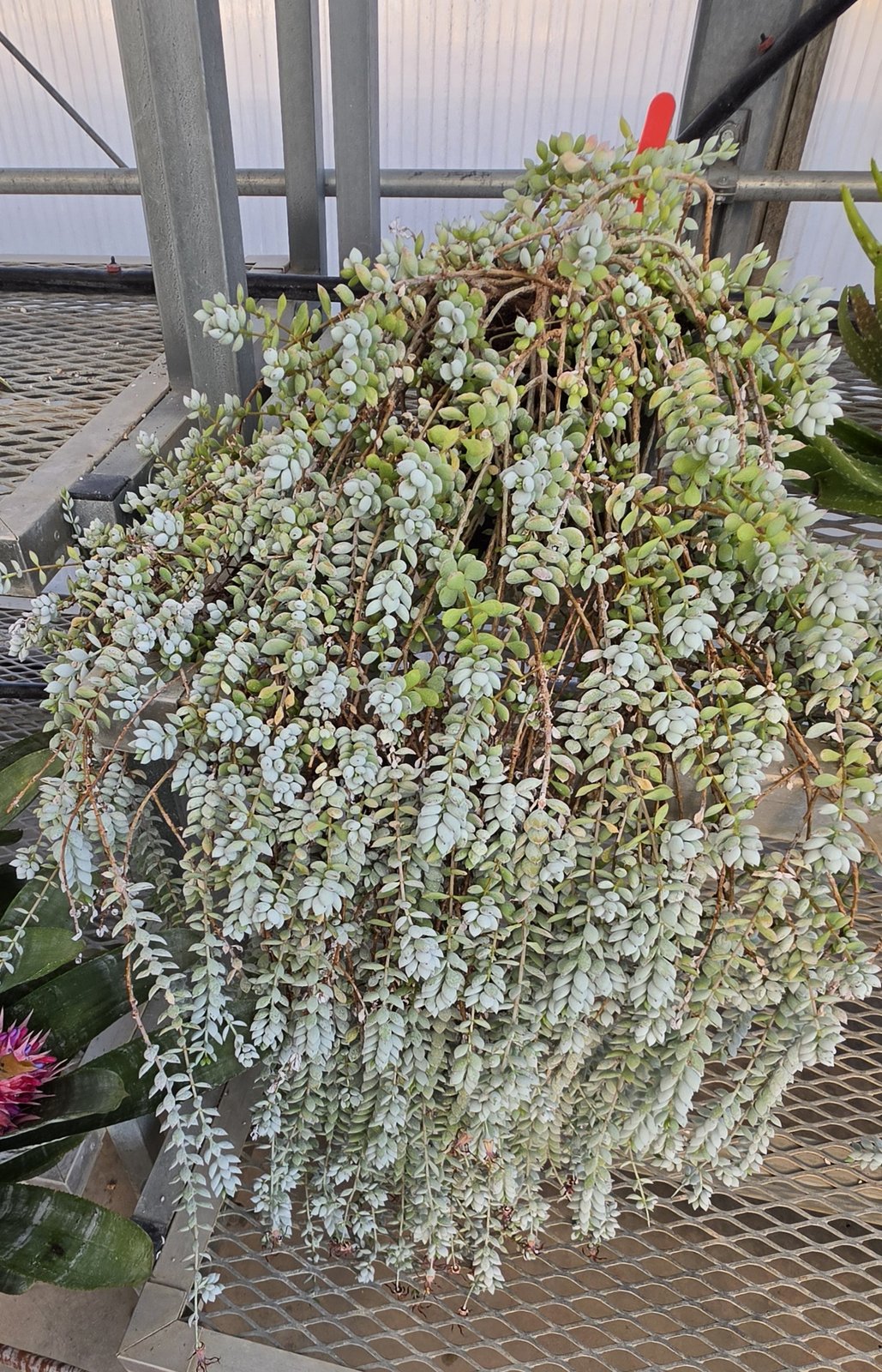
Sedum burrito · Burro's Tail (Baby Donkey Tail)
CON-0077
📍 Location not set
Identification
Sedum burrito · Burro's Tail (Baby Donkey Tail)
The plant shows dense, trailing succulent stems covered in tightly packed, plump, ovoid-oblong glaucous blue-green leaves, forming long cascading strands typical of a hanging basket succulent. This growth habit and leaf shape strongly resemble Sedum burrito (Burro's Tail), which has shorter, more rounded/oval leaves compared to the more cylindrical, pointed leaves of the closely related Sedum morganianum (Donkey's Tail). The leaves here appear somewhat plump and slightly flattened rather than tightly cylindrical, favoring S. burrito, though some fallen/browning leaves and stem dieback suggest stress or rough handling. Similar species to rule out: Sedum morganianum (longer, more pointed leaves), Sedum treleasei, or Graptopetalum/Sedeveria hybrids with similar glaucous coloring. A close-up of individual leaf shape (rounded vs. tapered tip) and any flower clusters (pink/red star-shaped flowers for S. burrito) would help confirm the exact species.
Generated 2026-08-27 20:34 by anthropic (claude-sonnet-5).
Health
Care Information
- Light
- Bright light is essential; a sunny windowsill or bright indirect light indoors, tolerates some direct sun especially morning sun.
- Water
- Allow soil to dry out completely between waterings; water thoroughly then let it dry again, roughly every 10-14 days, less in winter.
- Nutrients
- Light feeding with a diluted balanced or cactus/succulent fertilizer monthly during spring and summer; skip fertilizing in winter.
- Repotting
- Repot every 2-3 years or when it outgrows its container; the trailing stems mean a hanging pot or elevated position works well long-term.
- Soil media
- Cactus/succulent mix with excellent drainage; add extra perlite or pumice if the base mix retains too much moisture.
- Temp & humidity
- 65-80F; low to moderate humidity is fine -- this succulent prefers dry air over humid conditions.
- Temperature range
- 🌡️ 65-80F
- Humidity range
- 💦 20-40%
- Care group
- 🏷️ Bright & Dry
- Toxicity
- Not known to be significantly toxic to pets or people, though as with most succulents ingestion in large amounts could cause mild GI upset; safe for general public display.
- Pests & diseases
- Generally trouble-free; watch for mealybugs in leaf axils and root/stem rot from overwatering or poor drainage. Leaves drop easily if bumped -- handle with care.
- Propagation
- Very easy from leaf or stem cuttings -- let a dropped leaf or stem section callus for a day or two, then lay on top of dry succulent mix until roots and a new rosette form.
Generated 2026-08-27 20:34 by anthropic (claude-sonnet-5).