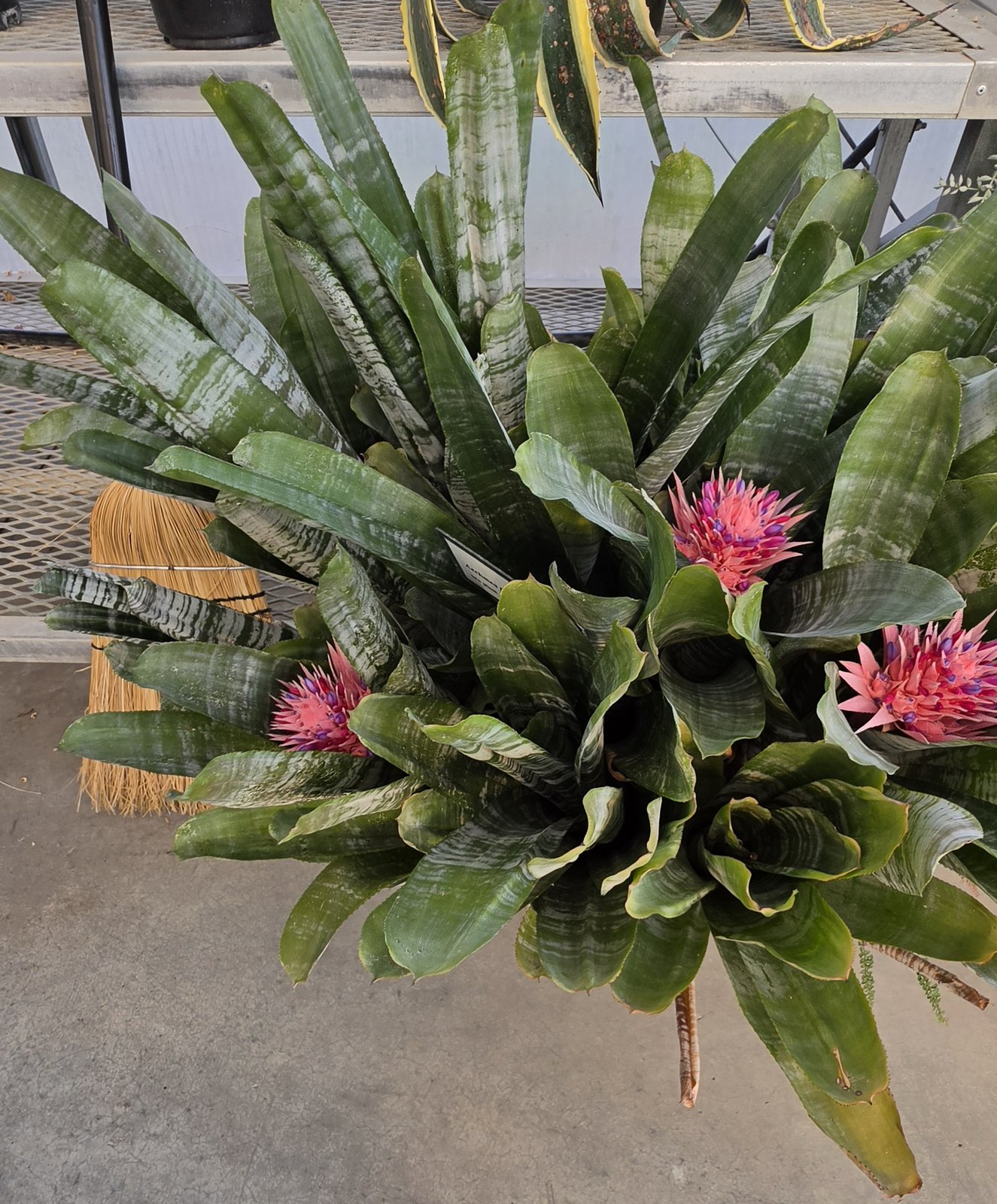
Aechmea fasciata · Silver Vase Bromeliad / Urn Plant
CON-0076
📍 Location not set
Identification
Aechmea fasciata · Silver Vase Bromeliad / Urn Plant
The rosette-forming succulent-like leaves with distinctive silvery-gray horizontal banding on a dark green background are highly characteristic of Aechmea fasciata. The pink, spiky bracts emerging from the leaf axils (which will later produce small blue/purple flowers) are also classic for this species - the pink inflorescence with pointed bracts is a hallmark feature. The broad, strap-like leaves arranged in a tank-forming rosette that holds water at the base is typical bromeliad architecture. Other Aechmea species or hybrids (like Aechmea 'Blue Tango' or other fasciata cultivars) could look similar, so I can't rule out a closely related cultivar with full certainty. A clearer view of the mature inflorescence with visible flowers, plus the exact leaf margin (spines are typically present but hard to see clearly here), would help confirm species versus a similar banded Aechmea hybrid. Note: the sword-like variegated leaves in the background (upper part of photo) belong to a different plant (likely Sansevieria/Dracaena trifasciata) and are not part of the bromeliad specimen being identified - I focused on the pink-flowering bromeliad rosette as the primary subject.
Generated 2026-08-24 23:06 by anthropic (claude-sonnet-5).
Health
Care Information
- Light
- Bright, indirect light; some direct morning sun is fine but protect from harsh midday sun which can scorch the silvery foliage.
- Water
- Keep the central 'vase' (cup formed by the leaves) filled with water, flushing and refreshing it every 1-2 weeks to prevent stagnation; water the soil sparingly, only when it dries out, since this bromeliad absorbs most moisture through the leaf cup rather than roots.
- Nutrients
- Feed lightly with a diluted (quarter-strength) balanced liquid fertilizer poured into the central cup or misted onto leaves monthly during spring and summer; skip fertilizing in winter.
- Repotting
- Rarely needs repotting since the mother plant dies after flowering; repot only to size up an offset (pup) into fresh mix once it has its own roots.
- Soil media
- Chunky, fast-draining epiphytic mix -- orchid bark with some perlite -- as roots are mainly for anchorage, not water uptake.
- Temp & humidity
- 65-80F; prefers high humidity (50%+); mist surrounding air or group with other tropicals if conservatory zone runs dry.
- Temperature range
- 🌡️ 65-80F
- Humidity range
- 💦 50%+
- Care group
- 🏷️ Bright & Humid
- Toxicity
- No known toxicity concerns for pets or people; safe near visitor foot traffic.
- Pests & diseases
- Generally trouble-free; watch for scale and mealybugs, and avoid letting water sit stagnant too long in the cup to prevent rot or mosquito breeding.
- Propagation
- Propagate by division -- once the mother plant flowers and begins to decline, it produces offsets ('pups') at the base; let these grow to about a third the size of the parent before separating with roots intact and potting individually.
Generated 2026-08-24 23:06 by anthropic (claude-sonnet-5).