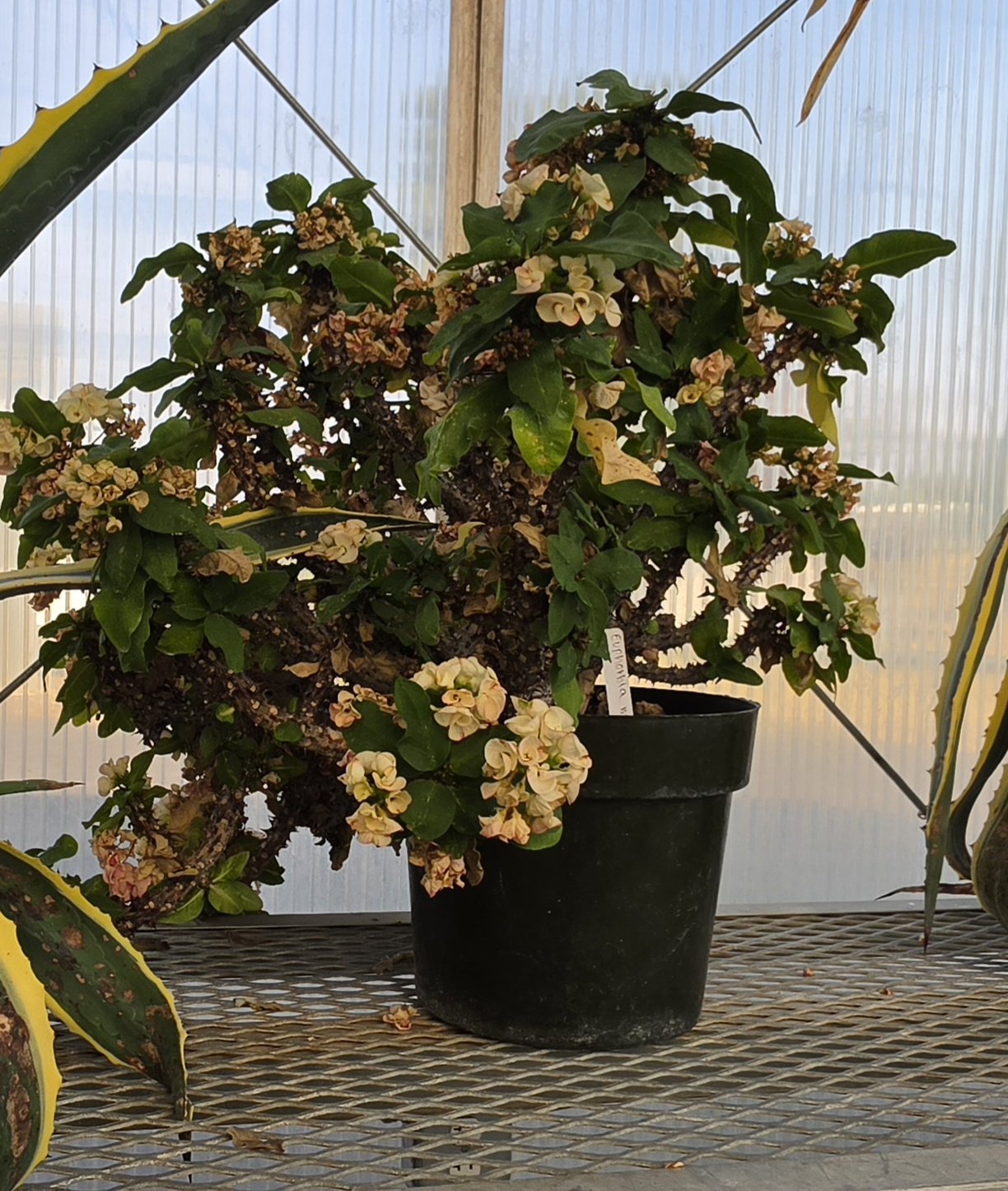
Euphorbia milii · Crown of Thorns
CON-0073
📍 Location not set
Identification
Euphorbia milii · Crown of Thorns
The plant label visible in the pot reads 'Euphorbia mi...' confirming the genus. Visual features support this: thick, spiny, dark woody stems covered in sharp thorns, thin oval-shaped simple leaves clustered near stem tips, and clusters of small flowers with pale cream/yellowish bracts (cyathia) typical of Euphorbia milii. The sprawling, somewhat leggy and stressed growth habit with many leaves showing yellowing/necrosis suggests the plant is in poor health, possibly from underwatering, poor light, or root stress - consistent with the note that the plant may not be in ideal condition. Confidence is 'probable' rather than 'certain' because the specific cultivar (there are many Euphorbia milii cultivars with varying bract colors) cannot be determined, and without full label legibility, closely related Euphorbia species like E. lophogona could resemble this if the label were absent. A clearer photo of the label or a close-up of the flower bracts would help confirm exact cultivar.
Generated 2026-08-26 21:05 by anthropic (claude-sonnet-5).
Health
Care Information
- Light
- Bright light, ideally 4+ hours of direct or strong sun daily; leggy growth and poor flowering result from too little light.
- Water
- Let soil dry out fully between waterings; water thoroughly then wait. Reduce watering significantly in winter to nearly monthly.
- Nutrients
- Balanced liquid fertilizer diluted to half-strength monthly during spring-summer growth; skip feeding in winter.
- Repotting
- Repot every 2-3 years in spring, or when rootbound; handle with thick gloves due to spines and sap.
- Soil media
- Cactus/succulent mix with extra perlite or coarse sand for sharp drainage.
- Temp & humidity
- 65-85F; low to moderate humidity is fine -- this succulent tolerates dry indoor/conservatory air well.
- Temperature range
- 🌡️ 65-85F
- Humidity range
- 💦 30-50%
- Care group
- 🏷️ Bright & Dry
- Toxicity
- Milky sap is toxic and can cause skin/eye irritation and is toxic if ingested by pets or people; wear gloves and eye protection when pruning, and site away from heavy public handling.
- Pests & diseases
- Generally trouble-free; watch for mealybugs and spider mites, and root rot if overwatered or kept in poorly draining soil.
- Propagation
- Stem cuttings root readily; let the cut end callus/dry for a few days before placing in dry succulent mix to avoid rot, and wear gloves for the irritating sap.
Generated 2026-08-26 21:05 by anthropic (claude-sonnet-5).