Echeveria agavoides · Lipstick Echeveria
CON-0070
📍 Location not set
Identification
Echeveria agavoides · Lipstick Echeveria
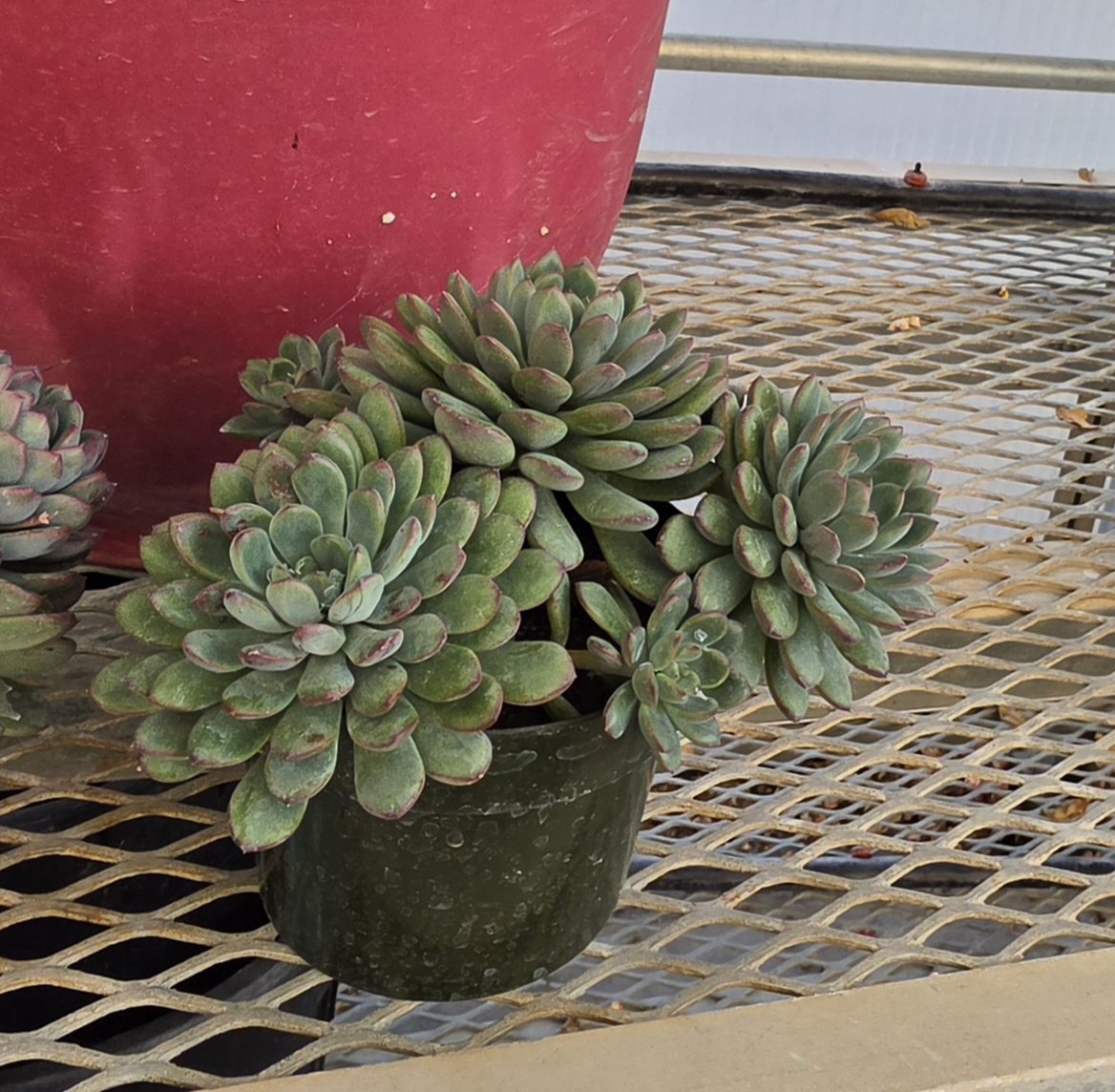
The plant forms tight, symmetrical rosettes of thick, fleshy, triangular leaves that come to a distinct pointed tip. The leaf margins show a reddish/maroon edge, which is characteristic of the 'lipstick' coloration seen in Echeveria agavoides, especially under bright light or slight stress. The overall rosette shape is more angular and pointed than the rounder-leaved Echeveria elegans, and the leaves are not as club-shaped as Echeveria pulvinata or Graptopetalum species. Multiple offsets/pups are visible clustering around the main rosette, consistent with this species' typical clumping growth habit. However, without a flower or clearer view of leaf texture (glossy vs. slightly powdery), I cannot rule out closely related cultivars such as Echeveria agavoides 'Red Edge' or hybrids like Echeveria 'Blue Curls', which share similar coloring and form. A closer photo of a single leaf showing surface texture (matte/farina vs glossy) and any flower stalk would help confirm the exact species/cultivar.
Generated 2026-08-27 15:56 by anthropic (claude-sonnet-5).
Health
Care Information
- Light
- Bright light is essential; several hours of direct sun (morning sun is ideal) will keep the rosette compact and bring out red leaf-tip coloring, though intense afternoon summer sun through glass can scorch it.
- Water
- Soak thoroughly then let the soil dry out completely before watering again, roughly every 10-14 days; cut back to monthly or less in winter.
- Nutrients
- Feed sparingly with a diluted balanced or cactus/succulent fertilizer once a month during spring and summer growing season; skip feeding in fall and winter.
- Repotting
- Repot every 2-3 years or when the rosette outgrows its pot, ideally in spring; handle carefully as leaves detach easily.
- Soil media
- Cactus/succulent mix with extra perlite or pumice for sharp drainage.
- Temp & humidity
- 65-80F; low humidity (30-40%) is fine, this is a desert succulent that dislikes damp, stagnant air.
- Temperature range
- 🌡️ 65-80F
- Humidity range
- 💦 30-40%
- Care group
- 🏷️ Bright & Dry
- Toxicity
- No known toxicity concerns for pets or people.
- Pests & diseases
- Watch for mealybugs in leaf crevices; root and stem rot are the main risk if overwatered or soil stays soggy.
- Propagation
- Very easy from leaf cuttings -- gently twist off a healthy leaf, let it callus for a day or two, then lay on well-draining soil until roots and a plantlet form; offsets can also be separated and potted.
Generated 2026-08-27 15:57 by anthropic (claude-sonnet-5).