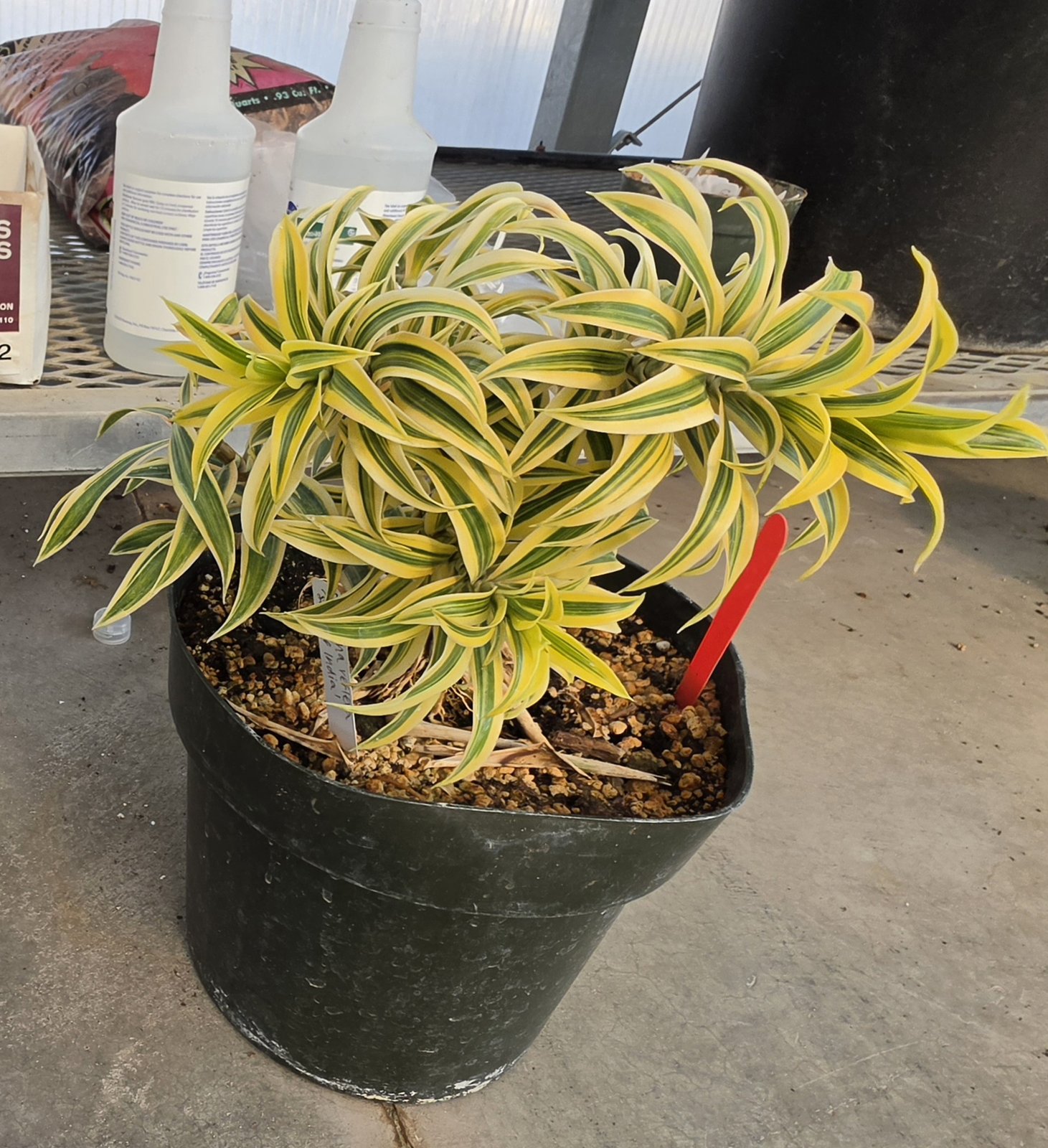
Dracaena reflexa var. angustifolia 'Variegata' · Song of India
CON-0066
📍 Location not set
Identification
Dracaena reflexa var. angustifolia 'Variegata' · Song of India
The plant shows dense whorls of narrow, strap-like, pointed leaves radiating outward from multiple rosette-like growth points, arranged in a spiral pattern typical of Dracaena reflexa. The leaves display strong yellow marginal variegation with a green central stripe, a hallmark of the 'Song of India' cultivar. Growth habit is compact and shrubby with woody stems visible at the base, consistent with juvenile Dracaena reflexa. There is also a partially visible plant tag in the pot reading what appears to be '...reflex... India,' supporting this identification. Similar species to rule out include Dracaena marginata (which has thinner, more linear leaves without the same spiral rosette density) and Pleomele/Dracaena angustifolia non-variegated forms. Confidence is 'probable' rather than 'certain' because the visible tag is partially obscured and cultivar name variations (e.g., 'Song of India' vs 'Variegata') can be inconsistently applied in trade.
Generated 2026-08-27 20:31 by anthropic (claude-sonnet-5).
Health
Care Information
- Light
- Bright, indirect light is best; tolerates medium light but variegation fades if too dark, and direct sun can scorch leaves.
- Water
- Allow the top 1-2 inches of soil to dry out between waterings, roughly every 10-14 days; reduce further in winter. Sensitive to overwatering and fluoride/chlorine in tap water, which can cause leaf tip burn.
- Nutrients
- Feed with a balanced liquid fertilizer diluted to half-strength monthly during spring and summer; skip fertilizing in fall and winter.
- Repotting
- Repot every 2-3 years in spring when rootbound, sizing up only one pot size at a time since this species prefers being slightly snug.
- Soil media
- Well-draining standard potting mix with added perlite or bark for aeration.
- Temp & humidity
- 65-80F; moderate to high humidity (40-60%) appreciated but tolerates average indoor humidity fine.
- Temperature range
- 🌡️ 65-80F
- Humidity range
- 💦 40-60%
- Care group
- 🏷️ Medium Light & Moderate Humidity
- Toxicity
- Toxic to cats and dogs if ingested (contains saponins), causing vomiting and drooling; keep away from pets and curious visitors.
- Pests & diseases
- Watch for spider mites and mealybugs, especially in dry conditions; scale can also appear. Root rot is the main risk if overwatered or left in soggy soil.
- Propagation
- Stem cuttings (canes) root readily in water or moist soil; cut a section with at least one node and allow the cut end to callus before placing in medium.
Generated 2026-08-27 20:31 by anthropic (claude-sonnet-5).