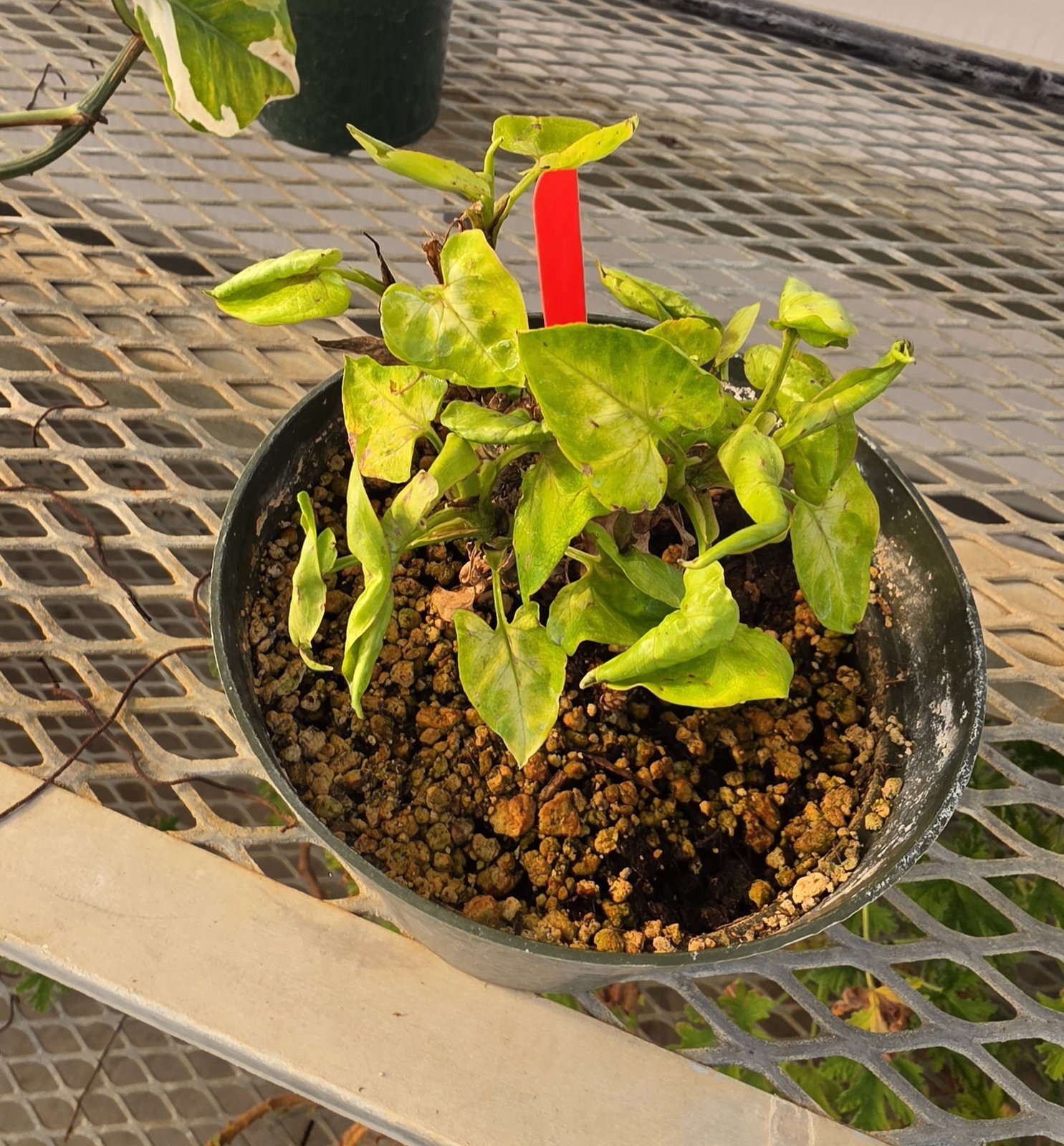
Syngonium podophyllum · Arrowhead plant
CON-0061
📍 Location not set
Identification
Syngonium podophyllum · Arrowhead plant
The leaves in this photo show a distinctly sagittate (arrow-shaped) form with basal lobes, rather than the simple ovate-cordate (heart-shaped) leaves typical of juvenile Epipremnum aureum, which was already ruled out. The overall chartreuse/yellow-green coloration with slightly darker green marbling, the compact non-climbing rosette habit, and the thin petioles are consistent with Syngonium podophyllum, especially a chartreuse cultivar like 'Neon' or 'Lime'. However, some leaves appear partially unfurled or stressed (possibly from underwatering or nutrient deficiency, given the yellowing and curling), which makes exact cultivar identification difficult. Similar look-alikes to rule out include Philodendron hederaceum (which has glossier, more uniformly heart-shaped leaves without arrow lobes) and young Alocasia/Caladium types, which usually have thicker, more rigid leaves with prominent central ribs. A clearer photo showing a mature leaf with fully developed lobes, the petiole attachment point, and any visible latex or sap when cut would help confirm the genus with more certainty.
Generated 2026-08-24 22:46 by anthropic (claude-sonnet-5).
Health
Care Information
- Light
- Bright, indirect light; tolerates medium light but variegation fades and growth slows in low light. Avoid direct sun which can scorch leaves.
- Water
- Water when the top 1-2 inches of soil are dry, roughly every 7-10 days; reduce frequency in winter.
- Nutrients
- Balanced liquid fertilizer diluted to half strength every 4 weeks during spring-summer growth; skip or reduce in winter.
- Repotting
- Repot every 1-2 years in spring, or when roots fill the pot; also a good time to provide a moss pole for climbing support.
- Soil media
- Well-draining aroid mix -- standard potting soil amended with perlite and orchid bark.
- Temp & humidity
- 65-80F; moderate to high humidity (50%+) preferred, but adapts reasonably well to average indoor conditions.
- Temperature range
- 🌡️ 65-80F
- Humidity range
- 💦 50%+
- Care group
- 🏷️ Bright & Humid
- Toxicity
- Contains calcium oxalate crystals; toxic if ingested by pets or people and sap can irritate skin/eyes -- wear gloves when pruning and keep away from public foot traffic.
- Pests & diseases
- Watch for spider mites, mealybugs, and scale, especially in dry air. Root rot can occur if overwatered or soil stays soggy.
- Propagation
- Stem cuttings with a node root readily in water or moist soil; this is the easiest and most reliable method.
Generated 2026-08-24 22:46 by anthropic (claude-sonnet-5).