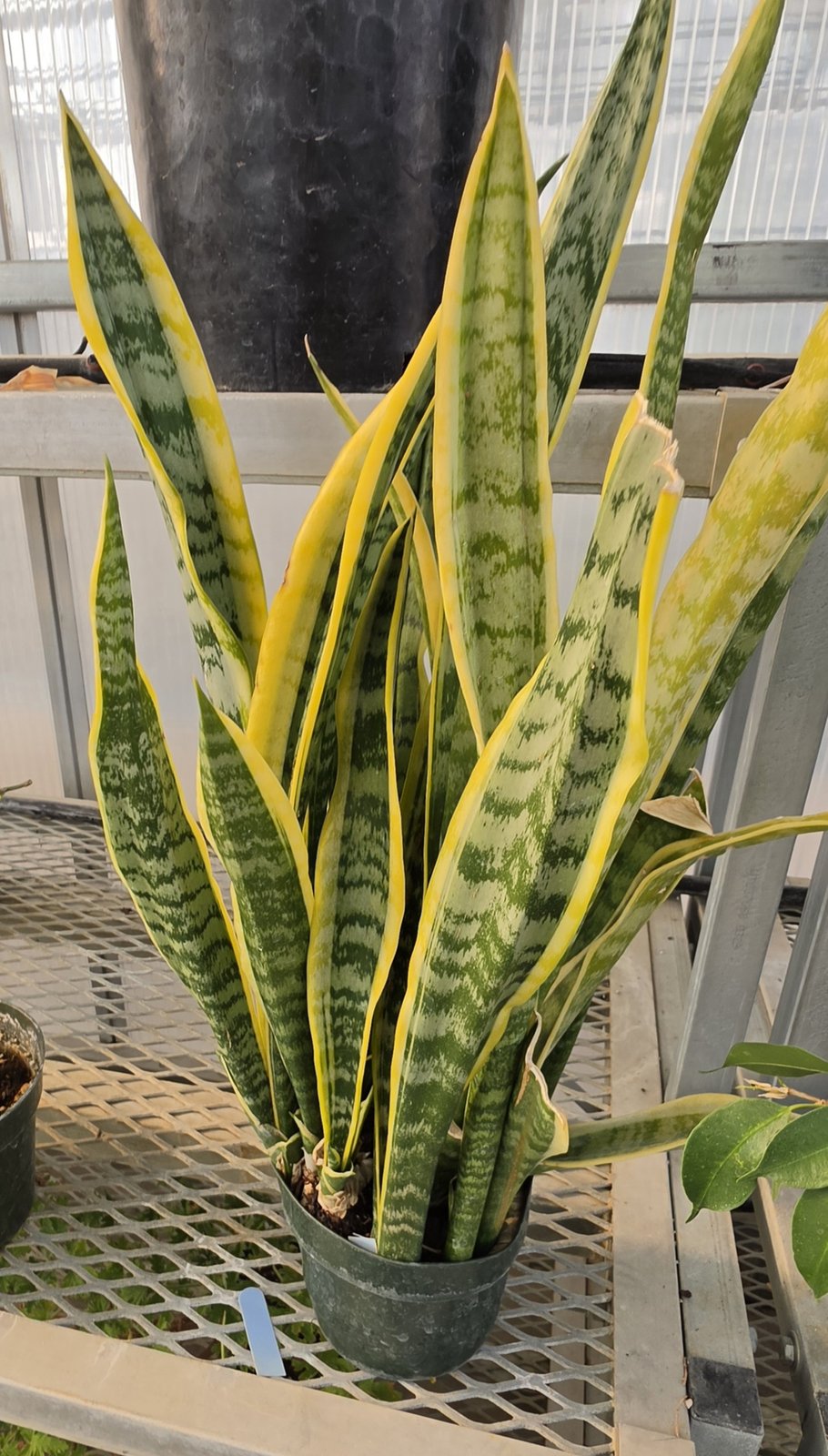
Dracaena trifasciata 'Laurentii' · Variegated Snake Plant / Mother-in-Law's Tongue
CON-0060
📍 Location not set
Identification
Dracaena trifasciata 'Laurentii' · Variegated Snake Plant / Mother-in-Law's Tongue
The plant shows tall, stiff, sword-like succulent leaves growing in a rosette from a basal cluster, with characteristic dark green horizontal mottled/banding patterns typical of Sansevieria trifasciata (now classified as Dracaena trifasciata). The bright yellow leaf margins running the full length of the leaves are the hallmark of the 'Laurentii' cultivar specifically. Leaf tips are pointed and slightly twisting, another typical trait. To confirm the exact cultivar versus similar variegated forms like 'Golden Hahnii' (which is more compact/rosette form) or 'Bantel's Sensation' (which has white vertical stripes rather than yellow margins), it would help to see the overall plant height/size and confirm there's no dwarf rosette habit. Overall growth habit and coloring strongly match D. trifasciata 'Laurentii'.
Generated 2026-08-14 01:17 by anthropic (claude-sonnet-5).
Health
Care Information
- Light
- Tolerates low light but grows best in bright indirect light; avoid intense direct sun which can bleach or scorch the leaves.
- Water
- Allow soil to dry out fully between waterings, roughly every 2-4 weeks; this plant is highly drought-tolerant and much more likely to suffer from overwatering than underwatering.
- Nutrients
- Feed with a diluted balanced liquid fertilizer once or twice during the growing season (spring-summer); little to no feeding needed in fall/winter.
- Repotting
- Repot only every 2-3 years or when clearly rootbound, as it prefers being slightly snug in its pot; use a well-draining potting mix.
- Soil media
- Well-draining potting mix formulated for cacti/succulents, or standard potting soil amended with extra perlite.
- Temp & humidity
- Prefers 65-85F and tolerates average room humidity well; no special humidity measures needed, making it flexible across different conservatory zones.
- Temperature range
- 🌡️ 65-85F
- Humidity range
- 💦 20-50%
- Care group
- 🏷️ Low Light & Dry
- Toxicity
- Mildly toxic if ingested by pets or people (contains saponins), which can cause nausea or vomiting; keep away from areas with grazing animals or curious small children.
- Pests & diseases
- Generally very trouble-free; occasional mealybugs or spider mites in dry conditions. Root rot is the main risk and almost always due to overwatering or poor drainage.
- Propagation
- Division of offsets/pups at the base during repotting is fastest and preserves variegation; leaf cuttings also root in soil or water but the 'Laurentii' yellow-edge variegation is usually lost and reverts to plain green.
Generated 2026-08-27 20:36 by anthropic (claude-sonnet-5).