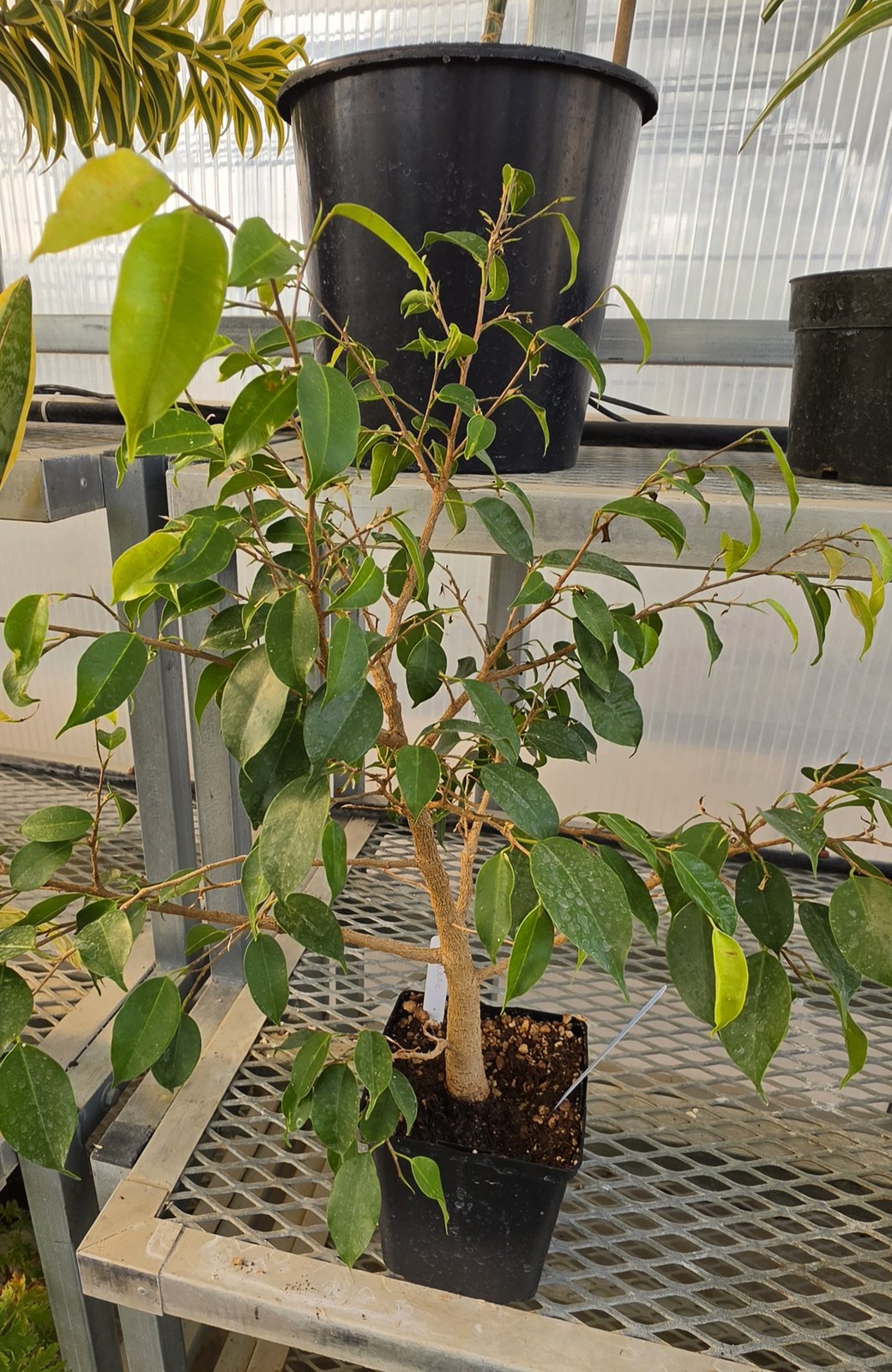
Ficus benjamina · Weeping Fig
CON-0059
📍 Location not set
Identification
Ficus benjamina · Weeping Fig
The plant shows the characteristic slender, arching branches with a slightly weeping habit, glossy ovate-elliptic leaves with pointed drip tips and a smooth entire margin, and a light tan-gray woody stem with lenticel texture typical of Ficus benjamina. The small potted specimen appears to be a young nursery/greenhouse specimen with some leaf yellowing likely from stress or transplant shock. The overall leaf arrangement, alternate phyllotaxy, and thin petioles are consistent with this species. Similar species to rule out include Ficus benjamina cultivars like 'Danielle' or 'Monique' (which have similar leaves but different growth density), as well as Ficus microcarpa (which has more leathery, rounder leaves) and Ficus retusa. A close-up of the leaf tip and base, and any latex sap presence when a leaf is torn, would help confirm the exact species/cultivar.
Generated 2026-08-24 22:52 by anthropic (claude-sonnet-5).
Health
Care Information
- Light
- Bright indirect light; some direct morning sun is fine but avoid harsh midday sun and deep shade, which causes leaf drop.
- Water
- Water when the top 1-2 inches of soil are dry, typically weekly; reduce frequency in winter and avoid letting it sit in water.
- Nutrients
- Balanced liquid fertilizer every 4-6 weeks during spring-summer growth; skip feeding in fall/winter.
- Repotting
- Repot every 2 years in spring, or when roots fill the pot; tolerates some root restriction.
- Soil media
- Well-draining standard potting mix, e.g. peat/bark-based mix with perlite added.
- Temp & humidity
- 65-80F; moderate humidity (40-50%) is tolerated, though it appreciates slightly higher; avoid cold drafts and sudden temperature swings.
- Temperature range
- 🌡️ 65-80F
- Humidity range
- 💦 40-50%
- Care group
- 🏷️ Medium Light & Moderate Humidity
- Toxicity
- Mildly toxic to pets and people if ingested; sap can cause skin/eye irritation and is a known latex allergen trigger for sensitive individuals -- caution with public access.
- Pests & diseases
- Very prone to leaf drop from environmental change (moving, drafts, light shifts); watch for scale, mealybugs, and spider mites, especially in dry air.
- Propagation
- Stem tip cuttings root in water or moist soil; take a 4-6 inch cutting with a few leaves and keep humid until rooted.
Generated 2026-08-24 22:52 by anthropic (claude-sonnet-5).