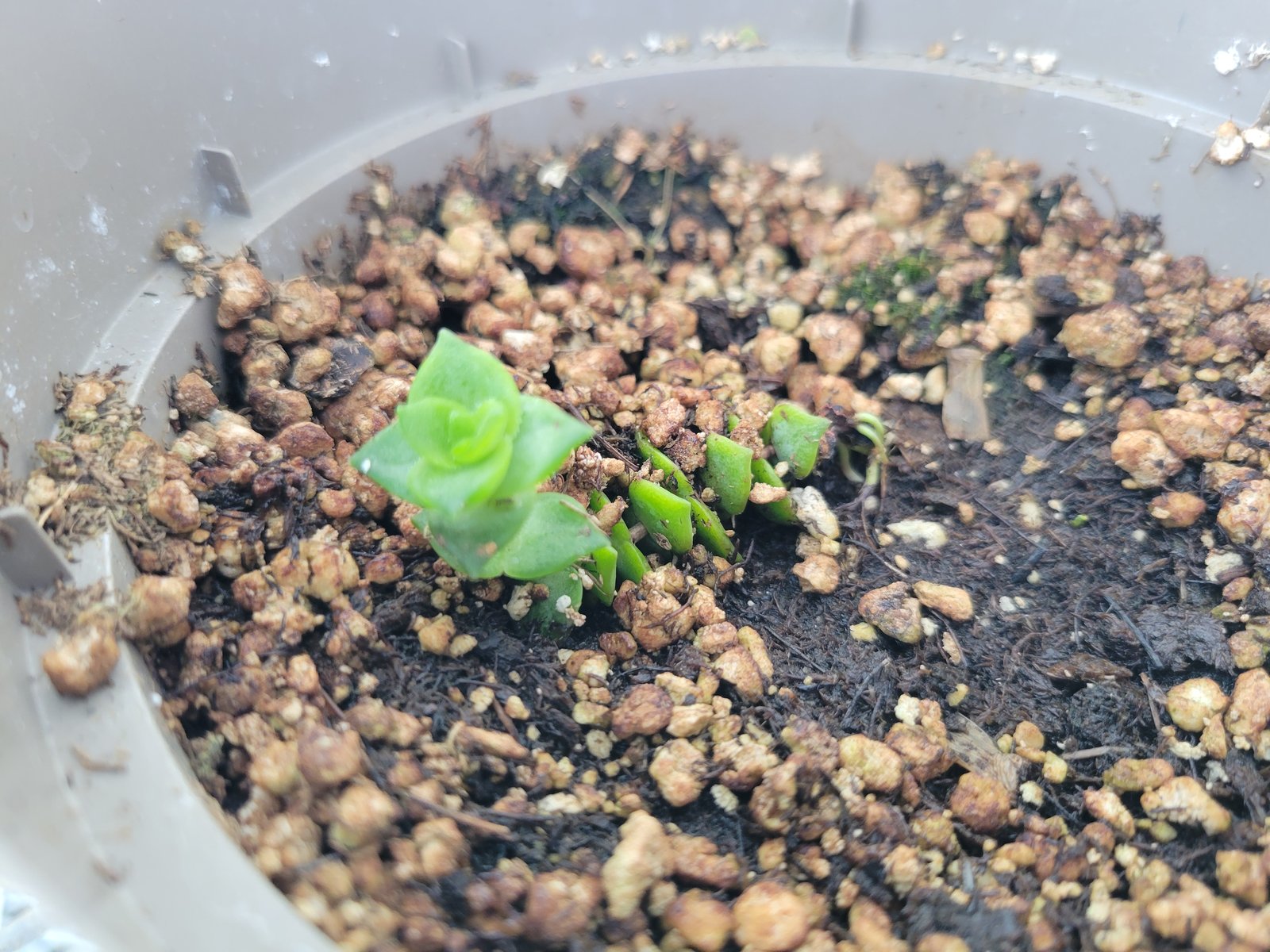
Crassula perforata · String of Buttons
CON-0055
📍 Location not set
Identification
Crassula perforata · String of Buttons
The tall, narrow stems are lined with small, triangular, fleshy leaves arranged in opposite pairs that appear fused around the stem in a stacked, 'strung-together' pattern - a hallmark of Crassula perforata rather than the rejected Crassula ovata, which has thicker, oval, non-perfoliate leaves on stouter branches. The reddish-purple leaf margins and thin, wiry stems reaching upward also match C. perforata's typical growth habit. There is a separate, more compact rosette-forming succulent with pink/cream variegated leaves visible at the base of the pot (possibly a different Crassula or Cotyledon cultivar) that appears to be a second plant sharing the container rather than part of the same specimen. Similar species to rule out include Crassula rupestris (which has more rounded, less pointed leaf pairs and a chunkier stacked appearance) and Crassula pellucida - a closer photo of the leaf attachment point (to confirm the perfoliate/fused-base leaf pairs) and any flowers would help confirm the species with more certainty.
Generated 2026-08-15 00:43 by anthropic (claude-sonnet-5).
Health
Care Information
- Light
- Bright light including some direct sun; a south or east-facing window or bright greenhouse spot works well. Insufficient light causes leggy growth and poor coloration.
- Water
- Water deeply then let soil dry out completely, roughly every 2-3 weeks; cut back significantly in winter to monthly or less.
- Nutrients
- Feed with a diluted cactus/succulent fertilizer monthly during spring and summer growth; skip feeding in fall and winter.
- Repotting
- Repot every 2 years or when it outgrows its pot, ideally in spring; this species grows in a stacking chain-like pattern and can get top-heavy.
- Soil media
- Fast-draining cactus/succulent mix; add extra perlite or pumice for sharper drainage.
- Temp & humidity
- Prefers 65-80F with average to low humidity; tolerates brief cooler nights but protect from frost below 40F.
- Temperature range
- Not recorded
- Humidity range
- Not recorded
- Care group
- Not recorded
- Toxicity
- Mildly toxic if ingested by pets or people and may cause mild skin irritation; keep away from areas with heavy visitor or pet traffic.
- Pests & diseases
- Generally trouble-free; watch for mealybugs in leaf crevices and root/stem rot from overwatering or poor drainage.
- Propagation
- Not recorded
Generated 2026-08-15 00:44 by anthropic (claude-sonnet-5).