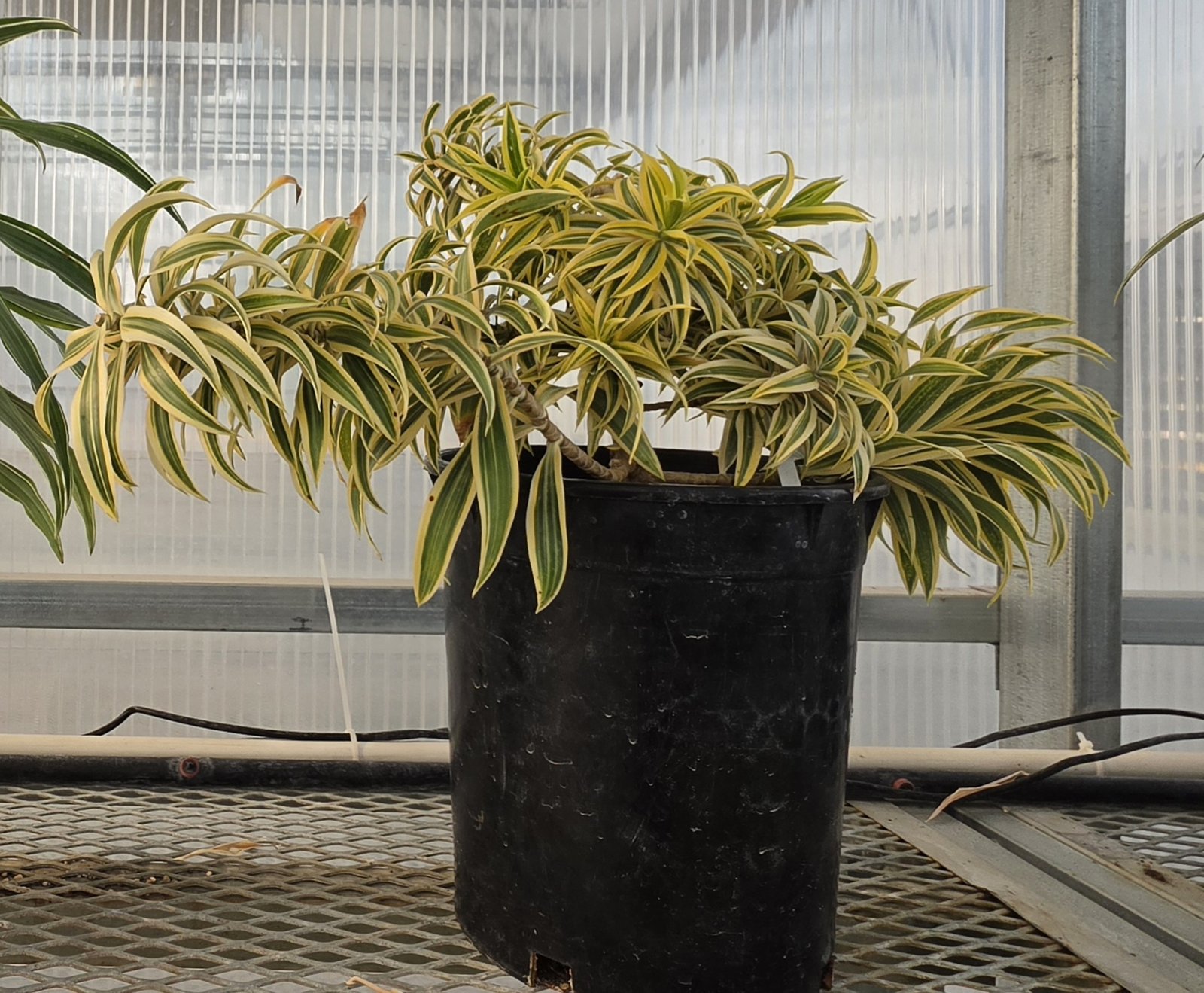
Dracaena reflexa 'Song of India' · Song of India
CON-0049
📍 Location not set
Identification
Dracaena reflexa 'Song of India' · Song of India
The plant shows narrow, lance-shaped leaves with pointed tips arranged in dense whorled rosettes at the ends of woody, somewhat twisted stems, which is characteristic of Dracaena reflexa. The leaves display strong yellow-to-cream marginal variegation with a green center stripe, matching the common cultivar 'Song of India' (sometimes 'Song of Jamaica' has more yellow-centered variegation, which is a similar alternative to rule out). The multi-branched, shrubby habit with stacked leaf whorls and visible leaf scars on the stems is also typical of this species as grown in containers. Confidence is 'probable' rather than 'certain' because exact cultivar determination would benefit from a clearer view of stem branching pattern and a closer look at leaf base attachment, but the overall gestalt strongly supports the suspected ID of Dracaena reflexa.
Generated 2026-10-06 04:42 by anthropic (claude-sonnet-5).
Health
Care Information
- Light
- Bright, indirect light tolerates some shade well; avoid direct sun which can bleach or scorch the variegated leaves.
- Water
- Allow the top 1-2 inches of soil to dry out between waterings, roughly every 7-10 days; reduce frequency in winter. Sensitive to overwatering, which causes root rot.
- Nutrients
- Feed with a balanced liquid fertilizer diluted to half strength monthly during spring and summer; skip feeding in fall and winter.
- Repotting
- Repot every 2 years or when rootbound, preferably in spring; this plant tolerates being slightly potbound.
- Soil media
- Well-draining standard potting mix with added perlite or bark for aeration.
- Temp & humidity
- 65-80F; moderate humidity (40-50%) is fine, though it appreciates slightly higher if the room runs dry.
- Temperature range
- 🌡️ 65-80F
- Humidity range
- 💦 40-50%
- Care group
- 🏷️ Medium Light & Moderate Humidity
- Toxicity
- Toxic to cats and dogs if ingested (contains saponins), causing vomiting and drooling; keep away from pets and curious visitors.
- Pests & diseases
- Watch for spider mites and mealybugs, especially in dry indoor air; also prone to leaf spot and root rot if overwatered or soil stays soggy.
- Propagation
- Stem cuttings root readily in water or moist potting mix; cut a section with at least one node and keep warm and humid until roots form.
Generated 2026-10-06 04:42 by anthropic (claude-sonnet-5).