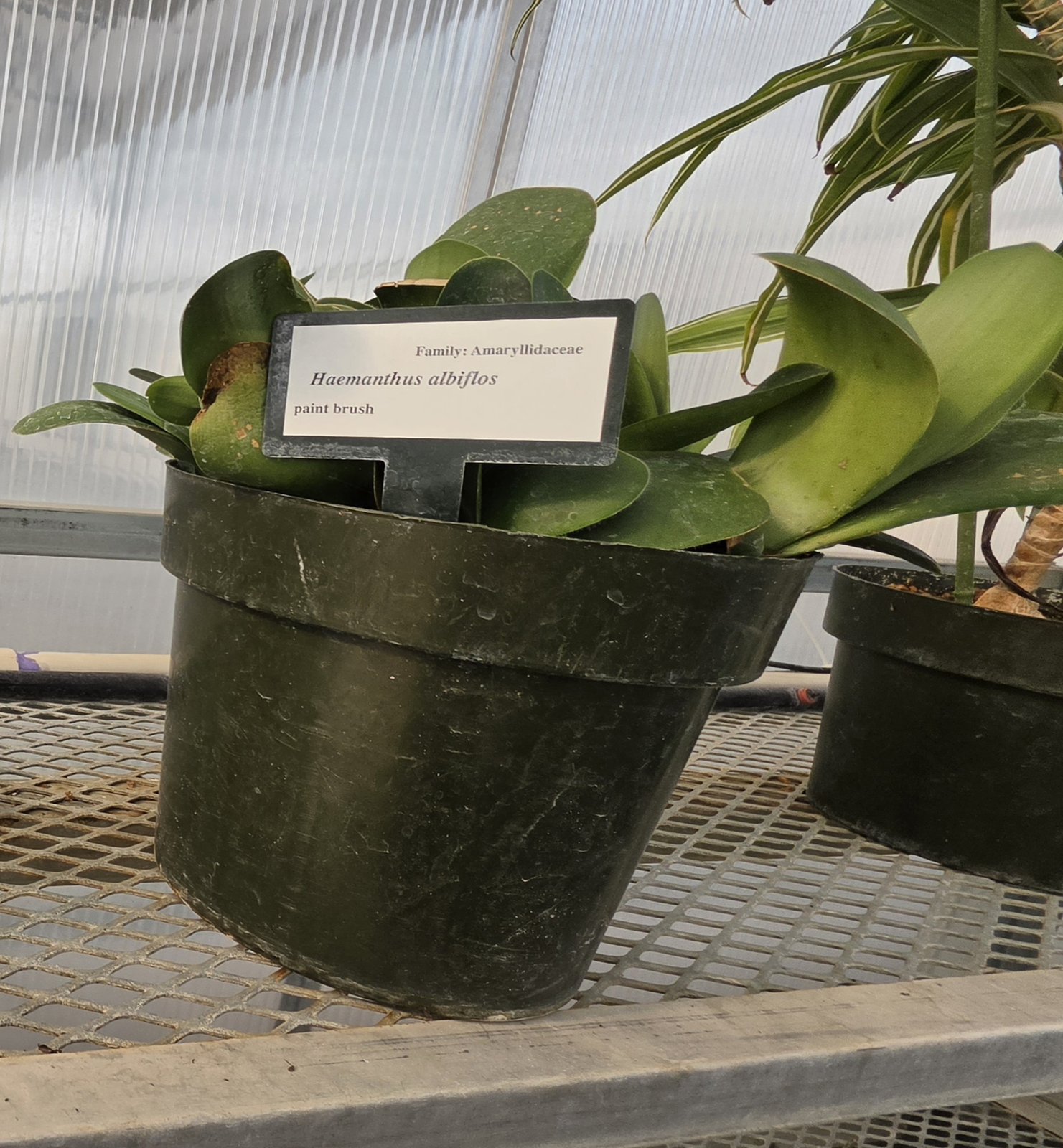
Haemanthus albiflos · Paint brush lily
CON-0047
📍 Location not set
Identification
Haemanthus albiflos · Paint brush lily
The plant has a printed nursery/conservatory label directly attached to the pot stating 'Family: Amaryllidaceae, Haemanthus albiflos, paint brush.' This matches the visible plant, which shows the characteristic broad, strap-like, thick succulent leaves arranged in a fan from a central base, consistent with Haemanthus albiflos. The leaf surface has a slightly rough, dotted texture typical of this species. Since the identification is confirmed by an official label alongside consistent morphological features, confidence is high. Other plants visible in the pot (the strap-leaved variegated foliage and the succulent leaves to the right) belong to different neighboring plants (likely a Sansevieria and a Chlorophytum or similar), not the labeled Haemanthus, so they were excluded from the identification.
Generated 2026-08-24 22:54 by anthropic (claude-sonnet-5).
Health
Care Information
- Light
- Bright, indirect light is ideal; it tolerates partial shade well but avoid harsh direct sun which can scorch the strappy leaves.
- Water
- Water moderately, letting the top inch or so of soil dry out between waterings; cut back significantly in winter when growth slows.
- Nutrients
- Feed with a balanced liquid fertilizer monthly during the spring-summer growing season; withhold in winter.
- Repotting
- Repot only every 2-3 years, in spring -- this bulb actually prefers being slightly pot-bound and flowers better when snug.
- Soil media
- Well-draining potting mix, such as a standard mix amended with extra perlite or coarse sand.
- Temp & humidity
- 60-75F with moderate humidity (40-60%); adapts well to typical indoor/conservatory room conditions without special misting.
- Temperature range
- 🌡️ 60-75F
- Humidity range
- 💦 40-60%
- Care group
- 🏷️ Medium Light & Moderate Humidity
- Toxicity
- Contains alkaloids typical of the Amaryllidaceae family; toxic if ingested by pets or people, and sap may irritate skin -- wear gloves when handling bulbs or sap.
- Pests & diseases
- Generally trouble-free; watch for mealybugs and scale in leaf axils, and guard against bulb/root rot from overwatering.
- Propagation
- Divide offsets (bulblets) from the base of the mature bulb at repotting time, ensuring each division has roots attached.
Generated 2026-08-24 22:55 by anthropic (claude-sonnet-5).