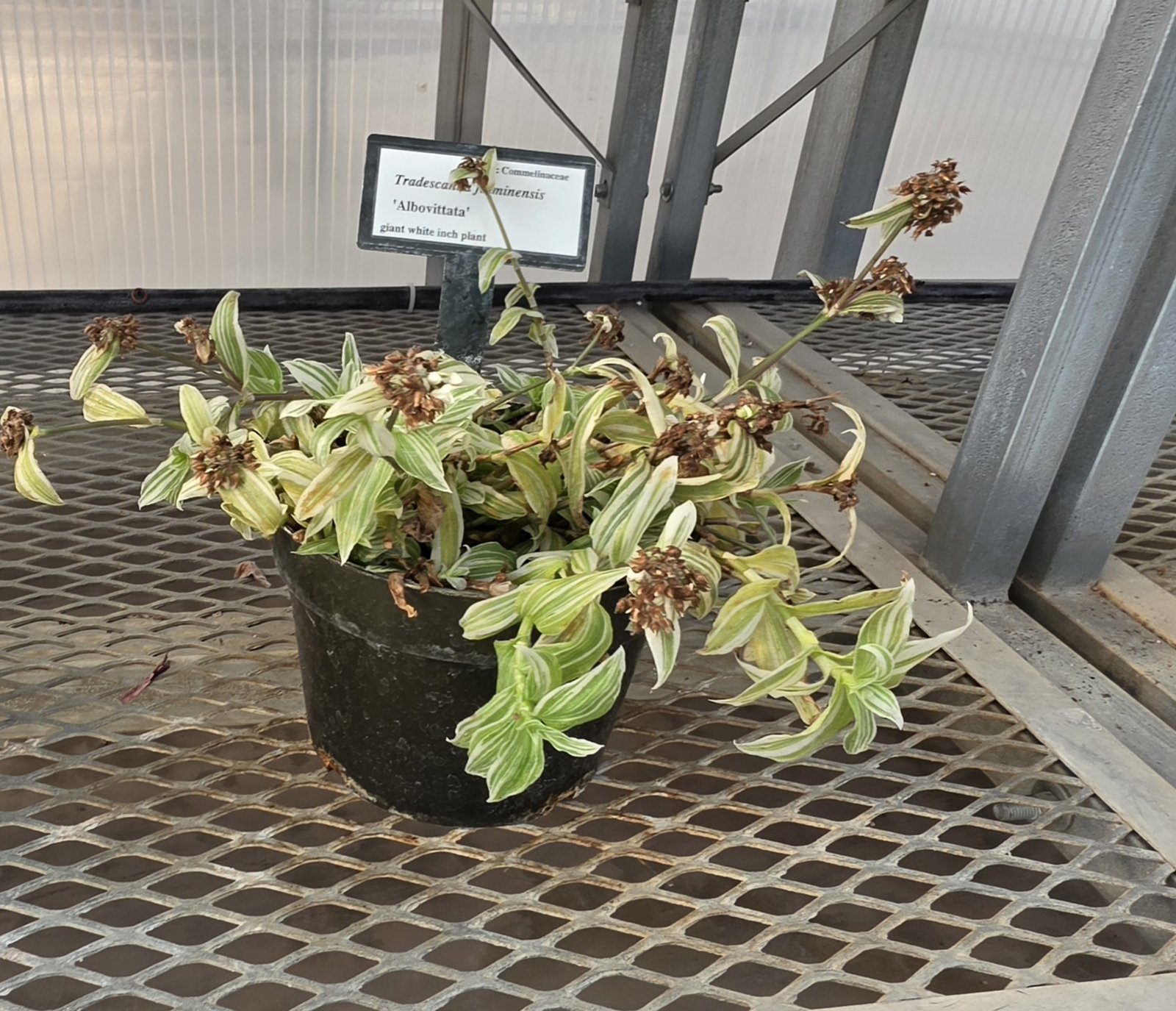
Tradescantia fluminensis 'Albovittata' · Giant white inch plant
CON-0040
📍 Location not set
Identification
Tradescantia fluminensis 'Albovittata' · Giant white inch plant
The plant's own label in the photo explicitly reads 'Tradescantia [flu]minensis' 'Albovittata' - giant white inch plant, under family Commelinaceae, confirming the identification provided by conservatory staff. The visible foliage is consistent with this label: lance-shaped leaves with strong longitudinal white/cream variegation alternating with green stripes, a sprawling/trailing habit typical of Tradescantia, and clustered terminal inflorescences (now mostly dried/spent) typical of the genus. The somewhat wilted, leggy, and dried-flower condition suggests the plant is stressed or past bloom, but the leaf variegation pattern and growth habit match the Albovittata cultivar well. No features in the photo (leaf shape, stem succulence, variegation pattern) contradict the label, so I'm deferring to the provided tag as definitive confirmation rather than treating it as merely a suggestion.
Generated 2026-10-06 04:31 by anthropic (claude-sonnet-5).
Health
Care Information
- Light
- Bright, indirect light; variegation on 'Albovittata' fades with too little light but direct sun can scorch the leaves.
- Water
- Keep soil evenly moist but not soggy, watering when the top inch of soil dries out, typically about once a week.
- Nutrients
- Feed with a balanced liquid fertilizer diluted to half-strength monthly during spring and summer; skip feeding in fall and winter.
- Repotting
- Repot or refresh yearly in spring; this fast-growing trailer benefits more from regular trimming and re-rooting than deep repotting.
- Soil media
- Standard well-draining potting mix, ideally with some perlite added for aeration.
- Temp & humidity
- 65-80F; moderate humidity (40-50%) is fine, though it appreciates slightly higher humidity for lush growth.
- Temperature range
- 🌡️ 65-80F
- Humidity range
- 💦 40-50%
- Care group
- 🏷️ Medium Light & Moderate Humidity
- Toxicity
- Mildly irritating sap can cause skin or mouth irritation in pets and people; keep away from heavy public handling and use gloves if sap-sensitive.
- Pests & diseases
- Generally trouble-free; watch for spider mites and aphids in dry conditions, and stem rot if kept too wet or in poor drainage.
- Propagation
- Extremely easy from stem cuttings -- place a cutting with a node in water or moist soil and it roots within days to a couple weeks.
Generated 2026-10-06 04:32 by anthropic (claude-sonnet-5).