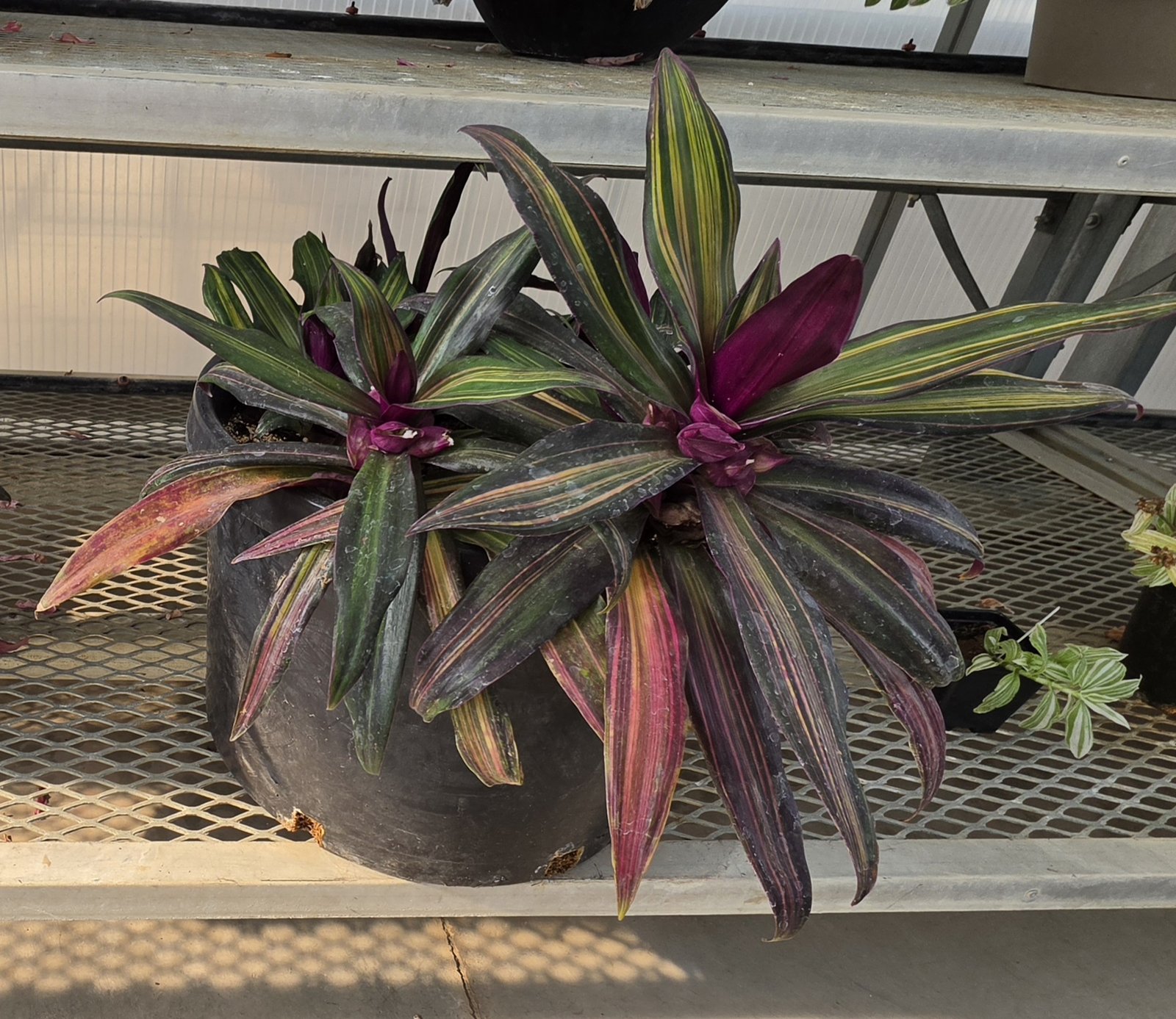
Tradescantia spathacea 'Tricolor' · Tricolor Oyster Plant (Moses in the Cradle)
CON-0038
📍 Location not set
Identification
Tradescantia spathacea 'Tricolor' · Tricolor Oyster Plant (Moses in the Cradle)
The plant shows a rosette of thick, lance-shaped, sword-like leaves arranged spirally, with striking longitudinal cream/yellow variegation on the upper leaf surface and deep purple/magenta undersides, which is the classic coloration of the 'Tricolor' cultivar of Tradescantia spathacea (syn. Rhoeo spathacea, Rhoeo discolor). Small boat-shaped purple bracts are visible nestled at the base of the leaves near the center of the rosette, characteristic of this species' inflorescence structure (the small white flowers themselves are tucked inside these purple bracts, and a hint of white flower parts is visible in the image). The succulent, waxy texture of the leaves and low clumping growth habit in a pot also fit this species well. Alternatives to rule out include other Tradescantia/Rhoeo cultivars with different variegation patterns (e.g., 'Sitara's Gold' or plain green Tradescantia spathacea), or Cryptanthus (earth star bromeliads), which can have similar striped rosettes but lack the characteristic purple boat-shaped bracts and have a stiffer, more star-like leaf arrangement. A closer photo of the flower bracts and undersides of the leaves would help confirm the exact cultivar with full certainty.
Generated 2026-08-14 00:58 by anthropic (claude-sonnet-5).
Health
Care Information
- Light
- Bright indirect to partial direct light; some morning sun helps keep the pink/purple striping vibrant, but avoid harsh midday sun which can bleach or scorch leaves.
- Water
- Allow the top inch or two of soil to dry out between waterings, then water thoroughly; this plant tolerates some drought better than overwatering, so reduce frequency in winter.
- Nutrients
- Feed with a balanced liquid fertilizer diluted by half, monthly during spring and summer; skip fertilizing in fall and winter.
- Repotting
- Repot every 1-2 years in spring, or when it becomes rootbound/outgrows its container; it's a fast, clumping grower that also propagates easily via offsets.
- Soil media
- Well-draining standard potting mix with added perlite or coarse sand.
- Temp & humidity
- Prefers warm conditions, roughly 65-85F, and is not frost-tolerant; average to high humidity is ideal but it's fairly adaptable to normal room humidity.
- Temperature range
- 🌡️ 65-85F
- Humidity range
- 💦 40-50%
- Care group
- 🏷️ Bright & Dry
- Toxicity
- Sap can cause skin irritation and is toxic if ingested (contains calcium oxalates), so wear gloves when pruning or repotting and keep away from curious pets or young visitors.
- Pests & diseases
- Generally hardy and pest-resistant; watch for occasional mealybugs or scale, and root rot if kept too wet or in poorly draining soil.
- Propagation
- Easily propagated by dividing offsets/pups from the base, or by rooting stem cuttings in water or moist soil.
Generated 2026-08-27 20:40 by anthropic (claude-sonnet-5).