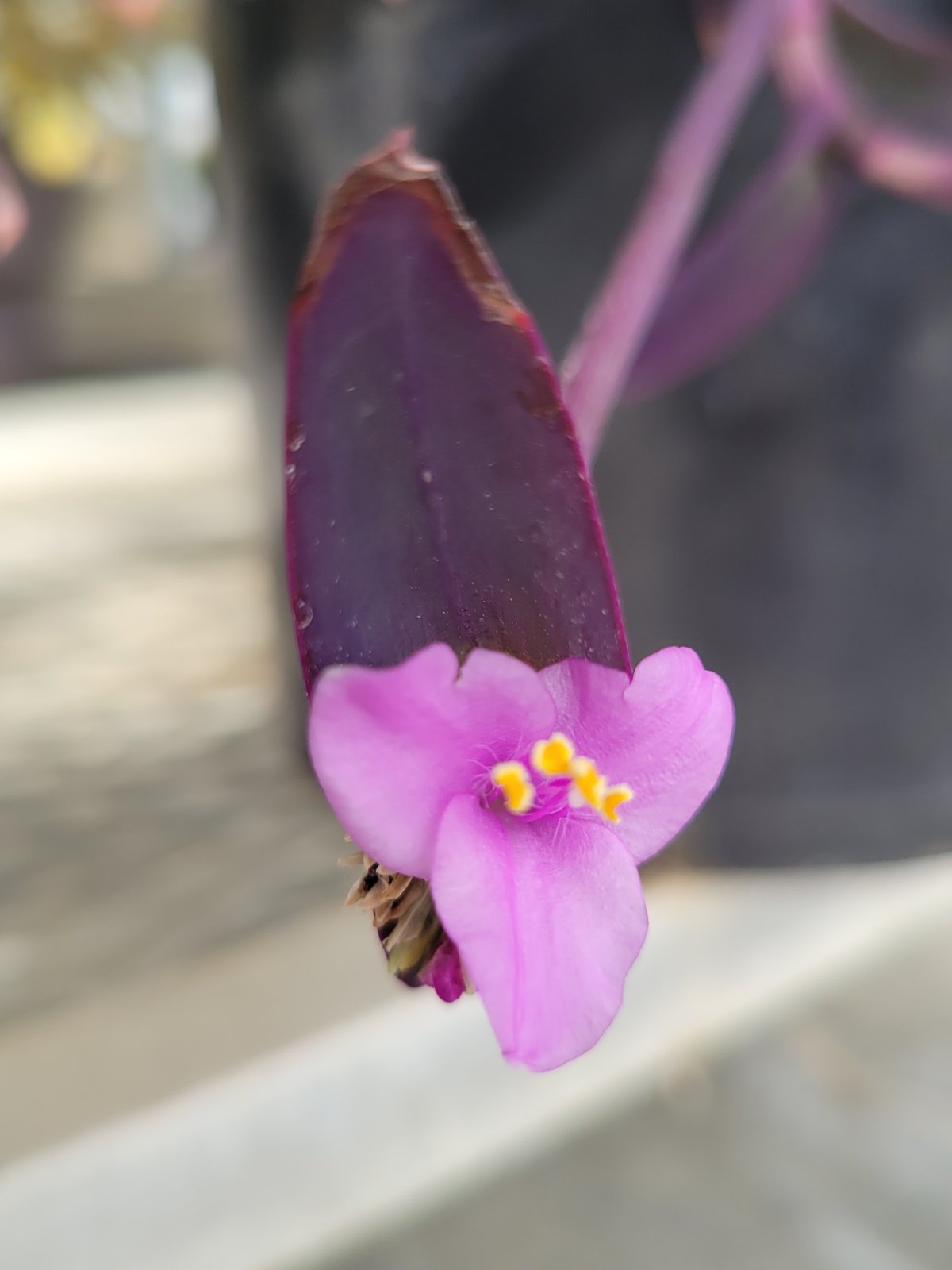
Tradescantia pallida · Purple Heart
CON-0033
📍 Location not set
Identification
Tradescantia pallida · Purple Heart
The plant shows the characteristic deep purple/magenta lanceolate leaves with a sheathing, jointed stem structure typical of Tradescantia. The trailing habit, succulent-like elongated pointed leaves clasping the stem at swollen nodes, and uniform saturated violet-purple coloration on both leaves and stems strongly suggest Tradescantia pallida (Purple Heart / Purple Queen). The small pink-purple three-petaled flowers visible at branch tips (partially visible upper right and lower left) are consistent with Tradescantia's typical ephemeral flowers. Similar species to rule out include Tradescantia zebrina (which usually has silvery striping on leaf upper surface) and Setcreasea pallida (an older synonym for the same plant, so not a true alternative). A clearer close-up of an open flower (three rounded petals, yellow anthers) and a look at the leaf undersides (which are typically deep purple/fuzzy in T. pallida) would help confirm the species with certainty.
Generated 2026-08-15 00:20 by anthropic (claude-sonnet-5).
Health
Care Information
- Light
- Bright light, including some direct sun, brings out the best purple leaf color; too little light causes it to fade to green and grow leggy.
- Water
- Allow soil to dry out slightly between waterings; it's drought-tolerant with somewhat succulent stems and leaves, so err on the side of underwatering.
- Nutrients
- Light feeding with a balanced liquid fertilizer monthly during spring and summer is sufficient; no fertilizer needed in fall/winter.
- Repotting
- Repot every 1-2 years in spring or when rootbound; it's a fast, trailing grower that also propagates very easily from stem cuttings.
- Soil media
- Well-draining potting mix with added perlite or sand; avoid soggy, heavy soils.
- Temp & humidity
- Prefers warm conditions, roughly 65-85F, and tolerates average room humidity well; not frost-hardy and should be protected below 50F.
- Temperature range
- 🌡️ 65-85F
- Humidity range
- 💦 30-50%
- Care group
- 🏷️ Bright & Dry
- Toxicity
- Sap can cause skin irritation or contact dermatitis in sensitive individuals, and the plant is mildly toxic if ingested by pets or people; use gloves when pruning and keep away from curious pets or small children.
- Pests & diseases
- Generally hardy with few problems; watch for spider mites in dry conditions and root rot if overwatered or left in soggy soil.
- Propagation
- Extremely easy from stem cuttings; place a few inches of stem in water or moist soil and roots form within days to a couple weeks.
Generated 2026-08-24 22:42 by anthropic (claude-sonnet-5).