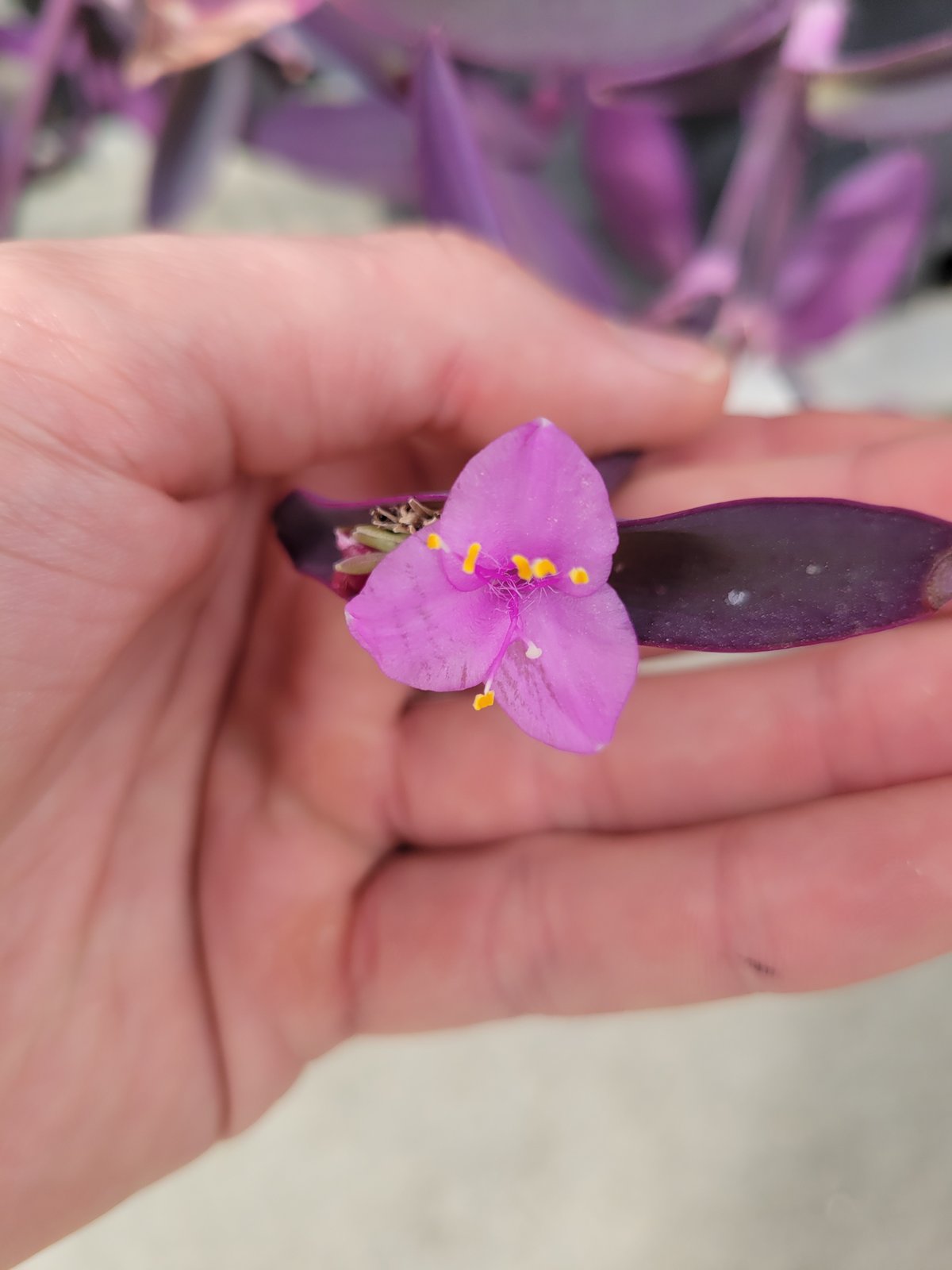
Tradescantia pallida · Purple Heart (Purple Queen)
CON-0032
📍 Location not set
Identification
Tradescantia pallida · Purple Heart (Purple Queen)
The plant shows the characteristic deep purple, lance-shaped succulent leaves arranged alternately along trailing/sprawling stems, with a slightly waxy/glaucous bloom on the leaf surface. Small three-petaled pink/magenta flowers are visible at stem tips, consistent with Tradescantia's typical Commelinaceae flower structure. The sprawling, semi-succulent stems and leaf clasping habit (leaves wrapping around the stem at the base) are also diagnostic of Tradescantia. Similar species to rule out include Tradescantia zebrina (which has silvery striping on leaves, not present here) and Tradescantia spathacea (which has a more rosette, boat-shaped leaf form). The uniform solid purple coloration without variegation and the narrow pointed leaf shape most closely match T. pallida, sometimes sold under the cultivar name 'Purpurea'. Confidence is 'probable' rather than 'certain' since some stress-related color intensification or hybrid cultivars could look similar, and no close-up of flower center or leaf underside is available to fully confirm structural details.
Generated 2026-08-13 17:07 by anthropic (claude-sonnet-5).
Health
Care Information
- Light
- Bright light, including some direct morning or evening sun, to maintain vivid purple leaf color; too little light causes fading and leggy growth.
- Water
- Water when the top inch of soil is dry, roughly every 7-10 days; drought-tolerant but avoid letting it sit soggy.
- Nutrients
- Balanced liquid fertilizer diluted to half-strength monthly during spring and summer growth; skip in winter.
- Repotting
- Repot every 1-2 years in spring, or when it becomes rootbound/leggy; easy to refresh by taking cuttings instead of repotting.
- Soil media
- Well-draining standard potting mix with added perlite or sand.
- Temp & humidity
- 65-85F; tolerates average room humidity (30-50%) and does not require extra humidification.
- Temperature range
- 🌡️ 65-85F
- Humidity range
- 💦 30-50%
- Care group
- 🏷️ Bright & Dry
- Toxicity
- Sap can cause skin irritation or allergic dermatitis in some people and pets; wear gloves when pruning and keep away from heavy public handling.
- Pests & diseases
- Generally hardy; watch for spider mites and mealybugs in dry conditions, and stem/root rot if overwatered or drainage is poor.
- Propagation
- Not recorded
Generated 2026-08-15 05:41 by anthropic (claude-sonnet-5).