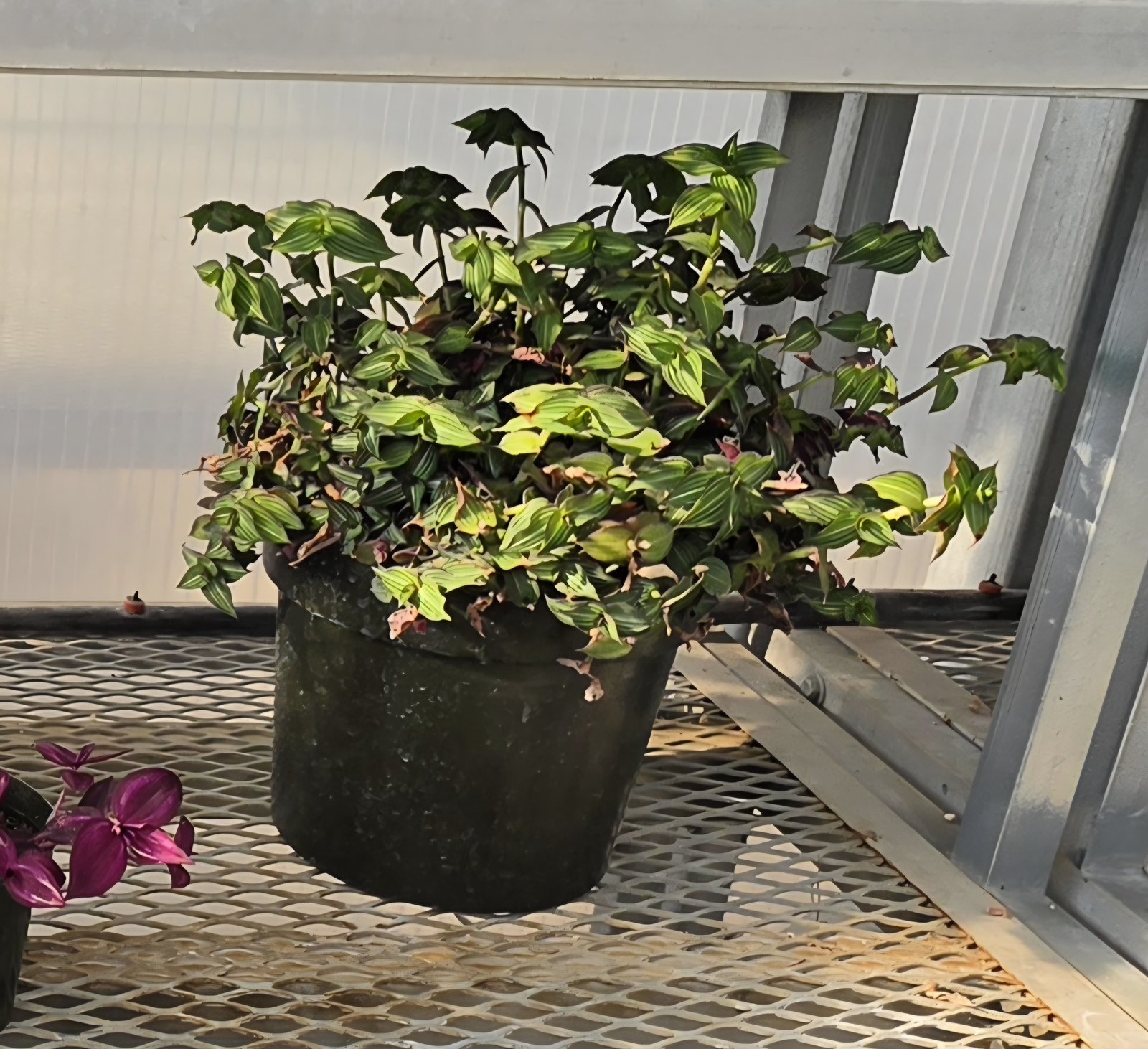
Callisia elegans · Striped Inch Plant
CON-0031
📍 Location not set
Identification
Callisia elegans · Striped Inch Plant
The plant has small, lance-shaped leaves with strong parallel white/silver striping over green, a dense mounding-trailing habit, and purplish-maroon coloring on leaf undersides and new growth emerging as dark, almost black pointed shoots. This general look (striped succulent-ish foliage, purple reverse, compact spreading habit) is very similar to Tradescantia zebrina, which has already been ruled out. Callisia elegans (Striped Inch Plant) produces smaller, more lance-shaped leaves with tighter, more numerous white stripes and a denser, less sprawling habit than T. zebrina, which matches the tightly packed, small-leaved clumps seen here better than Tradescantia. However, without a clear close-up of leaf undersides, stem thickness, or flowers, I can't rule out other candidates such as Tradescantia fluminensis 'Variegata' or Callisia repens 'Bianca', which have comparable striped foliage. A macro shot of a single leaf (top and underside), the stem cross-section, and any flowers (three-petaled for Tradescantia, small white for Callisia) would help confirm the exact genus/species.
Generated 2026-08-15 04:21 by anthropic (claude-sonnet-5).
Health
Care Information
- Light
- Bright indirect light; some gentle morning direct sun is fine, but avoid harsh midday sun which fades the striped leaf pattern.
- Water
- Keep soil lightly, evenly moist; water when the top inch dries out, and reduce watering in winter.
- Nutrients
- Feed with a balanced liquid fertilizer diluted to half strength monthly during spring and summer; skip feeding in fall/winter.
- Repotting
- Repot or refresh annually in spring since this trailing plant grows quickly and can get leggy; easy to propagate fresh cuttings instead of repotting old growth.
- Soil media
- Well-draining standard potting mix with added perlite for aeration.
- Temp & humidity
- 65-80F; prefers moderate to high humidity (40-60%); tolerates average indoor humidity but benefits from occasional misting or a pebble tray in dry rooms.
- Temperature range
- 🌡️ 65-80F
- Humidity range
- 💦 40-60%
- Care group
- 🏷️ Bright & Humid
- Toxicity
- No significant toxicity reported, but sap may cause mild skin irritation in sensitive individuals; generally safe near pets and visitors with normal handling.
- Pests & diseases
- Watch for spider mites and mealybugs, especially in dry air; stems can rot if overwatered or if the soil stays soggy.
- Propagation
- Very easy from stem cuttings -- trailing stems root readily in water or moist soil, even from small nodal segments.
Generated 2026-08-21 17:47 by anthropic (claude-sonnet-5).