Begonia heracleifolia · Star Begonia (Mapleleaf Begonia)
CON-0023
📍 Location not set
Identification
Begonia heracleifolia · Star Begonia (Mapleleaf Begonia)
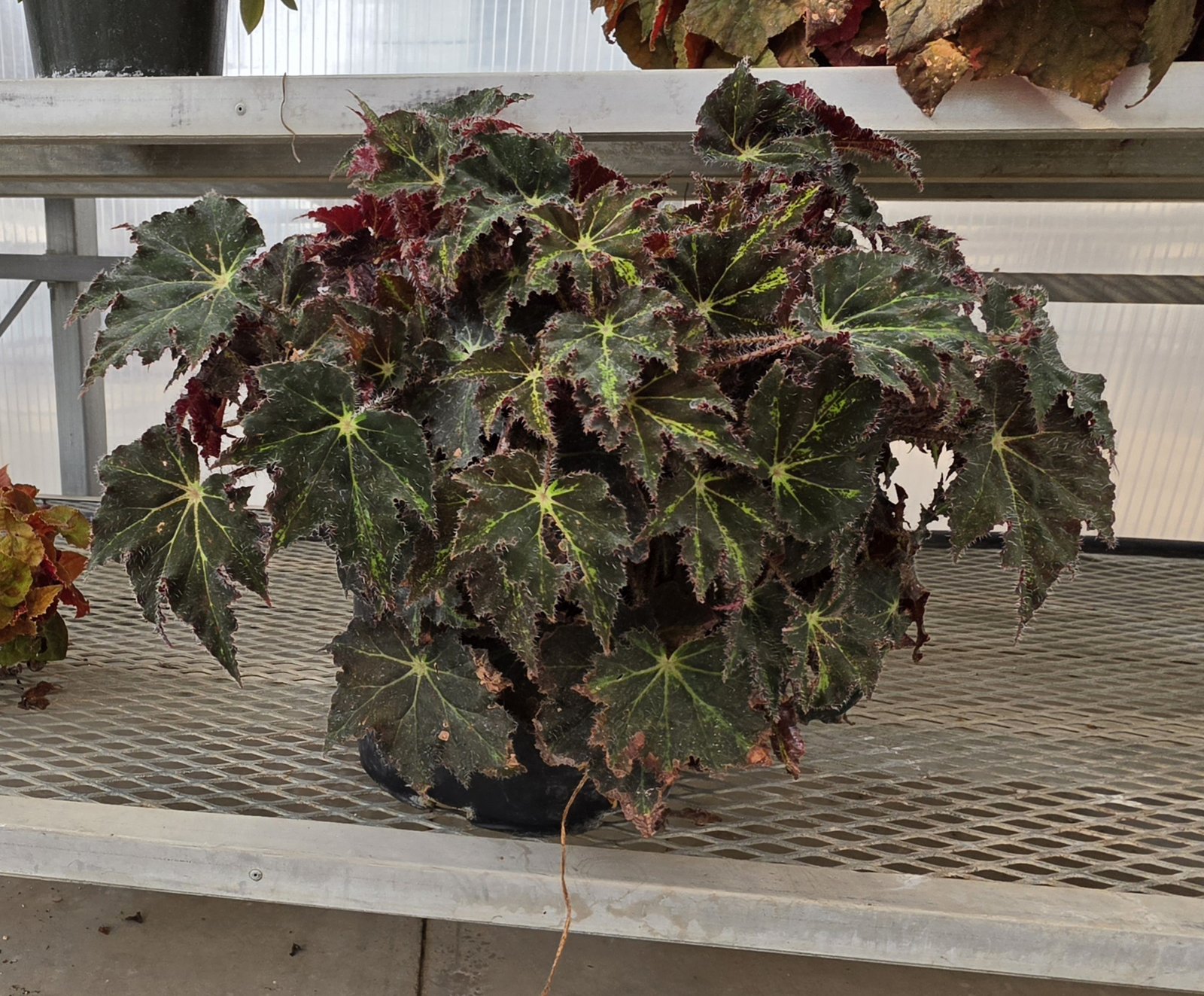
The plant shows deeply lobed, star/palmate-shaped leaves with 5-9 pointed lobes radiating from a central point, consistent with the common name 'star begonia' given to B. heracleifolia. The leaf surface shows dark green coloration with reddish-maroon tones and lighter green along the veins, a pattern typical of this species and its cultivars. The leaf margins are serrated/toothed and appear to have fine hairs (pubescence) along the edges and veins, which is characteristic of B. heracleifolia's rhizomatous begonia group. The growth habit is clumping/mounding from what appears to be a rhizomatous base, matching this species' typical form. Similar species to rule out would include other rhizomatous begonias like B. bowerae or hybrid 'Rex' type begonias, but the strongly star-shaped leaf lobing with this particular vein pattern and coloration most closely matches B. heracleifolia or one of its many cultivars (e.g., 'Nigricans', 'Pewter'). Without seeing flowers or a clearer close-up of leaf texture/hair density, I can't rule out a closely related cultivar with full certainty, so I'm marking this as probable rather than certain.
Generated 2026-10-06 02:09 by anthropic (claude-sonnet-5).
Health
Care Information
- Light
- Medium to bright indirect light; some morning sun is fine but protect from harsh midday direct sun which can scorch the patterned leaves.
- Water
- Allow the top inch or so of soil to dry out between waterings, roughly every 7-9 days; this rhizomatous begonia is more drought-tolerant than wax begonias and dislikes soggy soil.
- Nutrients
- Feed with a balanced liquid fertilizer diluted to half strength every 4 weeks during spring through fall; withhold in winter.
- Repotting
- Repot every 1-2 years in spring, or when the rhizome outgrows the pot -- it tends to grow along the soil surface and spread outward.
- Soil media
- Well-draining potting mix amended with perlite and some organic matter (peat or coir); good aeration matters more than richness.
- Temp & humidity
- 65-75F with moderate to high humidity (50-60%); appreciates a pebble tray or humid conservatory room but avoid wetting the fuzzy leaves.
- Temperature range
- 🌡️ 65-75F
- Humidity range
- 💦 50-60%
- Care group
- 🏷️ Medium Light & Moderate Humidity
- Toxicity
- Contains soluble calcium oxalates; mildly toxic if ingested by pets or people, causing mouth/GI irritation -- keep away from curious pets and small children.
- Pests & diseases
- Watch for powdery mildew and botrytis in stagnant humid air, and mealybugs or spider mites in dry conditions; good air circulation prevents most fungal issues. Root/rhizome rot can occur if overwatered.
- Propagation
- Rhizome division is easiest -- cut sections with roots and a growing point attached and pot separately; can also propagate via leaf or petiole cuttings in moist soil mix.
Generated 2026-10-06 02:09 by anthropic (claude-sonnet-5).