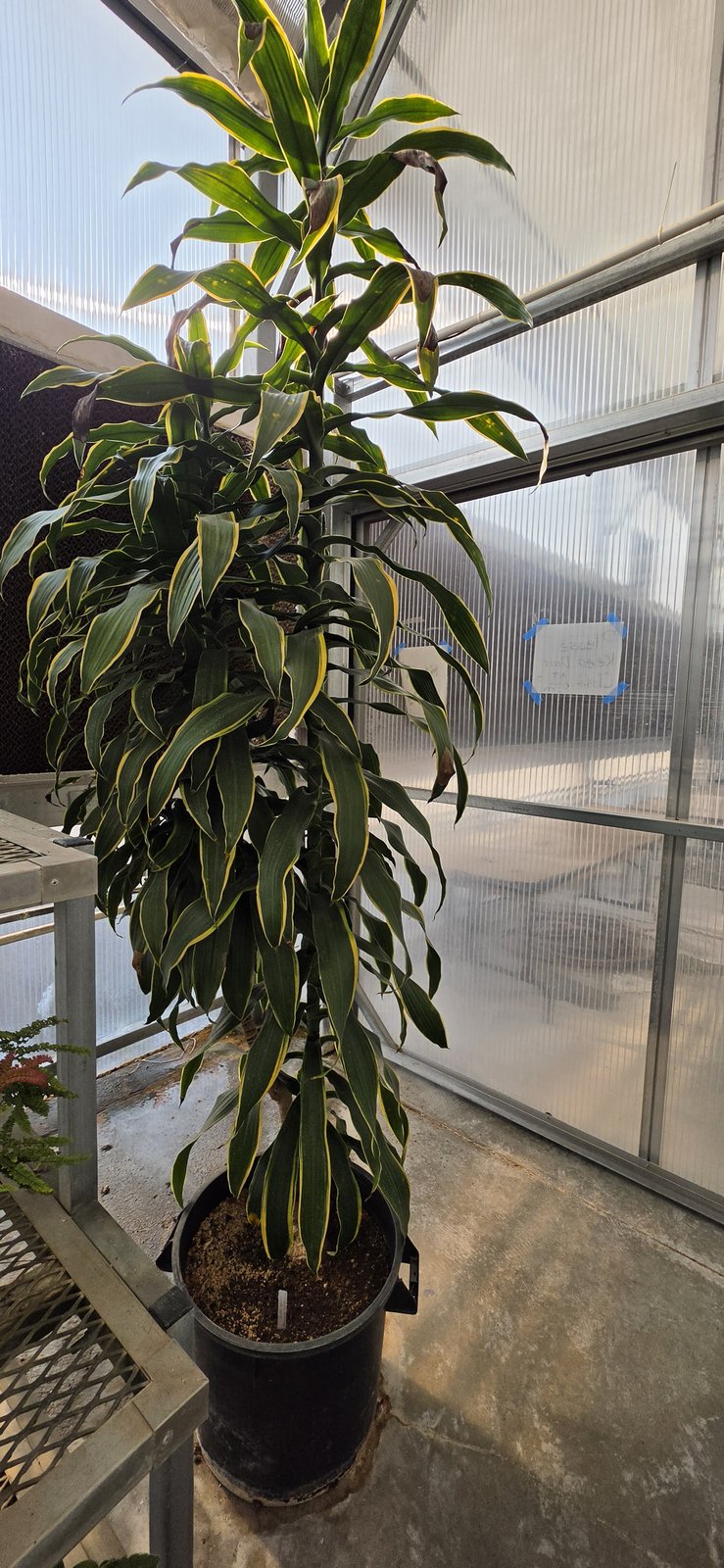
Dracaena fragrans 'Massangeana' · Corn Plant
CON-0022
📍 Location not set
Identification
Dracaena fragrans 'Massangeana' · Corn Plant
The plant shows a tall, single woody cane with strap-like, arching lanceolate leaves clustered densely near the top and cascading down the stem, a growth habit typical of Dracaena fragrans. The leaves display broad yellow-green central striping bordered by dark green margins, consistent with the popular 'Massangeana' cultivar. Leaf texture appears glossy and somewhat leathery, and the plant is grown in a nursery pot within what looks like a greenhouse/conservatory setting, fitting typical cultivation of this common houseplant. Some leaf tip browning suggests minor stress (possibly fluoride sensitivity or underwatering), common in Dracaena. Similar species to rule out include Dracaena deremensis 'Warneckii' (which has narrower, more upright leaves with white/cream stripes rather than the broader yellow-centered striping seen here) and Cordyline fruticosa (which has more colorful, often reddish leaves and a different leaf attachment). The overall leaf width, striping pattern, and cane growth strongly favor D. fragrans 'Massangeana', though without a clear view of the leaf base attachment or any flowering structures, exact cultivar confirmation remains probable rather than certain.
Generated 2026-08-21 17:51 by anthropic (claude-sonnet-5).
Health
Care Information
- Light
- Bright, indirect light is ideal; it also tolerates medium/low light conditions well, but avoid direct sun which can scorch the leaves.
- Water
- Allow the top 1-2 inches of soil to dry out between waterings, roughly every 1-2 weeks; reduce frequency in winter and always avoid letting the pot sit in water.
- Nutrients
- Feed with a balanced liquid fertilizer diluted to half-strength monthly during spring and summer; skip fertilizing in fall and winter.
- Repotting
- Repot every 2-3 years in spring when rootbound, sizing up only one pot size; this plant tolerates being slightly rootbound.
- Soil media
- Well-draining standard potting mix with added perlite or sand for aeration.
- Temp & humidity
- Prefers 65-80F and average to high humidity (40%+); protect from cold drafts below 55F and mist or use a pebble tray in drier rooms.
- Temperature range
- 🌡️ 65-80F
- Humidity range
- 💦 40-50%
- Care group
- 🏷️ Medium Light & Moderate Humidity
- Toxicity
- Toxic to cats and dogs if ingested (contains saponins), causing vomiting, drooling, or dilated pupils; also mildly toxic if ingested by people, potentially causing nausea. Keep away from pets and discourage visitors from tasting foliage; no significant skin irritation risk to staff during normal handling.
- Pests & diseases
- Watch for spider mites, mealybugs, and scale, especially in dry indoor air; check leaf axils and undersides regularly. Root rot can occur if overwatered or in poorly draining soil, and fluoride sensitivity often shows as brown leaf tips.
- Propagation
- Stem cuttings (canes) root readily in water or moist soil -- a common commercial method is cutting the cane into sections and laying them horizontally to sprout new shoots.
Generated 2026-08-21 17:52 by anthropic (claude-sonnet-5).